
The Foundations of Human Experience: Lecture 5 of 14: Lecture delivered in Stuttgart, Germany on August 26, 1919; from The Collected Works of Rudolf Steiner
This lecture is part of the collection "The Foundations of Human Experience" by Rudolf Steiner. Steiner (1861-1925) was an Austrian philosopher, social reformer, architect, and esotericist. He gained initial recognition as a literary critic and cultural philosopher. At the beginning of the 20th century, he founded a spiritual movement, Anthroposophy. He is considered the father of Waldorf education, biodynamic agriculture, anthroposophical medicine and spiritual science. The convergence of the three activities of the soul. The connection of cognitive and will activities in the antipathetic and sympathetic processes of seeing. The greater isolation of the human being from the environment in contrast to that of animals. The necessity of an interpenetration of thinking and willing. Isolation from the world in seeing and connection with the world in doing. The struggle against animalistic "sympathetic" instincts through the integration of moral ideals. The intertwining of soul activities exemplified by the argument between Brentano and Sigwart about the nature of human judgment. Feeling as retained cognition and willing: the revelation of hidden sympathy and antipathy in willing and thinking. The rise of feeling in the body through the touching of blood and nerves exemplified by the eyes and ears. The argument between Wagner and Hanslick concerning feeling and cognition in musical hearing. The erroneous position of modern psychology exemplified by sense theory. Errors in Kantianism. The entire Collected Works of Rudolf Steiner are available from SteinerBooks.
1001557465
The Foundations of Human Experience: Lecture 5 of 14: Lecture delivered in Stuttgart, Germany on August 26, 1919; from The Collected Works of Rudolf Steiner
This lecture is part of the collection "The Foundations of Human Experience" by Rudolf Steiner. Steiner (1861-1925) was an Austrian philosopher, social reformer, architect, and esotericist. He gained initial recognition as a literary critic and cultural philosopher. At the beginning of the 20th century, he founded a spiritual movement, Anthroposophy. He is considered the father of Waldorf education, biodynamic agriculture, anthroposophical medicine and spiritual science. The convergence of the three activities of the soul. The connection of cognitive and will activities in the antipathetic and sympathetic processes of seeing. The greater isolation of the human being from the environment in contrast to that of animals. The necessity of an interpenetration of thinking and willing. Isolation from the world in seeing and connection with the world in doing. The struggle against animalistic "sympathetic" instincts through the integration of moral ideals. The intertwining of soul activities exemplified by the argument between Brentano and Sigwart about the nature of human judgment. Feeling as retained cognition and willing: the revelation of hidden sympathy and antipathy in willing and thinking. The rise of feeling in the body through the touching of blood and nerves exemplified by the eyes and ears. The argument between Wagner and Hanslick concerning feeling and cognition in musical hearing. The erroneous position of modern psychology exemplified by sense theory. Errors in Kantianism. The entire Collected Works of Rudolf Steiner are available from SteinerBooks.
1.29
In Stock
5
1

The Foundations of Human Experience: Lecture 5 of 14: Lecture delivered in Stuttgart, Germany on August 26, 1919; from The Collected Works of Rudolf Steiner
18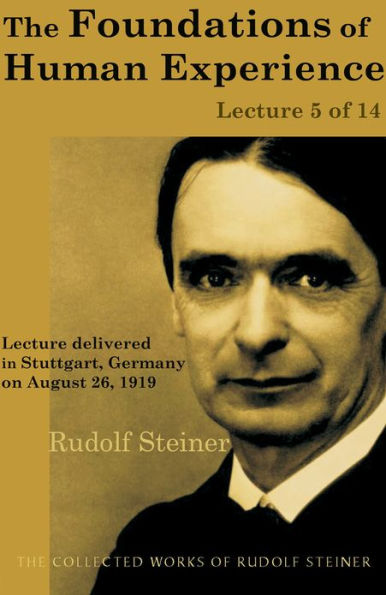
The Foundations of Human Experience: Lecture 5 of 14: Lecture delivered in Stuttgart, Germany on August 26, 1919; from The Collected Works of Rudolf Steiner
18Related collections and offers
1.29
In Stock

Product Details
| ISBN-13: | 9780880107549 |
|---|---|
| Publisher: | Steiner |
| Publication date: | 09/01/1996 |
| Sold by: | Barnes & Noble |
| Format: | eBook |
| Pages: | 18 |
| File size: | 284 KB |
| Age Range: | 5 - 10 Years |
From the B&N Reads Blog