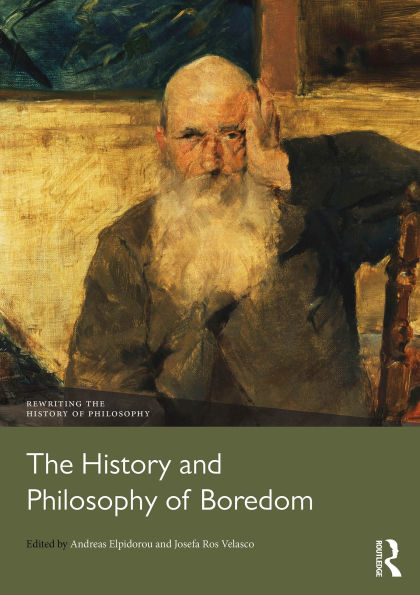
The History and Philosophy of Boredom

From Lucretius’s horror loci and Buddhist drowsiness to the religious boredom of acedia and the philosophical explorations of Kant, Schopenhauer, Kierkegaard, and Heidegger, boredom has long been a subject of philosophical fascination. Its story, unfolding through millennia, encompasses apathy, weariness, disaffection, melancholy, ennui, tedium, and monotony. Today, boredom assumes new forms: the drudgery of precarious work, the alienation of neoliberalism, the emptiness of leisure, and the overstimulation of our hyperconnected, technologically saturated lives.

The History and Philosophy of Boredom is an outstanding collection, exploring boredom’s intellectual history from its early origins in classical thought to its contemporary manifestations. Containing eighteen specially commissioned chapters by an international team of contributors, the volume is organized into four thematic parts:

  • Ancient Philosophical Perspectives
  • Religious and Medieval Explorations
  • Modern Philosophical Investigations
  • Critical and Interdisciplinary Approaches

Topics include boredom in Socratic dialogue, Daoist and Buddhist traditions, Stoicism, and Cynicism; the religious significance of boredom in Judaism and early Christianity; boredom’s role in the works of Kant, Kierkegaard, Schopenhauer, Mill, and Nietzsche; philosophical pessimism; phenomenological approaches; boredom as a political phenomenon; and boredom’s intersections with capitalism, socialism, racial identity, and transhumanism.

The History and Philosophy of Boredom is indispensable for students and researchers in the history of philosophy, emotion studies, phenomenology, and moral psychology. It will also interest scholars in religion, classics, sociology, and the history of psychology.

1146667133
The History and Philosophy of Boredom

From Lucretius’s horror loci and Buddhist drowsiness to the religious boredom of acedia and the philosophical explorations of Kant, Schopenhauer, Kierkegaard, and Heidegger, boredom has long been a subject of philosophical fascination. Its story, unfolding through millennia, encompasses apathy, weariness, disaffection, melancholy, ennui, tedium, and monotony. Today, boredom assumes new forms: the drudgery of precarious work, the alienation of neoliberalism, the emptiness of leisure, and the overstimulation of our hyperconnected, technologically saturated lives.

The History and Philosophy of Boredom is an outstanding collection, exploring boredom’s intellectual history from its early origins in classical thought to its contemporary manifestations. Containing eighteen specially commissioned chapters by an international team of contributors, the volume is organized into four thematic parts:

  • Ancient Philosophical Perspectives
  • Religious and Medieval Explorations
  • Modern Philosophical Investigations
  • Critical and Interdisciplinary Approaches

Topics include boredom in Socratic dialogue, Daoist and Buddhist traditions, Stoicism, and Cynicism; the religious significance of boredom in Judaism and early Christianity; boredom’s role in the works of Kant, Kierkegaard, Schopenhauer, Mill, and Nietzsche; philosophical pessimism; phenomenological approaches; boredom as a political phenomenon; and boredom’s intersections with capitalism, socialism, racial identity, and transhumanism.

The History and Philosophy of Boredom is indispensable for students and researchers in the history of philosophy, emotion studies, phenomenology, and moral psychology. It will also interest scholars in religion, classics, sociology, and the history of psychology.

63.99 In Stock
The History and Philosophy of Boredom

The History and Philosophy of Boredom

The History and Philosophy of Boredom

The History and Philosophy of Boredom

eBook

$63.99 

Available on Compatible NOOK devices, the free NOOK App and in My Digital Library.
WANT A NOOK?  Explore Now

Related collections and offers


Overview

From Lucretius’s horror loci and Buddhist drowsiness to the religious boredom of acedia and the philosophical explorations of Kant, Schopenhauer, Kierkegaard, and Heidegger, boredom has long been a subject of philosophical fascination. Its story, unfolding through millennia, encompasses apathy, weariness, disaffection, melancholy, ennui, tedium, and monotony. Today, boredom assumes new forms: the drudgery of precarious work, the alienation of neoliberalism, the emptiness of leisure, and the overstimulation of our hyperconnected, technologically saturated lives.

The History and Philosophy of Boredom is an outstanding collection, exploring boredom’s intellectual history from its early origins in classical thought to its contemporary manifestations. Containing eighteen specially commissioned chapters by an international team of contributors, the volume is organized into four thematic parts:

  • Ancient Philosophical Perspectives
  • Religious and Medieval Explorations
  • Modern Philosophical Investigations
  • Critical and Interdisciplinary Approaches

Topics include boredom in Socratic dialogue, Daoist and Buddhist traditions, Stoicism, and Cynicism; the religious significance of boredom in Judaism and early Christianity; boredom’s role in the works of Kant, Kierkegaard, Schopenhauer, Mill, and Nietzsche; philosophical pessimism; phenomenological approaches; boredom as a political phenomenon; and boredom’s intersections with capitalism, socialism, racial identity, and transhumanism.

The History and Philosophy of Boredom is indispensable for students and researchers in the history of philosophy, emotion studies, phenomenology, and moral psychology. It will also interest scholars in religion, classics, sociology, and the history of psychology.


Product Details

ISBN-13: 9781040356517
Publisher: Taylor & Francis
Publication date: 06/04/2025
Series: Rewriting the History of Philosophy
Sold by: Barnes & Noble
Format: eBook
Pages: 318
File size: 1 MB

About the Author

Andreas Elpidorou is Professor of Philosophy at the University of Louisville, USA. His books include The Anatomy of Boredom (2025), and Propelled: How Boredom, Frustration, and Anticipation Lead Us to the Good Life (2020).

Josefa Ros Velasco holds a Ph.D. in Philosophy and has received the Spanish National Research Award in 2022. Currently, she is a Professor at ESIC University and leads as PI the “PRE-BORED” project, funded by the EU H2020 program. She is the author of The Disease of Boredom (2025).

Table of Contents

Notes on Contributors Introduction: Histories of Boredom Andreas Elpidorou and Josefa Ros Velasco Part 1: Ancient Philosophical Perspectives 1. Boredom as a Vice of the Mind. The Contrastive Method of Socratic Dialogue Laura Candiotto 2. East Side Story: Daoism and Buddhism on the Nature of Boredom Bongrae Seok 3. Ancient Cynics on Boredom: Only the Boring Are Bored Glenn M. Trujillo, Jr. 4. Boredom in Seneca’s Epistles: Sameness and Stoic Aesthetics Chiara Graf Part 2: Religious and Medieval Explorations 5. Boredom in Jewish Tradition: Longing for Radical Amazement Erica Brown 6. The Sin of Our Age: Acedia in Early Christianity and in the Present Peter Toohey and Danielle Greenberg 7. Make Grace Come Green Again: Medieval Perspectives on Boredom Michael L. Raposa 8. Noetic Boredom: Acedia, Dejection, and the Virtues in the Philokalia and Tibetan Buddhism Thomas Cattoi Part 3: Modern Philosophical Investigations 9. A Mental Diatetic to Avoid (European) Boredom: Kant as a Life Coach Nuria Sánchez Madrid 10. Boredom, Motivation, and the Value of Life: Schopenhauer, Mill, and Nietzsche Joshua Isaac Fox 11. Boredom in Philosophical Pessimism: Philipp Mainländer Ignacio Moya Arriagada 12. Boredom, Despair, and Faith in Kierkegaard Megan Altman and Adam Buben Part 4: Critical and Interdisciplinary Approaches 13. Is There Intentionality in Boredom? Phenomenological Perspectives Carmen López Sáenz 14. The Experience of Boredom in Classical Contemporaneity Josefa Ros Velasco 15. Spectacular Desolation: Boredom as a Political Phenomenon Elizabeth S. Goodstein 16. Capitalism, Socialism, Boredom: The “Object as Comrade” Michael E. Gardiner 17. Racialized Boredom Sierra Sheard and Andreas Elpidorou 18. Transhumanism: The tedium and Dilemmas of Transcending the Mortal Condition Esther Sánchez González. Index

From the B&N Reads Blog

Customer Reviews