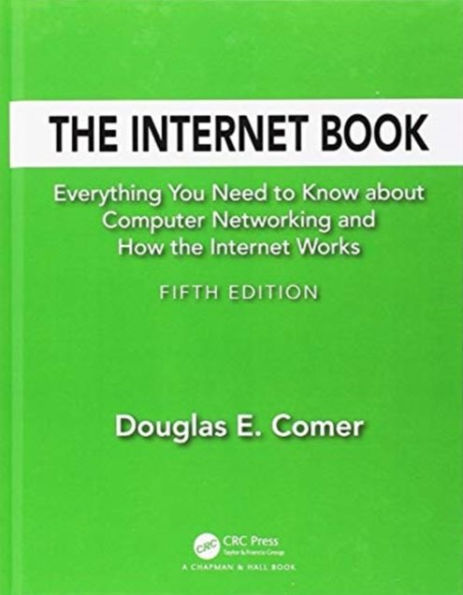
The Internet Book: Everything You Need to Know about Computer Networking and How the Internet Works
The Internet Book, Fifth Edition explains how computers communicate, what the Internet is, how the Internet works, and what'services the Internet offers. It is designed for readers who do not have a strong technical background — early chapters clearly explain the terminology and concepts needed to understand all the services. It helps the reader to understand the technology behind the Internet, appreciate how the Internet can be used, and discover why people find it so exciting. In addition, it explains the origins of the Internet and shows the reader how rapidly it has grown. It also provides information on how to avoid scams and exaggerated marketing claims.

The first section of the book introduces communication system concepts and terminology. The second section reviews the history of the Internet and its incredible growth. It documents the rate at which the digital revolution occurred, and provides background that will help readers appreciate the significance of the underlying design. The third section describes basic Internet technology and capabilities. It examines how Internet hardware is organized and how software provides communication. This section provides the foundation for later chapters, and will help readers ask good questions and make better decisions when salespeople offer Internet products and services. The final section describes application services currently available on the Internet. For each service, the book explains both what the service offers and how the service works.

About the Author

Dr. Douglas Comer is a Distinguished Professor at Purdue University in the departments of Computer Science and Electrical and Computer Engineering. He has created and enjoys teaching undergraduate and graduate courses on computer networks and Internets, operating systems, computer architecture, and computer software. One of the researchers who contributed to the Internet as it was being formed in the late 1970s and 1980s, he has served as a member of the Internet Architecture Board, the group responsible for guiding the Internet’s development. Prof. Comer is an internationally recognized expert on computer networking, the TCP/IP protocols, and the Internet, who presents lectures to a wide range of audiences. In addition to research articles, he has written a series of textbooks that describe the technical details of the Internet. Prof. Comer’s books have been translated into many languages, and are used in industry as well as computer science, engineering, and business departments around the world. Prof. Comer joined the Internet project in the late 1970s, and has had a high-speed Internet connection to his home since 1981. He wrote this book as a response to everyone who has asked him for an explanation of the Internet that is both technically correct and easily understood by anyone. An Internet enthusiast, Comer displays INTRNET on the license plate of his car.
1122413811
The Internet Book: Everything You Need to Know about Computer Networking and How the Internet Works
The Internet Book, Fifth Edition explains how computers communicate, what the Internet is, how the Internet works, and what'services the Internet offers. It is designed for readers who do not have a strong technical background — early chapters clearly explain the terminology and concepts needed to understand all the services. It helps the reader to understand the technology behind the Internet, appreciate how the Internet can be used, and discover why people find it so exciting. In addition, it explains the origins of the Internet and shows the reader how rapidly it has grown. It also provides information on how to avoid scams and exaggerated marketing claims.

The first section of the book introduces communication system concepts and terminology. The second section reviews the history of the Internet and its incredible growth. It documents the rate at which the digital revolution occurred, and provides background that will help readers appreciate the significance of the underlying design. The third section describes basic Internet technology and capabilities. It examines how Internet hardware is organized and how software provides communication. This section provides the foundation for later chapters, and will help readers ask good questions and make better decisions when salespeople offer Internet products and services. The final section describes application services currently available on the Internet. For each service, the book explains both what the service offers and how the service works.

About the Author

Dr. Douglas Comer is a Distinguished Professor at Purdue University in the departments of Computer Science and Electrical and Computer Engineering. He has created and enjoys teaching undergraduate and graduate courses on computer networks and Internets, operating systems, computer architecture, and computer software. One of the researchers who contributed to the Internet as it was being formed in the late 1970s and 1980s, he has served as a member of the Internet Architecture Board, the group responsible for guiding the Internet’s development. Prof. Comer is an internationally recognized expert on computer networking, the TCP/IP protocols, and the Internet, who presents lectures to a wide range of audiences. In addition to research articles, he has written a series of textbooks that describe the technical details of the Internet. Prof. Comer’s books have been translated into many languages, and are used in industry as well as computer science, engineering, and business departments around the world. Prof. Comer joined the Internet project in the late 1970s, and has had a high-speed Internet connection to his home since 1981. He wrote this book as a response to everyone who has asked him for an explanation of the Internet that is both technically correct and easily understood by anyone. An Internet enthusiast, Comer displays INTRNET on the license plate of his car.

110.0 In Stock
The Internet Book: Everything You Need to Know about Computer Networking and How the Internet Works

The Internet Book: Everything You Need to Know about Computer Networking and How the Internet Works

by Douglas E. Comer
The Internet Book: Everything You Need to Know about Computer Networking and How the Internet Works

The Internet Book: Everything You Need to Know about Computer Networking and How the Internet Works

by Douglas E. Comer

Hardcover(New)

$110.00 
  • SHIP THIS ITEM
    In stock. Ships in 3-7 days. Typically arrives in 3 weeks.
  • PICK UP IN STORE

    Your local store may have stock of this item.

Related collections and offers


Overview

The Internet Book, Fifth Edition explains how computers communicate, what the Internet is, how the Internet works, and what'services the Internet offers. It is designed for readers who do not have a strong technical background — early chapters clearly explain the terminology and concepts needed to understand all the services. It helps the reader to understand the technology behind the Internet, appreciate how the Internet can be used, and discover why people find it so exciting. In addition, it explains the origins of the Internet and shows the reader how rapidly it has grown. It also provides information on how to avoid scams and exaggerated marketing claims.

The first section of the book introduces communication system concepts and terminology. The second section reviews the history of the Internet and its incredible growth. It documents the rate at which the digital revolution occurred, and provides background that will help readers appreciate the significance of the underlying design. The third section describes basic Internet technology and capabilities. It examines how Internet hardware is organized and how software provides communication. This section provides the foundation for later chapters, and will help readers ask good questions and make better decisions when salespeople offer Internet products and services. The final section describes application services currently available on the Internet. For each service, the book explains both what the service offers and how the service works.

About the Author

Dr. Douglas Comer is a Distinguished Professor at Purdue University in the departments of Computer Science and Electrical and Computer Engineering. He has created and enjoys teaching undergraduate and graduate courses on computer networks and Internets, operating systems, computer architecture, and computer software. One of the researchers who contributed to the Internet as it was being formed in the late 1970s and 1980s, he has served as a member of the Internet Architecture Board, the group responsible for guiding the Internet’s development. Prof. Comer is an internationally recognized expert on computer networking, the TCP/IP protocols, and the Internet, who presents lectures to a wide range of audiences. In addition to research articles, he has written a series of textbooks that describe the technical details of the Internet. Prof. Comer’s books have been translated into many languages, and are used in industry as well as computer science, engineering, and business departments around the world. Prof. Comer joined the Internet project in the late 1970s, and has had a high-speed Internet connection to his home since 1981. He wrote this book as a response to everyone who has asked him for an explanation of the Internet that is both technically correct and easily understood by anyone. An Internet enthusiast, Comer displays INTRNET on the license plate of his car.


Product Details

ISBN-13: 9781138331334
Publisher: Taylor & Francis
Publication date: 08/22/2018
Edition description: New
Pages: 404
Product dimensions: 7.00(w) x 9.00(h) x (d)

About the Author

Douglas Comer is a Distinguished Professor at Purdue University in

the departments of Computer Science and Electrical and Computer Engineering.

He has created and enjoys teaching undergraduate and graduate

courses on computer networks and Internets, operating systems, computer

architecture, and computer software. One of the researchers who

contributed to the Internet as it was being formed in the late 1970s and

1980s, he has served as a member of the Internet Architecture Board, the

group responsible for guiding the Internet’s development. Comer is an

internationally recognized expert on computer networking, the TCP/IP

protocols, and the Internet, who presents lectures to a wide range of audiences.

In addition to research articles, he has written a series of textbooks

that describe the technical details of the Internet. Comer’s books

have been translated into many languages, and are used in industry as

well as computer science, engineering, and business departments around

the world. He is a Fellow of The Association for Computing Machinery

(the major professional society in computer science) and editor of the

scientific journal, Software — Practice and Experience.

Professor Comer had dial-up Internet access from his home in the

late 1970s, has enjoyed a direct connection with twenty-four hour per

day service since 1981, and uses the Internet daily. He wrote this book

as a response to everyone who has asked him for an explanation of the

Internet that is both technically correct and easily understood by anyone.

An Internet enthusiast, Comer displays INTRNET on the license plate of

his car.

Read an Excerpt

PREFACE:

Preface

The Internet Book explains how computers communicate, what the Internet is, how the Internet works, and what services the Internet offers you. It is designed for readers who do not have a strong technical background — early chapters clearly explain the terminology and concepts needed to understand all the services. When you finish reading, you will understand the technology behind the Internet, will appreciate how the Internet can be used, and discover why people find it so exciting. In addition, you will understand the origins of the Internet and see how rapidly it has grown.

Instead of using mathematics, algorithms, or computer programs, the book uses analogies from everyday life to explain technology. For example, to explain why digital communication is superior to analog, the text uses an analogy of sending signals through fog with a flashlight. To explain how audio can be played back for the user at a steady rate when packets arrive in clumps, the text uses the analogy of many gallons of milk arriving at a supermarket in one shipment, but being sold one gallon at a time.

In addition to explaining the services users encounter such as e-mail, file transfer, and web browsing, the text covers key networking concepts such as packet switching, Local Area Networks, protocol software, and domain names. More important, the text builds on fundamentals — it describes basic Internet communication facilities first, and then shows how the basic facilities are used to provide a variety of services. Finally, the book includes an extensive glossary of technical terms with easy-to-understand definitions; readers are encouraged to consult theglossary as they read.

The third edition retains the same general structure as the previous edition, but adds four new chapters and updates material throughout. Chapter 2 surveys a variety of Web sites, and encourages readers to begin exploring the Web while they read. The other three new chapters are especially significant. Chapter 14 covers Internet connection technologies, including ADSL and cable modems, technologies which are now available to consumers. Chapters 29 and 30 cover the related topics of security and ecommerce, both of which are increasingly important. Chapter 29 explains encryption technology, and Chapter 30 shows how the technology is used to conduct business.

As with the previous edition, the book is divided into four main parts. The first part begins with fundamental concepts such as digital and analog communication. It also introduces packet switching, and explains the Local Area Network technologies that are used in most businesses.

The second part of the book gives a short history of the Internet research project and the development of the Internet. Although most of the history can be skipped, readers should pay attention to the phenomenal growth rate, which demonstrates that the technology was designed incredibly well — no other communication technology has remained as unchanged through such rapid growth.

The third part of the book explains how the Internet works, including a description of the two fundamental protocols used by all services: the Internet Protocol (IP) and the Transmission Control Protocol (TCP). Although they omit technical details, the chapters in this part allow students to understand the essential role of each protocol and gain perspective on the overall design.

The fourth part of the book examines services available on the Internet. In addition to covering browsers, plugins, CGI, and search engines used with the World Wide Web, chapters discuss e-mail, network newsgroups, file and fax transfer, and audio and video communication. In each case, the text explains how the service operates and how it uses facilities in the underlying system.

The Internet Book makes an excellent reference text for a college-level course on the Internet. Although presented in a nontechnical manner, the material is scientifically accurate. More important, in the twenty-first century, an educated person will need to know more than how to use a browser or set up a Web page — they should have some understanding of what goes on behind the scenes. They can acquire such knowledge from this text.

Instructors are encouraged to combine classroom lectures with laboratory sessions in which students see and use the technology first-hand. In all courses, early labs should focus on exploring a variety of services, including sending e-mail, using a browser, using a search engine, downloading files via FTP, listening to audio, and using an IP telephone, if one is available. I encourage all students, even those who have no interest in computers, to build a trivial Web page by hand. In addition to helping them see the relationship between tags in an HTML document and the resulting display, it shows students how a server transfers files on a computer disk to a browser. Seeing the relationship in labs helps students better understand as they read about the underlying process.

Lab projects later in the semester depend on the type of course. Business-oriented courses often focus students on using the Internet — labs require students to search the Internet for information and then use the information to write a short paper. Other courses use labs to focus on tools such as programs used to create a Web page. Some courses combine both by having students search for information and then create a Web page that contains links to the information. In any case, we have found that students enter Internet courses with genuine enthusiasm and motivation; a professor's task is merely to provide perspective and remind students throughout the semester why the Internet is so exciting.

The author thanks many people who have contributed to editions of this book. John Lin, Keith Rovell, Rob Slade, and Christoph Schuba read early versions and made suggestions. Dwight Barnette, George Polyzo, Donald Knudson, Dale Musser, and Dennis Ray sent the publisher reviews of a previous edition. Scott Comer provided a student perspective. As always, my wife, Chris, carefully edited the manuscript, solved many problems, and improved the wording.

Douglas E. Comer
March, 2000

Table of Contents

The Internet Is Everywhere. Telephones Everywhere. The World Was Once Analog. The Past and Present Digital Network. Basic Communication. Local Area Networks. Internet: Motivation and Beginnings. The Incredible Growth. Packet Switching. Internet: A Network of Networks. Internet Access Using Broadband and Wireless. Internet Performance. IP: Software to Create A Virtual Network. TCP: Software for Reliable Communication. Clients, Servers, And Internet Services. Names for Computers. Sharing an Internet Connection (NAT). Why the Internet Works Well. Electronic Mail. The World Wide Web: Browsers and Basics. The World Wide Web: HTML and Web Pages. The World Wide Web: Web Pages That Change. Social Networking and Personal Publishing. The Internet of Things. Internet Search (Search Engines). Voice and Video Communication (VoIP). File Transfer and Data Sharing. Remote Desktop. Cloud Services and Cloud Computing. Network Security (Encryption and Firewalls). Security Scams: Fooling Users. Secure Access from A Distance (VPNs). Internet Economics and Electronic Commerce. A Global Digital Library.

Preface

PREFACE:

Preface

The Internet Book explains how computers communicate, what the Internet is, how the Internet works, and what services the Internet offers you. It is designed for readers who do not have a strong technical background — early chapters clearly explain the terminology and concepts needed to understand all the services. When you finish reading, you will understand the technology behind the Internet, will appreciate how the Internet can be used, and discover why people find it so exciting. In addition, you will understand the origins of the Internet and see how rapidly it has grown.

Instead of using mathematics, algorithms, or computer programs, the book uses analogies from everyday life to explain technology. For example, to explain why digital communication is superior to analog, the text uses an analogy of sending signals through fog with a flashlight. To explain how audio can be played back for the user at a steady rate when packets arrive in clumps, the text uses the analogy of many gallons of milk arriving at a supermarket in one shipment, but being sold one gallon at a time.

In addition to explaining the services users encounter such as e-mail, file transfer, and web browsing, the text covers key networking concepts such as packet switching, Local Area Networks, protocol software, and domain names. More important, the text builds on fundamentals — it describes basic Internet communication facilities first, and then shows how the basic facilities are used to provide a variety of services. Finally, the book includes an extensive glossary of technical terms with easy-to-understand definitions; readers are encouraged to consulttheglossary as they read.

The third edition retains the same general structure as the previous edition, but adds four new chapters and updates material throughout. Chapter 2 surveys a variety of Web sites, and encourages readers to begin exploring the Web while they read. The other three new chapters are especially significant. Chapter 14 covers Internet connection technologies, including ADSL and cable modems, technologies which are now available to consumers. Chapters 29 and 30 cover the related topics of security and ecommerce, both of which are increasingly important. Chapter 29 explains encryption technology, and Chapter 30 shows how the technology is used to conduct business.

As with the previous edition, the book is divided into four main parts. The first part begins with fundamental concepts such as digital and analog communication. It also introduces packet switching, and explains the Local Area Network technologies that are used in most businesses.

The second part of the book gives a short history of the Internet research project and the development of the Internet. Although most of the history can be skipped, readers should pay attention to the phenomenal growth rate, which demonstrates that the technology was designed incredibly well — no other communication technology has remained as unchanged through such rapid growth.

The third part of the book explains how the Internet works, including a description of the two fundamental protocols used by all services: the Internet Protocol (IP) and the Transmission Control Protocol (TCP). Although they omit technical details, the chapters in this part allow students to understand the essential role of each protocol and gain perspective on the overall design.

The fourth part of the book examines services available on the Internet. In addition to covering browsers, plugins, CGI, and search engines used with the World Wide Web, chapters discuss e-mail, network newsgroups, file and fax transfer, and audio and video communication. In each case, the text explains how the service operates and how it uses facilities in the underlying system.

The Internet Book makes an excellent reference text for a college-level course on the Internet. Although presented in a nontechnical manner, the material is scientifically accurate. More important, in the twenty-first century, an educated person will need to know more than how to use a browser or set up a Web page — they should have some understanding of what goes on behind the scenes. They can acquire such knowledge from this text.

Instructors are encouraged to combine classroom lectures with laboratory sessions in which students see and use the technology first-hand. In all courses, early labs should focus on exploring a variety of services, including sending e-mail, using a browser, using a search engine, downloading files via FTP, listening to audio, and using an IP telephone, if one is available. I encourage all students, even those who have no interest in computers, to build a trivial Web page by hand. In addition to helping them see the relationship between tags in an HTML document and the resulting display, it shows students how a server transfers files on a computer disk to a browser. Seeing the relationship in labs helps students better understand as they read about the underlying process.

Lab projects later in the semester depend on the type of course. Business-oriented courses often focus students on using the Internet — labs require students to search the Internet for information and then use the information to write a short paper. Other courses use labs to focus on tools such as programs used to create a Web page. Some courses combine both by having students search for information and then create a Web page that contains links to the information. In any case, we have found that students enter Internet courses with genuine enthusiasm and motivation; a professor's task is merely to provide perspective and remind students throughout the semester why the Internet is so exciting.

The author thanks many people who have contributed to editions of this book. John Lin, Keith Rovell, Rob Slade, and Christoph Schuba read early versions and made suggestions. Dwight Barnette, George Polyzo, Donald Knudson, Dale Musser, and Dennis Ray sent the publisher reviews of a previous edition. Scott Comer provided a student perspective. As always, my wife, Chris, carefully edited the manuscript, solved many problems, and improved the wording.

Douglas E. Comer
March, 2000

From the B&N Reads Blog

Customer Reviews