
The Mathematical Mind of F. M. Dostoevsky: Imaginary Numbers, Non-Euclidean Geometry, and Infinity reconstructs the curriculum and readings that F. M. Dostoevsky encountered during his studies and connects such sources to the mathematical references and themes in his published works. Prior to becoming a man of letters, Dostoevsky studied at the Main Engineering School in St. Petersburg from 1838 to 1843. After he was arrested, submitted to mock execution by firing squad, and sentenced to penal servitude in Siberia for his involvement in the revolutionary Petrashevsky Circle in 1849, most of his books and journals from the period of his education were confiscated, and destroyed by the Third Section of the Russian Secret Police. Although most scholars discount the legacy of his engineering studies, the literary aesthetics of his works communicate an acute awareness of mathematical principles and debates. This book unearths subtexts in works by Dostoevsky, communicating veins of mathematical thought that evolved throughout Classical Antiquity, the Renaissance, and the Scientific Revolution.
1146220722
The Mathematical Mind of F. M. Dostoevsky: Imaginary Numbers, Non-Euclidean Geometry, and Infinity
The Mathematical Mind of F. M. Dostoevsky: Imaginary Numbers, Non-Euclidean Geometry, and Infinity reconstructs the curriculum and readings that F. M. Dostoevsky encountered during his studies and connects such sources to the mathematical references and themes in his published works. Prior to becoming a man of letters, Dostoevsky studied at the Main Engineering School in St. Petersburg from 1838 to 1843. After he was arrested, submitted to mock execution by firing squad, and sentenced to penal servitude in Siberia for his involvement in the revolutionary Petrashevsky Circle in 1849, most of his books and journals from the period of his education were confiscated, and destroyed by the Third Section of the Russian Secret Police. Although most scholars discount the legacy of his engineering studies, the literary aesthetics of his works communicate an acute awareness of mathematical principles and debates. This book unearths subtexts in works by Dostoevsky, communicating veins of mathematical thought that evolved throughout Classical Antiquity, the Renaissance, and the Scientific Revolution.
121.5
In Stock
5
1

The Mathematical Mind of F. M. Dostoevsky: Imaginary Numbers, Non-Euclidean Geometry, and Infinity
394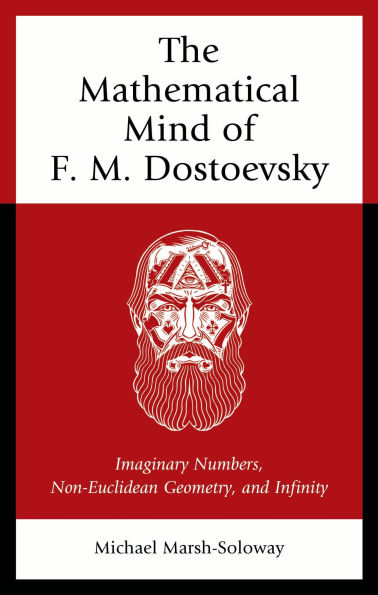
The Mathematical Mind of F. M. Dostoevsky: Imaginary Numbers, Non-Euclidean Geometry, and Infinity
394Related collections and offers
121.5
In Stock

Product Details
| ISBN-13: | 9781666948097 |
|---|---|
| Publisher: | Bloomsbury Publishing |
| Publication date: | 11/19/2024 |
| Sold by: | Barnes & Noble |
| Format: | eBook |
| Pages: | 394 |
| File size: | 6 MB |
About the Author
From the B&N Reads Blog