
Who is to be attended first? And how should such a decision be made? The Negotiation of Urgency: Economies of Attention in an Italian Emergency Room ethnographically explores the everyday life of one of the thickest places in contemporary societies: the ER, where aging, economic precarity, draconian migration laws, hospital overcrowding, and life and death, intersect daily. The book describes the effect of those intersections for clinicians and their patients, as well as for policy makers and the health-care system more generally.
Mirko Pasquini shows that there is more than medical urgency at stake in the ER, where mistrust of medical authority is fueled and violence often sparks. He analyzes the making of urgency, that is triage, not as a neutral medical way of sorting, but as a practice that actively creates difference through economies of attention. The Negotiation of Urgency illustrates both the limits of triage, and how those limits can spark improvisation and creative reinvention.
1146296696
Mirko Pasquini shows that there is more than medical urgency at stake in the ER, where mistrust of medical authority is fueled and violence often sparks. He analyzes the making of urgency, that is triage, not as a neutral medical way of sorting, but as a practice that actively creates difference through economies of attention. The Negotiation of Urgency illustrates both the limits of triage, and how those limits can spark improvisation and creative reinvention.
The Negotiation of Urgency: Economies of Attention in an Italian Emergency Room
Who is to be attended first? And how should such a decision be made? The Negotiation of Urgency: Economies of Attention in an Italian Emergency Room ethnographically explores the everyday life of one of the thickest places in contemporary societies: the ER, where aging, economic precarity, draconian migration laws, hospital overcrowding, and life and death, intersect daily. The book describes the effect of those intersections for clinicians and their patients, as well as for policy makers and the health-care system more generally.
Mirko Pasquini shows that there is more than medical urgency at stake in the ER, where mistrust of medical authority is fueled and violence often sparks. He analyzes the making of urgency, that is triage, not as a neutral medical way of sorting, but as a practice that actively creates difference through economies of attention. The Negotiation of Urgency illustrates both the limits of triage, and how those limits can spark improvisation and creative reinvention.
Mirko Pasquini shows that there is more than medical urgency at stake in the ER, where mistrust of medical authority is fueled and violence often sparks. He analyzes the making of urgency, that is triage, not as a neutral medical way of sorting, but as a practice that actively creates difference through economies of attention. The Negotiation of Urgency illustrates both the limits of triage, and how those limits can spark improvisation and creative reinvention.
29.95
In Stock
5
1


The Negotiation of Urgency: Economies of Attention in an Italian Emergency Room
181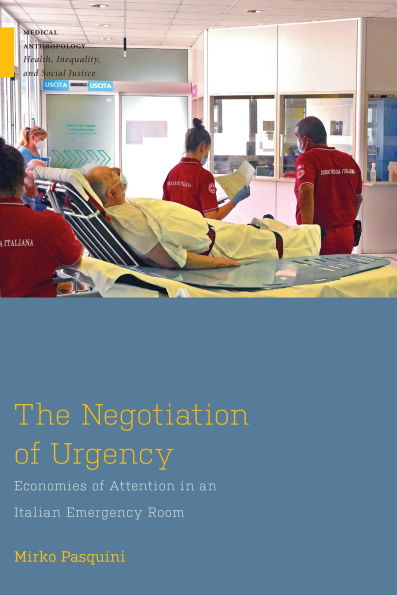
The Negotiation of Urgency: Economies of Attention in an Italian Emergency Room
181Related collections and offers
29.95
In Stock

Product Details
| ISBN-13: | 9781978836280 |
|---|---|
| Publisher: | Rutgers University Press |
| Publication date: | 06/17/2025 |
| Series: | Medical Anthropology |
| Sold by: | Barnes & Noble |
| Format: | eBook |
| Pages: | 181 |
| File size: | 3 MB |
About the Author
From the B&N Reads Blog