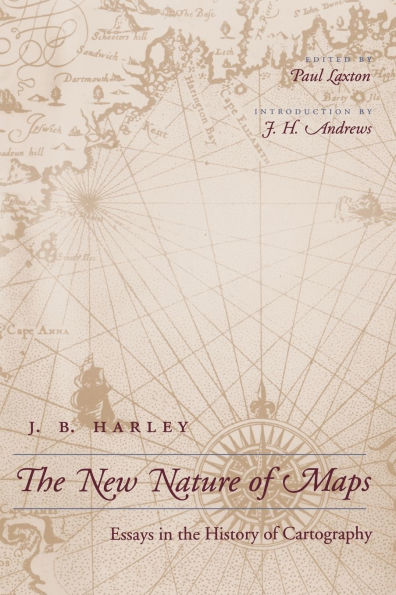
The New Nature of Maps: Essays in the History of Cartography
In this collection of essays J. B. Harley (1932-1991) draws on ideas in art history, literature, philosophy, and the study of visual culture to subvert the traditional, "positivist" model of cartography, replacing it with one that is grounded in an iconological and semiotic theory of the nature of maps. He defines a map as a "social construction" and argues that maps are not simple representations of reality but exert profound influences upon the way space is conceptualized and organized. A central theme is the way in which power—whether military, political, religious, or economic—becomes inscribed on the land through cartography. In this new reading of maps and map making, Harley undertakes a surprising journey into the nature of the social and political unconscious.

1122643231
The New Nature of Maps: Essays in the History of Cartography
In this collection of essays J. B. Harley (1932-1991) draws on ideas in art history, literature, philosophy, and the study of visual culture to subvert the traditional, "positivist" model of cartography, replacing it with one that is grounded in an iconological and semiotic theory of the nature of maps. He defines a map as a "social construction" and argues that maps are not simple representations of reality but exert profound influences upon the way space is conceptualized and organized. A central theme is the way in which power—whether military, political, religious, or economic—becomes inscribed on the land through cartography. In this new reading of maps and map making, Harley undertakes a surprising journey into the nature of the social and political unconscious.

32.95 In Stock
The New Nature of Maps: Essays in the History of Cartography

The New Nature of Maps: Essays in the History of Cartography

The New Nature of Maps: Essays in the History of Cartography

The New Nature of Maps: Essays in the History of Cartography

Paperback(New Edition)

$32.95 
  • SHIP THIS ITEM
    In stock. Ships in 2-4 days.
  • PICK UP IN STORE

    Your local store may have stock of this item.

Related collections and offers


Overview

In this collection of essays J. B. Harley (1932-1991) draws on ideas in art history, literature, philosophy, and the study of visual culture to subvert the traditional, "positivist" model of cartography, replacing it with one that is grounded in an iconological and semiotic theory of the nature of maps. He defines a map as a "social construction" and argues that maps are not simple representations of reality but exert profound influences upon the way space is conceptualized and organized. A central theme is the way in which power—whether military, political, religious, or economic—becomes inscribed on the land through cartography. In this new reading of maps and map making, Harley undertakes a surprising journey into the nature of the social and political unconscious.


Product Details

ISBN-13: 9780801870903
Publisher: Johns Hopkins University Press
Publication date: 10/03/2002
Edition description: New Edition
Pages: 352
Product dimensions: 6.00(w) x 9.00(h) x 0.75(d)
Age Range: 18 Years

About the Author

J. B. Harley lectured in historical geography at the Universities of Liverpool and Exeter before moving to the University of Wisconsin-Milwaukee. His ideas on the meaning of maps have influenced not just geographers and map historians but also students of art history and literature. At Milwaukee he began, with David Woodward, the multivolume History of Cartography, the first volume of which was published in 1987.

Paul Laxton lectured in the Department of Geography at the University of Liverpool for more than thirty years. He is now an independent scholar.

J. H. Andrews is a retired professor of geography at Trinity College, Dublin and author of A Paper Landscape: The Ordnance Survey in Nineteenth-Century Ireland and Shapes of Ireland.

Table of Contents

Introduction: Meaning, Knowledge, and Power in the Map Philosophy of J.B. Harley, by J. H. Andrews
1. Text and Contexts in the Interpretation of Early Maps
2. Maps, Knowledge, and Power
3. Silences and Secrecy: The Hidden Agenda of Cartography in Early Modern Europe
4. Power and Legitimation in the English Geographical Atlases of the Eighteenth Century
5. Deconstructing the Map
6. New England Cartography and the Native Americans
7. Can There Be a Cartographic Ethics

From the B&N Reads Blog

Customer Reviews