
This book explores such questions, focusing on American constitutional jurisprudence. It also argues that, in doing so, it is helpful to recognize that our interest in using and enhancing our perceptual power isn’t only an interest in doing so as part of First Amendment communication. It is also linked closely to other rights - to personal integrity and the liberty to use our body’s perceptual powers and to the constitution’s protection for freedom of thought or what some scholars call “cognitive liberty:” Our exercise of perception and our use of it to learn about our surroundings is a crucial part of exercising our and shaping our mind.
This book explores such questions, focusing on American constitutional jurisprudence. It also argues that, in doing so, it is helpful to recognize that our interest in using and enhancing our perceptual power isn’t only an interest in doing so as part of First Amendment communication. It is also linked closely to other rights - to personal integrity and the liberty to use our body’s perceptual powers and to the constitution’s protection for freedom of thought or what some scholars call “cognitive liberty:” Our exercise of perception and our use of it to learn about our surroundings is a crucial part of exercising our and shaping our mind.

The Right to See with Technology: Recording, Augmented Perception, and the Constitution
185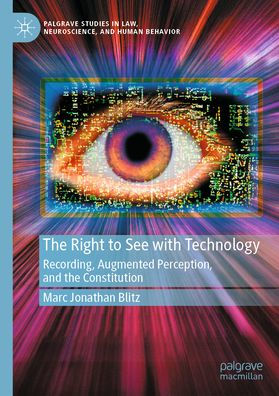
The Right to See with Technology: Recording, Augmented Perception, and the Constitution
185
Product Details
| ISBN-13: | 9783031895326 |
|---|---|
| Publisher: | Springer Nature Switzerland |
| Publication date: | 08/01/2025 |
| Series: | Palgrave Studies in Law, Neuroscience, and Human Behavior |
| Pages: | 185 |
| Product dimensions: | 5.83(w) x 8.27(h) x 0.00(d) |