Read an Excerpt
CHAPTER 1
Convergence: Human Life in the Year 2112
The significant problems we face cannot be solved at the same level of thinking we were at when we created them.
— Albert Einstein
There is a profound sense of wonder that one gets from staring into the depths of space on a clear night. For many, gazing up into the interminable vastness of the evening sky inspires an ease of passage between thoughts, and a path toward ultimate realization within the mind. With little doubt, our ancestors also found themselves gazing upward at such times of pensive reflection, whether their intent was to converse with spirits long removed from the confines of our static world, or perhaps merely to envisage a future it was known they would never live to see. Perhaps, on occasion, they were even so lucky as to have witnessed strange lights or other uncanny objects coasting through the heavens. Although this sort of curiosity must have been perplexing and seemingly impossible, it may also have granted those in earlier times a unique glimpse of things to come, inspiring notions of a future humanity capable of traveling beyond this world, and perhaps to vast and exotic locations inhabited by life entirely unlike our own.
Even notions of how life might exist here on Earth today, as perceived by the minds of those living as recently as one century ago, would likely seem simplistic or comical to us now. Indeed, the rapid expansion of our technology has managed to surpass ideas forecast by many of the finest thinkers of yesteryear. The brilliant Thomas Edison, still regarded as the fourth most prolific inventor in our history, managed to express his own fair share of ideas about a 21st century he envisioned that had been remarkably tame by our standards. For instance, in the summer of 1911 the Miami Metropolis featured an interview where the famous Wizard of Menlo Park predicted what books of the future would be like. "Books of the coming century will all be printed leaves of nickel," according to Edison, who said they would be "so light to hold that the reader can enjoy a small library in a single volume. A book two inches thick will contain forty thousand pages, the equivalent of a hundred volumes; six inches in aggregate thickness, it would suffice for all the contents of the Encyclopedia Britannica. And each volume would weigh less than a pound." It was boasted at the time that Edison could already produce "a pound weight of these nickel leaves, more flexible than paper and ten times as durable, at a cost of five shillings." That cost would have reduced drastically by 2011, the inventor surmised, had it not been for the emergence of a kind of wizardry even Edison couldn't have foreseen. As we know today, computer technology would begin to emerge throughout the middle part of the 20th century, which spurred the invention of devices such as iPads and e-readers just within the last few years. At the very least, Edison had been right about the use of metal in the construction of these futuristic "books."
Then in January 2012, just one year following the expected fruition of Edison's predictions from a century earlier, an article discussing the sorts of technology humans might expect to see in yet another hundred years appeared in the online edition of BBC News Magazine. The piece, "Twenty Top Predictions for Life 100 Years From Now," featured commentary from renowned futurologists Ian Pearson and Patrick Tucker, who ranked various reader-submitted future predictions in terms of their likelihood. Among the strange and incredible forecasts proposed were communication through thought transmission, brain-computer interfaces that will improve human thought, and even technology that would grant humans immortality. Remarkably, these three potentials were viewed as being more likely than the institution of a one-world currency or government, or that of future U.S. wars being managed entirely with remote drone technology, or even the potential for annual contracts replacing marriages.
A similar approach to crowd-sourcing predictions of the future appeared around the same time on the Website of the New York Times. Featured amid forecasts spanning the next 300 years were some of the following ideas, many of which involve artificial intelligence, biological improvement through Transhuman technology, and yes, even UFOs and extraterrestrials:
2020: Avatars will represent us on smartphones and other devices, rather than voice mail or call waiting, so that "even our best friends won't know they're talking to an artificial person."
2022: It will be learned that UFOs represent "tourists from Earth's future," and in some instances "future biologists collecting non-genetically modified food crop seeds."
2025: Online attendance surpasses on-campus enrollment in colleges and universities. Additionally, "we'll be laughing at these predictions," according to one user prediction.
2027: The first successful detection of a remote civilization is achieved through SETI, leading to a new field of "Extraterrestrial Studies" offered through major universities.
2029: Technology will "facilitate a seamless integration of personal and professional activity," rendering notions such as "workplace" or "business day" obsolete.
2030: Technology and popular demand usher the age of self-driving cars. At this point, the human mind will also "be understood well enough to be susceptible to remote 'hacking'."
2040: Biology is integrated more completely with computers, allowing small devices to monitor living organisms "to provide feedback on vitamin and mineral deficiencies or surpluses, chemical imbalances, etc."
2043: Artificial intelligence will come to be viewed as "a decisive factor in war."
2050: Artificial intelligence will be convicted of a crime for the first time in a court of law. Also, humans will be able "to directly and fully share" or even "combine their minds." This leads to the creation of "superminds" that interconnect the thought processes of several individuals for solving large problems.
2071: Personal computers will allow users the intricate manipulation of virtual icons in a 3-dimensional workspace through processes of "tactile holography."
2075: Distinctions between modern humans and machine will become meaningless.
2090: Early Transhumanism will begin to emerge, "where human body parts will be replaced or enhanced" solely because the newly created artificial prosthetics will allow better performance than our biology already does.
2096: "The Carl Sagan Memorial Telescope sees first light on the Moon. Its 20 km diameter primary mirror is able to detect the lights of small cities on nearby extra-solar Earth-like planets."
2100: The Singularity arrives.
2100: Scientists learn that the universe "is actually a digital simulation. Efforts are begun to contact the operators."
2222: Intelligent computers will design and construct future A.I. that exceeds their own intelligence, designed to be more "capable, compassionate and reflective" than their creators. The human species becomes irrelevant in the presence of multiple levels of more advanced intelligent beings on Earth.
2225: Humankind will establish contact for the first time with an intelligent extraterrestrial species.
2300: "Thought-based communication surpasses spoken and typed communication."
2300: By now, "it will be impossible to tell if a message received from space originated from a human created device or an alien species, since the devices will be evolving in ways humans cannot fully understand anymore."
Despite how this time frame provided is entirely based on guesswork by New York Times readers, it remains arguable that at least a good majority of these predictions will come to fruition sometime in our future. This is based, in part, on the consistency of these expectations among not just the general public, but also factions of the scientific establishment. Such a collection of proposed futuristic milestones may indeed serve in helping us formulate at least a rough idea of what the coming years and decades may look like; whatever the case, these sorts of technological achievements are on many people's minds, and virtually all of the notions expressed in the time frame have appeared with minimal variation elsewhere in various scientific journals, popular television shows and documentaries, and even in science fiction. It stands to reason that even the public's mere expectation that such technologies will eventually become a reality, paired with the benefit they would likely incur once they are finally achieved, will cause a number of scientific fields to continue steering toward research and development conducive to their ultimate realization.
One area that remains key to the overall furtherance of human technology has to do with the way that brain science is evolving. A better understanding of how the human mind works, after all, when paired with technological applications that can replicate or improve those processes, will likely also lead to the eventual creation of artificial intelligence, or A.I. True, the development of intelligence greater than our own may one day help improve our lives, but of equal interest regarding studies of the mind is the fact that, though we are getting close to revealing the brain's inner workings on some levels, existing technology that surrounds us every day has also begun to cause perceptible changes in how our minds function right now. In short, we are changing with every passing day and are already a very different humanity from that which existed a century ago. If such trends continue, one can only imagine what our species could be like, for instance, in the year 2112; one more century could bring with it unimaginable amounts of change, as we will soon begin to see.
In January 2012, OnlineCollege.org featured an article titled "15 Big Ways the Internet Is Changing Our Brain." These changes are becoming particularly obvious among those in parts of the world where technology and widespread accessibility to computers are prolific; they include trends showing IQ increases through time, as well as increased overall brain function and activity. Problem-solving capabilities seem to be showing improvement also, based on the way the minds of those involved heavily in the use of computers and the Internet each day "constantly seek out incoming information."
There are other changes occurring that, although some may consider them to be negative or even detrimental to our accepted norms, have nonetheless begun to illuminate the complex relationship computers and the Internet are shaping for themselves within our lives. "The Internet has become a primary form of external or transactive memory, where information is stored collectively outside ourselves," according to a May 2011 study that appeared in Science Magazine. "When faced with difficult questions, people are primed to think about computers," the study's abstract states, "When people expect to have future access to information, they have lower rates of recall of the information itself and enhanced recall instead for where to access it." In other words, Internet use is showing a tendency to cause reduced ability to remember specific details, favoring processes within the brain that focus instead on how to access the information online at a later time. A Columbia University study found that the use of search engines and similar Internet tools are literally "reorganizing the way we remember things," and the study's lead researcher, Betsy Sparrow, subsequently told the British Daily Mail Online that "our brains rely on the internet for memory in much the same way they rely on the memory of a friend, family member or co-worker. We remember less through knowing information itself than by knowing where the information can be found."
Perhaps the most fascinating element to this kind of research is that it points to how our brains are beginning to outsource certain learning processes and other functions to computers and the Internet. When stopping to consider all the vast potentials within the field of computer science, it also becomes easy to forget just how recent this technology, which has allowed innovations like the Web, really is. Internet use and accessibility had only become widespread by the mid-1990s, at which time the rate of annual growth among Web users was believed to have reached 100 percent for a number of consecutive years. Although our reliance on outsourcing information to an intangible "data cloud" has yet to lose the luster of modernity, on the other hand, concepts that involve the way human ideas could migrate into some form of a "collective" are indeed familiar to us already. Psychologist Carl Jung believed that there was a literal "collective unconsciousness," and one that was inherited rather than being learned by individuals, which united certain thoughts and subconscious traits among all humans. He writes:
In addition to our immediate consciousness, which is of a thoroughly personal nature and which we believe to be the only empirical psyche ... there exists a second psychic system of a collective, universal, and impersonal nature which is identical in all individuals. This collective unconscious does not develop individually but is inherited. It consists of pre-existent forms, the archetypes, which can only become conscious secondarily and which give definite form to certain psychic contents.
What Jung illustrates here is reminiscent, in a sense, of the technological trends we have begun to see in society today. Much like the famous psychologist believed that there were intangible elements that linked aspects of the human psyche, our minds are becoming interlinked in similar ways thanks to the Internet, which is quickly becoming a repository for all existing human knowledge. What we once kept in our minds, if not within the pages of countless volumes of books, is now migrating steadily toward the ever-growing database that is the World Wide Web.
It becomes staggering when we stop to consider just how much knowledge is being housed within the complex network of sites and servers that comprise the Internet. Furthermore, the majority of that information is made directly available to the greater masses, at little or no cost. Ranging from vast and complex scientific data, to the mundane socio-cultural memes and mainstays of humor in our daily lives, the Internet is becoming the literal summation of all human intelligence, stored within an equally complex electronic subspace that, by all accounts, could be likened to being a single, colossal representation of all human minds — and one with intelligence and capabilities far exceeding that of any single living person on Earth.
But just how much does the Internet really resemble the workings of a conscious mind? To be certain, there are many similarities, ranging from the way that data is collected and stored, to the way that processes existing within the Web are able to recall and utilize that information. "Many scientists believe that consciousness is a property that will inevitably emerge from any complex system that has the right sort of internal dynamics, and the right sort of interaction with its environment," says Ben Goertzel, PhD, an artificial intelligence expert and computer scientist. Goertzel further expounded on the potential likelihood of this idea in his article "When the Net Becomes Conscious":
The Internet perceives and acts on the world; it stores declarative, episodic and procedural memories; it recalls some information and forgets others; etc. In short it behaves a fair bit like a human mind. ... According to this perspective, the Internet might already have a degree of consciousness, though of a type quite different from human consciousness.
Futurist Dick Pelletier guesses that by the "mid-2030s, when artificial intelligence is expected to surpass human intelligence ... the Internet will become fully conscious as it guides humanity through this incredible 'magical future' time." But despite when this may occur, the question remains as to whether or not the emergence of anything resembling consciousness within the Web would be the result of intentional action on our part. Robert Heinlein's classic novel of lunar libertarianism, The Moon Is a Harsh Mistress, deals in part with an IBM-designed supercomputer installed on a lunar base, which attains consciousness as a result of constantly being fed more and more complex information over time:
(Continues…)
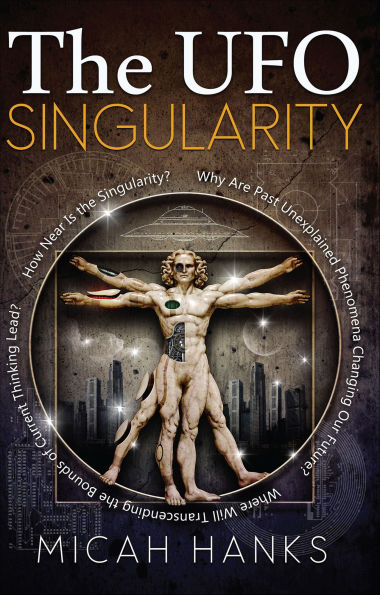
Excerpted from "The UFO Singularity"
by .
Copyright © 2013 Micah Hanks.
Excerpted by permission of Red Wheel/Weiser, LLC.
All rights reserved. No part of this excerpt may be reproduced or reprinted without permission in writing from the publisher.
Excerpts are provided by Dial-A-Book Inc. solely for the personal use of visitors to this web site.