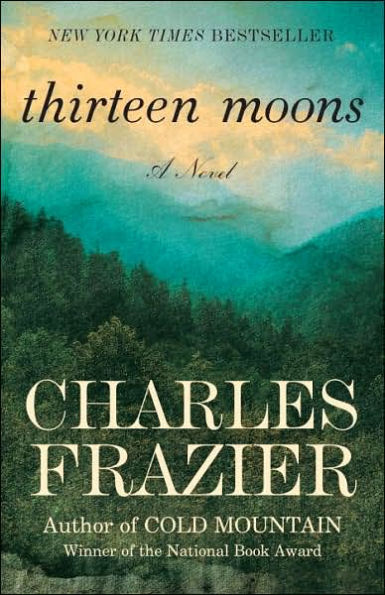
Thirteen Moons

( 58 )

Pick Up in Store

Reserve and pick up in 60 minutes at your local store

Paperback (Reprint)
$12.99
BN.com price
$15.00 List Price (Save 13%)
Marketplace (New and Used)
from
$0.99
$15.00 List Price (Save 93%)
Usually ships within 1-2 business days
All (268)  
Used (246)  
New (22)  
Close
Sort by
Page 1 of 27
Showing 1 – 10 of 268 (27 pages)
$0.99
(Save 93%)
Seller since 2011

Feedback rating:

(144)

Condition:

New — never opened or used in original packaging.

Like New — packaging may have been opened. A "Like New" item is suitable to give as a gift.

Very Good — may have minor signs of wear on packaging but item works perfectly and has no damage.

Good — item is in good condition but packaging may have signs of shelf wear/aging or torn packaging. All specific defects should be noted in the Comments section associated with each item.

Acceptable — item is in working order but may show signs of wear such as scratches or torn packaging. All specific defects should be noted in the Comments section associated with each item.

Used — An item that has been opened and may show signs of wear. All specific defects should be noted in the Comments section associated with each item.

Refurbished — A used item that has been renewed or updated and verified to be in proper working condition. Not necessarily completed by the original manufacturer.

Acceptable
2007 Paperback Fair The book is clean but may have markings or highlights througout.

Ships from: St Paul, MN

Usually ships in 1-2 business days

  • Canadian
  • International
  • Standard, 48 States
  • Standard (AK, HI)
  • Express, 48 States
  • Express (AK, HI)
$0.99
(Save 93%)
Seller since 2005

Feedback rating:

(3361)

Condition: Good
Reprint Good [ No Hassle 30 Day Returns ] Publisher: Random House Trade Paperbacks Pub Date: 6/5/2007 Binding: Paperback Pages: 432.

Ships from: College Park, MD

Usually ships in 1-2 business days

  • Canadian
  • International
  • Standard, 48 States
  • Standard (AK, HI)
  • Express, 48 States
  • Express (AK, HI)
$0.99
(Save 93%)
Seller since 2011

Feedback rating:

(144)

Condition: Acceptable
2007 Paperback Fair The book is clean but may have markings or highlights througout.

Ships from: St Paul, MN

Usually ships in 1-2 business days

  • Canadian
  • International
  • Standard, 48 States
  • Standard (AK, HI)
  • Express, 48 States
  • Express (AK, HI)
$0.99
(Save 93%)
Seller since 2011

Feedback rating:

(144)

Condition: Acceptable
2007 Paperback Fair The book is clean but may have markings or highlights througout.

Ships from: St Paul, MN

Usually ships in 1-2 business days

  • Canadian
  • International
  • Standard, 48 States
  • Standard (AK, HI)
  • Express, 48 States
  • Express (AK, HI)
$0.99
(Save 93%)
Seller since 2005

Feedback rating:

(2253)

Condition: Acceptable
2007 Paperback Fair This is a used book. It may contain highlighting/underlining and/or may show heavier signs of use. It may also be ex-library or missing its dust jacket. We ... ship every order promptly. Read more Show Less

Ships from: Tontitown, AR

Usually ships in 1-2 business days

  • Canadian
  • International
  • Standard, 48 States
  • Standard (AK, HI)
  • Express, 48 States
  • Express (AK, HI)
$0.99
(Save 93%)
Seller since 2008

Feedback rating:

(2587)

Condition: Very Good
VG Nice copy with light cover wear. Pages clean with tight binding.

Ships from: San Jose, CA

Usually ships in 1-2 business days

  • Canadian
  • International
  • Standard, 48 States
  • Standard (AK, HI)
  • Express, 48 States
  • Express (AK, HI)
$0.99
(Save 93%)
Seller since 2009

Feedback rating:

(422)

Condition: Good
2007 Paperback Good General Used Condiiton. Minor Defects may Exist. Minimal Shelf wear. Text may contain minor marking or highlighting, Binding Tight. Previous owners name or ... bookplate may be present. Like New, May have remainder mark (black line generally made acrossed bottom page edge to indicate close out by publisher) Read more Show Less

Ships from: Wichita, KS

Usually ships in 1-2 business days

  • Canadian
  • International
  • Standard, 48 States
  • Standard (AK, HI)
  • Express, 48 States
  • Express (AK, HI)
$0.99
(Save 93%)
Seller since 2009

Feedback rating:

(189)

Condition: Good
2007 Paperback Good This book looks good. It is like any used book you would expect to find in a used book shop.

Ships from: Garner, NC

Usually ships in 1-2 business days

  • Canadian
  • International
  • Standard, 48 States
  • Standard (AK, HI)
  • Express, 48 States
  • Express (AK, HI)
$0.99
(Save 93%)
Seller since 2008

Feedback rating:

(2587)

Condition: Very Good
VG Nice copy with light cover wear. Pages clean with tight binding.

Ships from: San Jose, CA

Usually ships in 1-2 business days

  • Canadian
  • International
  • Standard, 48 States
  • Standard (AK, HI)
  • Express, 48 States
  • Express (AK, HI)
$0.99
(Save 93%)
Seller since 2012

Feedback rating:

(0)

Condition: Good
2007 Paperback The cover may contain minor wear, and the corners may have some light degree of damage. If there are any notes present, they would only be penciled and only ... visible on a few pages. There are no ink markings of any kind, but there may be a remainder-mark on the outside edge of the pages. Proceeds benefit non-profit Goodwill Industries of San Francisco, San Mateo and Marin Counties. We create solutions to poverty through the businesses we operate. Your purchase creates jobs and transforms liv. Read more Show Less

Ships from: San Francisco, CA

Usually ships in 1-2 business days

  • Canadian
  • International
  • Standard, 48 States
  • Standard (AK, HI)
  • Express, 48 States
  • Express (AK, HI)
Page 1 of 27
Showing 1 – 10 of 268 (27 pages)
Close
Sort by
NOOK Book (eBook)
$11.99
BN.com price

Available on NOOK devices and apps

  • Nook Devices
  • NOOK
  • NOOK Color
  • NOOK Tablet
  • Tablet/Phone
  • NOOK for iPad
  • NOOK for iPhone
  • NOOK for Android
  • NOOK for Android (Tablet)
  • NOOK Kids for iPad
  • PC/Mac
  • NOOK Study
  • NOOK for PC
  • NOOK for Mac

Need a NOOK? Explore Now

Overview

This magnificent novel by one of America’s finest writers is the epic of one man’s remarkable journey, set in nineteenth-century America against the background of a vanishing people and a rich way of life.

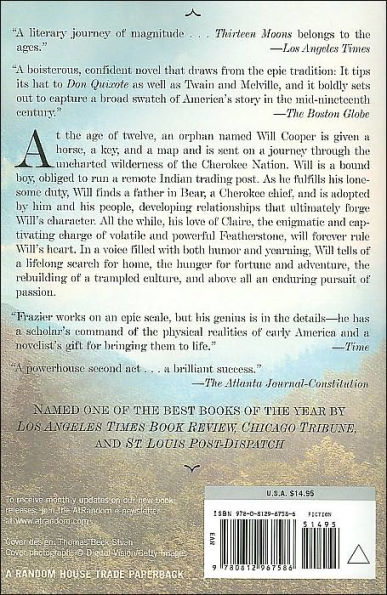
At the age of twelve, under the Wind moon, Will is given a horse, a key, and a map, and sent alone into the Indian Nation to run a trading post as a bound boy. It is during this time that he grows into a man, learning, as he does, of the raw power it takes to create a life, to find a home. In a card game with a white Indian named Featherstone, Will wins – for a brief moment – a mysterious girl named Claire, and his passion and desire for her spans this novel. As Will’s destiny intertwines with the fate of the Cherokee Indians – including a Cherokee Chief named Bear – he learns how to fight and survive in the face of both nature and men, and eventually, under the Corn Tassel Moon, Will begins the fight against Washington City to preserve the Cherokee’s homeland and culture. And he will come to know the truth behind his belief that “only desire trumps time.”

Brilliantly imagined, written with great power and beauty by a master of American fiction, Thirteen Moons is a stunning novel about a man’s passion for a woman, and how loss, longing and love can shape a man’s destiny over the many moons of a life.

Editorial Reviews

From Barnes & Noble
In another 19th-century venture, the author of the National Book Award-winning Cold Mountain dispatches a 12-year-old boy named Will on a man-size mission. Given only a horse, a key, and a map, this callow youth is sent alone into Indian country to run a trading post. Thrust into a frontier society where everything is uncertain, Will places his allegiance on the side of the embattled Cherokees and his love in the elusive hands of a young woman he won in a card game. A love story set in a fully imagined borderland world.
Kirkus Reviews
The recent resurgence in historical fiction arguably dates from the critical and popular success of North Carolinian Charles Frazier's memorable first novel, Cold Mountain. A romantic epic in the classic mold, this richly detailed sag of a Civil War deserter's homeward odyssey won the 1997 National Book Award and inspired a haunting 2003 feature film.

Classical precedent likewise informs and shapes Frazier's long-awaited second novel, in which a rootless an restless protagonist, like Cold Mountain's embattled hero, Inman, expends the energies of a long lifetime seeking permanent reunion with the only woman he'll ever love, who love shim in return yet moves in and out of his yearning orbit during the decades they are apart, but never entirely trusts him nor can bring herself to share his patchwork experience.

Like the beleaguered heroes of the books that are his lifelong sustenance, he's a visionary fixated on an ever-receding ideal: the noble knight Lancelot, cursed and burdened by his own divided and enervated loyalties.

She is Claire Featherstone, the ethereally beautiful young wife of a "white" (i.e. half-breed) Indian who prospers as a landowners and patriarch in the Cherokee Nation that stretches westward from the Carolinas to Oklahoma.

He is Will Cooper, an orphan and "bound boy" sold by his relatives to an "antique gentleman" who places adolescent Will in a moribund trading post on the edge of "the (Cherokee) Nation"--from which humble beginning he earns a vast fortune, bonds closely with his Cherokee neighbors and mentors (his conflicted friendship with the mercurial Featherstone overshadowed by his filial devotion to the equally prominent chief known as Bear), studies law and represents "his people" against the repressive policies of Indian-hating President Andrew Jackson, becomes a state senator and an itinerant buffer between the red men's and white men's worlds, all the while pursuing the memory, the dream and the promise of the elusive Claire.

Thirteen Moons brings this vanished world thrillingly to life, retelling the agonizing stories of "the Removal" (of Indians from their ancestral lands) and the lie of "Reconstruction"; creating literally dozens of heart-stopping word pictures (e.g. autumns display "a few stunted pumpkins still glowing in the fields an a few persistent apples hanging red in the skeletal orchards"); building unforgettable characterizations of the sorrow-laden everyman Will (whom we first, then finally, glimpse as a reclusive anachronism, weathered by "a near century of living"), unpredictable Featherstone and stoical Beat (a character Faulkner might have created), Claire who belongs to no man, ancient medicine woman Granny Squirrel, and all the uprooted and dispossessed souls enduring "the days and nights, the thirteen moons" of each accumulating year, while making their final journey "to the Nightland".

One of the great Native American--and American--stories, and a great gift to all of us, from one of our very best writers.
From The Critics
Mr. Frazier recounts Will’s melancholy adventures with plenty of narrative brio, giving the reader a succession of suspenseful -- and in some cases touching -- set pieces: the young Will venturing out into the wilderness for the first time, armed only with a sketchy map and a few provisions; Will facing off in a duel with Claire’s sadistic guardian, Featherstone; Will and Bear deciding to hunt down a group of their own people (who have killed some government soldiers) to win permission to stay on their land.
— The New York Times

Product Details

  • ISBN-13: 9780812967586
  • Publisher: Random House Publishing Group
  • Publication date: 6/5/2007
  • Edition description: Reprint
  • Pages: 432
  • Sales rank: 73,304
  • Product dimensions: 5.23 (w) x 7.99 (h) x 0.93 (d)

Meet the Author

Charles Frazier
Charles Frazier
With his award-winning, critically-lauded, must-read debut Cold Mountain, Charles Frazier seemed to come from out of nowhere, delivering the mythic “Great American novel.” Now nearly a decade after the publication of Cold Mountain, Frazier is back with his second novel Thirteen Moons, which proves that Frazier is anything but a one-hit wonder.

Biography

Charles Frazier had been teaching University-level literature part-time when he first became spellbound by the story of his great-great uncle W. P. Inman. Inman was a confederate soldier during the Civil War who took a harrowing foot-journey from the ravaged battle fields back to his home in the mountains of North Carolina. The specifics of Inman's history were sketchy, indeed, but Frazier's father spun his tale with such enticing drama that Frazier began filling in the gaps, himself. Bits of the life of Frazier's grandfather, who also fought in the Civil War, helped flesh out the journey of William Pinkney Inman. He also looked toward the legendary epic poem The Odyssey for inspiration. Slowly, a gripping tale of devotion, faith, redemption, and love coalesced in Frazier's mind. For six or seven years, he toiled away on the story that would ultimately become Cold Mountain, and with the novel's publication in 1997, the first-time author had a modern classic of American literature on his hands.

In Cold Mountain, Inman is a wounded confederate soldier who abandons the war to venture home to his beloved Ada. Along the way, he is confronted by various obstacles, but he journeys on valiantly, regardless. Frazier cleverly divides the narrative between Inman's trek and Ada's story as she struggles to make due in the wake of her father's death and the absence of her love.

When Frazier was only half finished with the book, he passed it along to friend and novelist Kaye Gibbons (Ellen Foster; A Virtuous Woman), who then got it into the hands of her agent. Much to his disbelief, Frazier's novel went on to become the smash sensation of the late-‘90s. Winning countless laudatory reviews from publications throughout the nation, Cold Mountain also became a must-read commercial smash. The novel ultimately won the coveted National Book Award for fiction and was adapted into an Oscar-winning motion picture starring Jude Law, Nicole Kidman and best supporting actress Renee Zellweger.

Now, nearly ten years after the publication of Cold Mountain, Frazier is finally back with Thirteen Moons. While Thirteen Moons returns to a 19th century setting, 12-year old Will is quite a different protagonist from Inman. With only a horse, a key, and a map, the boy is prodded into Indian country with the mission of running a trading post. In this dangerous environment, Will learns to empathize with the Cherokees, who open his mind to a much broader world than he had ever seen before. With the same lyrical fluidity and sense of wonder that brought Cold Mountain to life, Frazier fashions Thirteen Moons in similarly epic fashion. Once again, the critics are coming out to applaud Frazier's work, Kirkus reviews declaring Thirteen Moons "a great gift to all of us, from one of our very best writers."

Although Will is not directly based on a distant relative, as Inman had been, the story is equally close to the author's heart. "Growing up, I lived in a green valley surrounded by tall blue mountains," Frazier explains in an essay he wrote for Random House, Inc. "Not much more than a century earlier, the valley had been filled with Cherokee people, living on farms and in villages all up and down the river... In part, Thirteen Moons is my attempt to understand how I came to live where I did, not as history or myth, but as narrative."

Good To Know

Frazier grew up not far from the mountain he immortalized in Cold Mountain in the Blue Ridge of North Carolina. Although the actual Cold Mountain exists, the town after which it is named in the novel is entirely fictional.

Reportedly, Frazier was offered a whopping $8 million advance for Thirteen Moons.

    1. Hometown:
      Raleigh, North Carolina
    1. Date of Birth:
      1950
    2. Place of Birth:
      Asheville, North Carolina
    1. Education:
      B.A., University of North Carolina, Chapel Hill; M.A., Ph.D., Appalachian State University

Read an Excerpt

Chapter 1

PART ONE

...

bone moon

1

There is no scatheless rapture. love and time put me in this condition. I am leaving soon for the Nightland, where all the ghosts of men and animals yearn to travel. We’re called to it. I feel it pulling at me, same as everyone else. It is the last unmapped country, and a dark way getting there. A sorrowful path. And maybe not exactly Paradise at the end. The belief I’ve acquired over a generous and nevertheless inadequate time on earth is that we arrive in the afterlife as broken as when we departed from the world. But, on the other hand, I’ve always enjoyed a journey.

Cloudy days, I sit by the fire and talk nothing but Cherokee. Or else I sit silent with pen and paper, rendering the language into Sequoyah’s syllabary, the characters forming under my hand like hen- scratch hieroglyphs. On sunny days, I usually rock on the porch wrapped in a blanket and read and admire the vista. Many decades ago, when I built my farm out of raw land, I oriented the front of the house to aim west toward the highest range of mountains. It is a grand long view. The river and valley, and then the coves and blue ridges heaved up and ragged to the limits of eyesight.

Bear and I once owned all the landscape visible from my porch and a great deal more. People claimed that in Old Europe our holdings would have been enough land to make a minor country. Now I have just the one little cove opening onto the river. The hideous new railroad, of which I own quite a few shares, runs through my front yard. The black trains come smoking along twice a day, and in the summer when the house windows are open, the help wipes the soot off the horizontal faces of furniture at least three times a week. On the other side of the river is a road that has been there as some form of passway since the time of elk and buffalo, both long since extinguished. Now, mules drawing wagons flare sideways in the traces when automobiles pass. I saw a pretty one go by the other day. Yellow as a canary and trimmed with polished brass. It had a windshield like an oversized monocle, and it went ripping by at a speed that must have been close to a mile a minute. The end of the driver’s red scarf flagged straight out behind him, three feet long. I hated the racket and the dust that hung in the air long after the automobile was gone. But if I was twenty, I’d probably be trying to find out where you buy one of those fast bastards.

the night has become electrified. Midevening, May comes to my room. The turn of doorknob, click of bolt in hasp. The opening door casts a wedge of yellow hall light against the wall. Her slender dark hand twists the switch and closes the door. Not a word spoken. The brutal light is message enough. A clear glass bulb hangs in the center of the room from a cord of brown woven cloth. New wires run down the wall in an ugly metal conduit. The bare bulb’s little blazing filament burns an angry cloverleaf shape onto my eyeballs that will last until dawn. It’s either get up and shut off the electricity and light a candle to read by, or else be blinded.

I get up and turn off the light.

May is foolish enough to trust me with matches. I set fire to two tapers and prop a polished tin pie plate to reflect yellow light. The same way I lit book pages and notebook pages at a thousand campfires in the last century.

I’m reading The Knight of the Cart, a story I’ve known since youth. Lancelot is waiting where I left him the last time. Still every bit as anguished and torn about whether to protect his precious honor or to climb onto the shameful cart with the malefic dwarf driver, and perhaps by doing so to save Guinevere, perhaps have Guinevere for his own true love. Choosing incorrectly means losing all. I turn the pages and read on, hoping Lancelot will choose better if given one more chance. I want him to claim love over everything, but so far he has failed. How many more chances will I be able to give him?

The gist of the story is that even when all else is lost and gone forever, there is yearning. One of the few welcome lessons age teaches is that only desire trumps time.

A bedtime drink would be helpful. At some point in life, everybody needs medication to get by. A little something to ease the pain, smooth the path forward. But my doctor prohibits liquor, and so my own home has become as strict as if it were run by hard-shell Baptists. Memory is about the only intoxicant left.

I read on into the night until the house falls quiet. Lancelot is hopeless. I am dream-stricken to think he will ever choose better.

At some point, I put the book down and hold my right palm to the light. The silver scar running diagonal across all the deep lines seems to itch, but scratching does not help.

Late in the night, the door opens again. Scalding metallic light pours in from the hallway. May enters and walks to my bed. Her skin is the color of tanned deerhide, a mixture of several bloods—white and red and black—complex enough to confound those legislators who insist on naming every shade down to the thirty-second fraction. Whatever the precise formula is for May, it worked out beautifully. She’s too pretty to be real.

I knew her grandfather back in slavery days. Knew him and also owned him, if I’m to tell the truth. I still wonder why he didn’t cut my throat some night while I was asleep. I’d have had it coming. All us big men would have. But through some unaccountable generosity, May is as kind and protective as her grandfather was.

May takes the book as from a sleepy child, flaps it face down on the nightstand, blows out the candle with a moist breath, full lips pursed and shaped like a bow. I hear a hint of rattle in the lungs as the breath expires. I worry for her, though my doctor says she is fine. Consumption, though, is a long way to die. I’ve seen it happen more than once. May steps back to the door and is a black spirit shape against the light, like a messenger in a significant dream.

—Sleep, Colonel. You’ve read late.

Funny thing is, I actually try. I lie flat on my back in the dark with my arms on my chest. But I can’t sleep. It is a bitter-cold night and the fire has burnt down to hissing coals. I don’t ever sleep well anymore. I lie in bed in the dark and let the past sweep over me like stinging sheets of windblown rain. My future is behind me. I let gravity take me into the bed and before long I’m barely breathing. Practicing for the Nightland.

survive long enough and you get to a far point in life where nothing else of particular interest is going to happen. After that, if you don’t watch out, you can spend all your time tallying your losses and gains in endless narrative. All you love has fled or been taken away. Everything fallen from you except the possibility of jolting and unforewarned memory springing out of the dark, rushing over you with the velocity of heartbreak. May walking down the hall humming an old song—“The Girl I Left Behind Me”—or the mere fragrance of clove in spiced tea can set you weeping and howling when all you’ve been for weeks on end is numb.

At least that last one is explainable. Back in green youth, Claire became an advocate for flavored kisses. She would break off new spring growth at the end of a birch twig, peel the dark bark to the wet green pulp, and fray the fibers with her thumbnail—then put the twig in her mouth and hold it there like a cheroot. After a minute she’d toss it away and say, Now kiss me. And her mouth had the sweet sharp taste of birch. In summer, she did the same with the clear drop of liquid at the tip of honeysuckle blossoms, and in the fall with the white pulp of honey-locust pods. And in winter with a dried clove and a broken stick of cinnamon. Now kiss me.

at may’s urging, I recently agreed to buy an Edison music machine. The Fireside model. It cost an unimaginable twenty-two dollars. She tells me the way it works is that singers up North holler songs into an enormous metal cone, whereupon their voices are scarified in a thin gyre on a wax cylinder the size of a bean can. I imagine the singers looking as if they are being swallowed by a bear. After digestion, they come out of my corresponding little cone sounding tiny and earnest and far, far away.

May is relentlessly modern, which makes me wonder why she takes care of me, for I am resolutely antique. Her enthusiasm for the movies is beyond measure, though the nearest nickelodeon is half a day’s train ride away. Sometimes I give her a few dollars for the train ticket and the movie ticket, with some money left over for dinner along the way. She comes back all excited and full of talk about the thrill of the compact narratives, the inhuman beauty of certain actresses and actors, the magnitude of the images. I have never witnessed a movie other than once in Charleston, when I dropped a nickel into the slot of a kinetoscope viewer and wound the crank until the bell rang and put the sound tubes like a stethoscope to my ears and then bent to the eyepieces. All I perceived were senseless blurs moving tiny across my mind. I could not adjust my eyes to the pictures. Something looked a little like a man, but he seemed to have a dozen arms and legs and seemed not to occupy any specific world at all but just a grey fog broken by looming vague shapes. For all I could determine of his surroundings, the man might have been playing baseball or plowing a cornfield, or maybe boxing in a ring. I lost interest in the movies at that point.

But I understand that a movie has been made about my earlier life, and May described it to me in enthusiastic detail after it played in the nearest town. The title of it is The White Chief. I didn’t care to see it. Who wants every bit of life you’ve ever known boiled down to a few short minutes? I don’t need prompting. Memories from those way-back times flash up with great particularity—even individual trees, dead since long before the War, remain standing in my mind with every leaf etched distinct down to the pale palmate veins, their whole beings meaningful and bright with color. So why choose to enter that distressing grey cinema fog only to find some lost unrecognizable phantom of yourself moving through a vague and uncertain world?

in summer i still rally myself to go to the Warm Springs Hotel, a place I have frequented for more than half a century. Sometimes at the Springs I’m introduced to people who recognize my name, and I can see the incredulity on their faces. This example I’m about to tell happened last summer and will have to stand as representative for a number of similar occurrences.

A prominent family from down in the smothering part of the state had come up to the mountains to enjoy our cool climate. The father was a slight acquaintance of mine, and the son was a recently elected member of the state house. The father was young enough to be my child. They found me sitting on the gallery, reading the most recent number of a periodical—The North American Review to be specific, for I have been a subscriber over a span of time encompassing parts of eight decades.

The father shook my hand and turned to his boy. He said, Son, I want you to meet someone. I’m sure you will find him interesting. He was a senator and a colonel in the War. And, most romantically, white chief of the Indians. He made and lost and made again several fortunes in business and land and railroad speculation. When I was a boy, he was a hero. I dreamed of being half the man he was.

Something about the edge to his tone when he said the words chief, colonel, and senator rubbed me the wrong way. It suggested something ironic in those honorifics, which, beyond the general irony of everything, there is not. I nearly said, Hell, I’m twice the man you are now, despite our difference in age, so things didn’t work out so bright for your condescending hopes. And, by the way, what other than our disparity of age confers upon you the right to talk about me as if I’m not present? But I held my tongue. I don’t care. People can say whatever they want to about me when I’ve passed. And they can inflect whatever tone they care to use in the telling.

The son said, He’s not Cooper, is he? He blurted it out and was immediately sorry to sound completely ridiculous.

Even to me it sounded ridiculous. Almost as if the boy had asserted that Daniel Boone or Crockett yet lived. Perhaps Natty Bumppo. Some mythic relic of the time when the frontier ran down the crest of the Blue Ridge and most of the country was a sea of forest and savanna and mountains prowled by savage Indians. A time of long rifles and bears as big as railcars. Bloodthirsty wolves and mountain lions. Days of yore when America was no more than a strip of land stretching a couple of hundred miles west of the Atlantic and the rest was just a very compelling idea. I represented an old America of coonskin hats erupting into the now of telephones and mile-a-minute automobiles and electric lights and moving pictures and trains.

Maybe there is an odor of must and camphor about me. But I live on. My eyes are quick and blue behind the folded grey lids. I am amazed by their brightness every time I gather courage to look in the mirror, which is seldom. How possible that any living thing from that distant time yet survives?

I could see in the son’s expression that he was doing the arithmetic in his head, working the numbers. And then his face lit up when he realized that it summed.

I am not impossible, just very old.

I reached out my hand to shake and said, Will Cooper, live and in person.

He shook my hand and said something respectful about my awfully long and varied life.

First Chapter

PART ONE

... bone moon

1

There is no scatheless rapture. love and time put me in this condition. I am leaving soon for the Nightland, where all the ghosts of men and animals yearn to travel. We're called to it. I feel it pulling at me, same as everyone else. It is the last unmapped country, and a dark way getting there. A sorrowful path. And maybe not exactly Paradise at the end. The belief I've acquired over a generous and nevertheless inadequate time on earth is that we arrive in the afterlife as broken as when we departed from the world. But, on the other hand, I've always enjoyed a journey.

Cloudy days, I sit by the fire and talk nothing but Cherokee. Or else I sit silent with pen and paper, rendering the language into Sequoyah's syllabary, the characters forming under my hand like hen- scratch hieroglyphs. On sunny days, I usually rock on the porch wrapped in a blanket and read and admire the vista. Many decades ago, when I built my farm out of raw land, I oriented the front of the house to aim west toward the highest range of mountains. It is a grand long view. The river and valley, and then the coves and blue ridges heaved up and ragged to the limits of eyesight.

Bear and I once owned all the landscape visible from my porch and a great deal more. People claimed that in Old Europe our holdings would have been enough land to make a minor country. Now I have just the one little cove opening onto the river. The hideous new railroad, of which I own quite a few shares, runs through my front yard. The black trains come smoking along twice a day, and in the summer when the house windows are open, the help wipes the soot off the horizontal faces of furniture at least three times a week. On the other side of the river is a road that has been there as some form of passway since the time of elk and buffalo, both long since extinguished. Now, mules drawing wagons flare sideways in the traces when automobiles pass. I saw a pretty one go by the other day. Yellow as a canary and trimmed with polished brass. It had a windshield like an oversized monocle, and it went ripping by at a speed that must have been close to a mile a minute. The end of the driver's red scarf flagged straight out behind him, three feet long. I hated the racket and the dust that hung in the air long after the automobile was gone. But if I was twenty, I'd probably be trying to find out where you buy one of those fast bastards.

the night has become electrified. Midevening, May comes to my room. The turn of doorknob, click of bolt in hasp. The opening door casts a wedge of yellow hall light against the wall. Her slender dark hand twists the switch and closes the door. Not a word spoken. The brutal light is message enough. A clear glass bulb hangs in the center of the room from a cord of brown woven cloth. New wires run down the wall in an ugly metal conduit. The bare bulb's little blazing filament burns an angry cloverleaf shape onto my eyeballs that will last until dawn. It's either get up and shut off the electricity and light a candle to read by, or else be blinded.

I get up and turn off the light.

May is foolish enough to trust me with matches. I set fire to two tapers and prop a polished tin pie plate to reflect yellow light. The same way I lit book pages and notebook pages at a thousand campfires in the last century.

I'm reading The Knight of the Cart, a story I've known since youth. Lancelot is waiting where I left him the last time. Still every bit as anguished and torn about whether to protect his precious honor or to climb onto the shameful cart with the malefic dwarf driver, and perhaps by doing so to save Guinevere, perhaps have Guinevere for his own true love. Choosing incorrectly means losing all. I turn the pages and read on, hoping Lancelot will choose better if given one more chance. I want him to claim love over everything, but so far he has failed. How many more chances will I be able to give him?

The gist of the story is that even when all else is lost and gone forever, there is yearning. One of the few welcome lessons age teaches is that only desire trumps time.

A bedtime drink would be helpful. At some point in life, everybody needs medication to get by. A little something to ease the pain, smooth the path forward. But my doctor prohibits liquor, and so my own home has become as strict as if it were run by hard-shell Baptists. Memory is about the only intoxicant left.

I read on into the night until the house falls quiet. Lancelot is hopeless. I am dream-stricken to think he will ever choose better.

At some point, I put the book down and hold my right palm to the light. The silver scar running diagonal across all the deep lines seems to itch, but scratching does not help.

Late in the night, the door opens again. Scalding metallic light pours in from the hallway. May enters and walks to my bed. Her skin is the color of tanned deerhide, a mixture of several bloods—white and red and black—complex enough to confound those legislators who insist on naming every shade down to the thirty-second fraction. Whatever the precise formula is for May, it worked out beautifully. She's too pretty to be real.

I knew her grandfather back in slavery days. Knew him and also owned him, if I'm to tell the truth. I still wonder why he didn't cut my throat some night while I was asleep. I'd have had it coming. All us big men would have. But through some unaccountable generosity, May is as kind and protective as her grandfather was.

May takes the book as from a sleepy child, flaps it face down on the nightstand, blows out the candle with a moist breath, full lips pursed and shaped like a bow. I hear a hint of rattle in the lungs as the breath expires. I worry for her, though my doctor says she is fine. Consumption, though, is a long way to die. I've seen it happen more than once. May steps back to the door and is a black spirit shape against the light, like a messenger in a significant dream.

—Sleep, Colonel. You've read late.

Funny thing is, I actually try. I lie flat on my back in the dark with my arms on my chest. But I can't sleep. It is a bitter-cold night and the fire has burnt down to hissing coals. I don't ever sleep well anymore. I lie in bed in the dark and let the past sweep over me like stinging sheets of windblown rain. My future is behind me. I let gravity take me into the bed and before long I'm barely breathing. Practicing for the Nightland.

survive long enough and you get to a far point in life where nothing else of particular interest is going to happen. After that, if you don't watch out, you can spend all your time tallying your losses and gains in endless narrative. All you love has fled or been taken away. Everything fallen from you except the possibility of jolting and unforewarned memory springing out of the dark, rushing over you with the velocity of heartbreak. May walking down the hall humming an old song—"The Girl I Left Behind Me"—or the mere fragrance of clove in spiced tea can set you weeping and howling when all you've been for weeks on end is numb.

At least that last one is explainable. Back in green youth, Claire became an advocate for flavored kisses. She would break off new spring growth at the end of a birch twig, peel the dark bark to the wet green pulp, and fray the fibers with her thumbnail—then put the twig in her mouth and hold it there like a cheroot. After a minute she'd toss it away and say, Now kiss me. And her mouth had the sweet sharp taste of birch. In summer, she did the same with the clear drop of liquid at the tip of honeysuckle blossoms, and in the fall with the white pulp of honey-locust pods. And in winter with a dried clove and a broken stick of cinnamon. Now kiss me.

at may's urging, I recently agreed to buy an Edison music machine. The Fireside model. It cost an unimaginable twenty-two dollars. She tells me the way it works is that singers up North holler songs into an enormous metal cone, whereupon their voices are scarified in a thin gyre on a wax cylinder the size of a bean can. I imagine the singers looking as if they are being swallowed by a bear. After digestion, they come out of my corresponding little cone sounding tiny and earnest and far, far away.

May is relentlessly modern, which makes me wonder why she takes care of me, for I am resolutely antique. Her enthusiasm for the movies is beyond measure, though the nearest nickelodeon is half a day's train ride away. Sometimes I give her a few dollars for the train ticket and the movie ticket, with some money left over for dinner along the way. She comes back all excited and full of talk about the thrill of the compact narratives, the inhuman beauty of certain actresses and actors, the magnitude of the images. I have never witnessed a movie other than once in Charleston, when I dropped a nickel into the slot of a kinetoscope viewer and wound the crank until the bell rang and put the sound tubes like a stethoscope to my ears and then bent to the eyepieces. All I perceived were senseless blurs moving tiny across my mind. I could not adjust my eyes to the pictures. Something looked a little like a man, but he seemed to have a dozen arms and legs and seemed not to occupy any specific world at all but just a grey fog broken by looming vague shapes. For all I could determine of his surroundings, the man might have been playing baseball or plowing a cornfield, or maybe boxing in a ring. I lost interest in the movies at that point.

But I understand that a movie has been made about my earlier life, and May described it to me in enthusiastic detail after it played in the nearest town. The title of it is The White Chief. I didn't care to see it. Who wants every bit of life you've ever known boiled down to a few short minutes? I don't need prompting. Memories from those way-back times flash up with great particularity—even individual trees, dead since long before the War, remain standing in my mind with every leaf etched distinct down to the pale palmate veins, their whole beings meaningful and bright with color. So why choose to enter that distressing grey cinema fog only to find some lost unrecognizable phantom of yourself moving through a vague and uncertain world?

in summer i still rally myself to go to the Warm Springs Hotel, a place I have frequented for more than half a century. Sometimes at the Springs I'm introduced to people who recognize my name, and I can see the incredulity on their faces. This example I'm about to tell happened last summer and will have to stand as representative for a number of similar occurrences.

A prominent family from down in the smothering part of the state had come up to the mountains to enjoy our cool climate. The father was a slight acquaintance of mine, and the son was a recently elected member of the state house. The father was young enough to be my child. They found me sitting on the gallery, reading the most recent number of a periodical—The North American Review to be specific, for I have been a subscriber over a span of time encompassing parts of eight decades.

The father shook my hand and turned to his boy. He said, Son, I want you to meet someone. I'm sure you will find him interesting. He was a senator and a colonel in the War. And, most romantically, white chief of the Indians. He made and lost and made again several fortunes in business and land and railroad speculation. When I was a boy, he was a hero. I dreamed of being half the man he was.

Something about the edge to his tone when he said the words chief, colonel, and senator rubbed me the wrong way. It suggested something ironic in those honorifics, which, beyond the general irony of everything, there is not. I nearly said, Hell, I'm twice the man you are now, despite our difference in age, so things didn't work out so bright for your condescending hopes. And, by the way, what other than our disparity of age confers upon you the right to talk about me as if I'm not present? But I held my tongue. I don't care. People can say whatever they want to about me when I've passed. And they can inflect whatever tone they care to use in the telling.

The son said, He's not Cooper, is he? He blurted it out and was immediately sorry to sound completely ridiculous. Even to me it sounded ridiculous. Almost as if the boy had asserted that Daniel Boone or Crockett yet lived. Perhaps Natty Bumppo. Some mythic relic of the time when the frontier ran down the crest of the Blue Ridge and most of the country was a sea of forest and savanna and mountains prowled by savage Indians. A time of long rifles and bears as big as railcars. Bloodthirsty wolves and mountain lions. Days of yore when America was no more than a strip of land stretching a couple of hundred miles west of the Atlantic and the rest was just a very compelling idea. I represented an old America of coonskin hats erupting into the now of telephones and mile-a-minute automobiles and electric lights and moving pictures and trains.

Maybe there is an odor of must and camphor about me. But I live on. My eyes are quick and blue behind the folded grey lids. I am amazed by their brightness every time I gather courage to look in the mirror, which is seldom. How possible that any living thing from that distant time yet survives?

I could see in the son's expression that he was doing the arithmetic in his head, working the numbers. And then his face lit up when he realized that it summed.

I am not impossible, just very old.

I reached out my hand to shake and said, Will Cooper, live and in person.

He shook my hand and said something respectful about my awfully long and varied life.

Excerpted from Thirteen Moons by Charles Frazier Copyright © 2006 by Charles Frazier. Excerpted by permission of Random House, a division of Random House, Inc. All rights reserved. No part of this excerpt may be reproduced or reprinted without permission in writing from the publisher.

Customer Reviews
Average Rating 4
( 58 )

Rating Distribution

If you've bought this product, tell the world how you liked it.
Write a Review
See All Sort by: Showing 1 – 20 of 58 Customer Reviews
  • Anonymous

    Posted August 21, 2008

    I traveled through this novel with the author

    I could feel the story like I was there to see, taste, and breathe in the smells from campfire to death, feel the pain from the history the Native Americans indured from their removal from their homelands. This novel had life and death, love and hate, and survival brusting forth. Looking for a great novel....read this book!

    3 out of 3 people found this review helpful.

    Was this review helpful? Yes  No   Report this review
  • Anonymous

    Posted November 1, 2006

    charles frazier does it again

    Cold Mountain is still one of my very favorite books, after 10 years and many many books read. It remains the only book ive read where apon comming to its end I threw the book across the room and openly and auditably cussed the author. It riped my heart to shreds. I even thought about writing the author to complain about what seemed to be his total disregard for the emotions and heartache of one of his readers. I then went outside and contemplated the book in full. I came to the conclusion that raw and powerful emotions created by his wonderful piece of fiction instead proved to me how beautyful a book this really was.... Anyway, I went into reading Thirteen Moons with a mind determined not to compare this new book with Cold Mtn. And I was not let down one bit. This was another book that will go on my top shelf - books that are the most cherished - with haste. I loved it. Wonderful Characters and some of the most beautyful language Ive come across in modern lit. Read the book.

    2 out of 2 people found this review helpful.

    Was this review helpful? Yes  No   Report this review
  • Anonymous

    Posted October 4, 2006

    Step Into the Chilling Past

    Frazier does a wonderful job of digging into the interior of a white man who was rasied Cherokee. He becomes an Everyman to us in his quest for wisdom, love, land and honor. The best section is on the Cherokee Trail of Tears. Another moving account of the Trail of Tears is WALKING THE TRAIL by Jerry Ellis, the first person in modern history to walk the 900 mile route of the Trail. That book was nominated for a Pulitzer and National Book Award and is required reading in some US high schools and colleges.

    1 out of 1 people found this review helpful.

    Was this review helpful? Yes  No   Report this review
  • Posted January 2, 2012

    I keep returning to this book!

    Although I quite enjoyed "Cold Mountain" "Thirteen Moons" struck a much more powerful connection to me. To me CM was a movie script. Thirteen Moons is a novel. No comparison.

    Was this review helpful? Yes  No   Report this review
  • Posted July 2, 2011

    more from this reviewer

    Recommend

    Charles Frazier is a great author of literature. The main character of book is worth reading, but I must admit I did like Cold Mountain better. I will definetly read future works of Frazier's because his style is superb & refreshingly southern & unique!

    Was this review helpful? Yes  No   Report this review
  • Anonymous

    Posted April 25, 2011

    Excellent beginning!

    I loved the beginning of this book, but it dragged and fizzled towards the end. Some of the passages are so graphic and believable I was completely drawn in and couldn't put it down. It felt as if I was reading two different books at times (exciting, boring, exciting, boring). I believe it was Charles' intent to remain historically accurate as possible, but would loved to have the book develop the character and plot as time went by. However, there is no comparison to the heartache that Cold Mountain brings. I happen to love this time period fiction and hope that Charles Frazier brings more to us.

    Was this review helpful? Yes  No   Report this review
  • Anonymous

    Posted August 4, 2010

    Pretty Good

    Charles's writing is fantastic. He describes every thing in vivid detail. Some parts were boring, but they sure didn't stop me from readind this book!

    Was this review helpful? Yes  No   Report this review
  • Posted February 20, 2010

    more from this reviewer

    I Also Recommend:

    thirteen moons is a keeper

    Like Cold Mountain, this is a lush and expanding story...and like Cold Mountain there are images and thoughts that will stick with you for a long time to come.

    Was this review helpful? Yes  No   Report this review
  • Posted October 14, 2009

    more from this reviewer

    Great Read! I loved it.

    Wonderful book, love his writing style. wonderful view into the world of the American Frontier.

    Was this review helpful? Yes  No   Report this review
  • Anonymous

    Posted January 4, 2009

    It never ends...

    I finally slogged through this book. I'm not one to quit reading a book once I start it but this was really hard. I liked Cold Mountain but found Thirteen Moons too long and lost in itself. The premise of the story was good and interesting but the detail was overwhelming and the plot drawn out. There is rarely a book I don't like but sorry to say this one is a no go for me. I wouldn't recommend it to others.

    Was this review helpful? Yes  No   Report this review
  • Anonymous

    Posted August 19, 2008

    An eloquent writer and story

    I read Frazier's On Cold Mountain and enjoyed this book more. Great story of a simpler time with great characters, relationships, etc. A must read.

    Was this review helpful? Yes  No   Report this review
  • Anonymous

    Posted September 9, 2008

    BORING

    I just can't read another page. At page 176 I am throwing in the towel. The thought of reading this book any furthur is getting me depressed.I just don't care what happens to the characters in this book, nor do I find them the least bit interesting. Just awful--I'm mad I wasted my time.

    Was this review helpful? Yes  No   Report this review
  • Anonymous

    Posted June 20, 2008

    It's a chore

    This story started strong with interesting characters who developed nicely. You really felt you were getting to know them, then enter the history lesson. The novel came to a grinding halt as the reader is dragged through governmental poliny of Native Americans at the time. The characters nearly disappear as we are lectured on the unfairness of it all. I put this book down a little over half way through, something I rarely do. The idea of slogging thru more of the history made the idea of finishing a chore to be avoided.

    Was this review helpful? Yes  No   Report this review
  • Anonymous

    Posted June 22, 2008

    To Echo: Not Cold Mountain

    Thirteen Moons is, to echo a previous reviewer, not a carbon copy of Frazier's first novel. The biggest difference to me was this: When I read CM, I literally could not put it down. I read until I slept from fatigue. With TM, I enjoyed it, but it didn't keep me from sticking to my normal schedule. Some have said here that CM took a few pages to warm up to the story, and I couldn't disagree more. From the time Inman walks out of the hospital, I was hooked on the mystery of where he was going and how he would get there. With TM, however, it took me a few chapters to gain any interest, and were this not a book by the masterful Charles Frazier, I probably would have given it up. There is no literal path for the protagonist of TM to walk, nor destination for him to reach. That actual journey is taken by the Cherokee, and of that story in this book we read none. Will Cooper's destination, while he does spend his life traveling the country, is not one to be reached by on foot or horseback, his journey is the story of how he started out an orphan and became a chief. This book, to me, is like reading the Biblical book of Eccleciastes, in which the author comes to the end of his spectacular life and realizes it has been for naught, he has gained nothing. Will's resignation to abandonment and hopelessness feels identical.

    Was this review helpful? Yes  No   Report this review
  • Anonymous

    Posted May 16, 2008

    Its not Cold Mountain.

    Thats what you need to get over if you are going to read this book: It is not Cold Mountain. It took me half the book to get over that fact. Even though the time periods and settings are similar, the story, characters, and tone could not be more different. It can be startling at first. There is almost a detachment in the writing compared to Cold Mountain which was steeped in emotion. Charles Frazier's writing was enough to propel me through the first half of the book (it took me that long to fully embrace the story), but by the end of the book, I was rapt. This is truly a beautiful book, crafted by a master. Just remember to go in open minded, it is not Cold Mountain.

    Was this review helpful? Yes  No   Report this review
  • Anonymous

    Posted December 18, 2007

    A reviewer

    I loved this book. It is so well-written. Sometimes I would just read lines out loud because the writing was so good! I am an avid reader of history both fiction and non-fiction, but this book has appeal beyond the history lover. It is just beautifully written.

    Was this review helpful? Yes  No   Report this review
  • Anonymous

    Posted January 13, 2008

    Excellent Novel

    This is one of the best novels I have read in years. Frazier makes the pages come to life. Couldn't put it down once I started.

    Was this review helpful? Yes  No   Report this review
  • Anonymous

    Posted April 23, 2007

    I absolutely loved this book

    At least a dozen times while reading this book, I would marvel at a turn of a phrase and say to myself ... now THAT really got to the heart of the matter. If I have one slight criticism, it would be that I could never quite fathom Claire's motivation. What made her tick. The author has left this to our imagination. Frasier is one of the most gifted writers active today. I hope he doesn't take another 7 years to produce his next novel. I'm ready for it NOW!

    Was this review helpful? Yes  No   Report this review
  • Anonymous

    Posted March 20, 2007

    A beautiful read

    As with Cold Mountain, Frazier's first 20+ pages may seem to start slow, but it quickly takes off on an adventure that is both enthralling and amazing. The story is lyric and filled with pieces of American history and lore that are of real interest. A truly great novel from a terrific author.

    Was this review helpful? Yes  No   Report this review
  • Anonymous

    Posted March 10, 2007

    Beautiful imagery

    I enjoyed every word of this beautifully descriptive novel. I didn't want it to end. I could feel the dampness of the mountains, hear the birds, smell the woods.

    Was this review helpful? Yes  No   Report this review
See All Sort by: Showing 1 – 20 of 58 Customer Reviews

If you find inappropriate content, please report it to Barnes & Noble
Why is this product inappropriate?
Comments (optional)
500 character limit