- Shopping Bag ( 0 items )
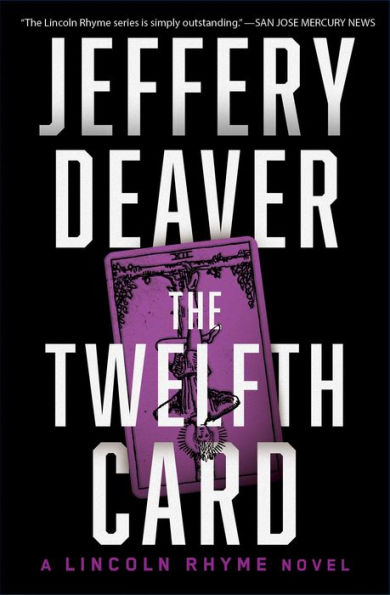
The Twelfth Card is a two-day cat-and-mouse chase through the streets of uptown Manhattan as quadriplegic detective Lincoln Rhyme and Amelia Sachs try to outguess Thompson Boyd -- by all appearances a nondescript, innocuous man, but one whose past has turned him into a killing machine as unfeeling and cunning as a wolf. Boyd is after Geneva Settle, a high school girl from Harlem, and it's up to Lincoln and Amelia to figure out why.
The motive may have to do with a term paper that Geneva is writing about her ancestor, Charles Singleton, a former slave. A teacher and farmer in New York State, Charles was active in the early civil rights movement but was arrested for theft and disgraced. Assisted by their team, Fred Dellray, Mel Cooper and Lon Sellitto (suffering badly from a case of nerves due to a near miss by the killer), Lincoln and Amelia work frantically to figure out where the hired gun will strike next and stop him, all the while trying to determine what actually happened on that hot July night in 1868 when Charles was arrested. What went on at the mysterious meetings he attended in Gallows Heights, a neighborhood on the Upper West Side of Manhattan that was a tense mix of wealthy financiers, political crooks like Boss Tweed and working-class laborers and thugs? And, most important for Geneva Settle's fate, what was the "secret" that tormented Charles's every waking hour?
Deaver's inimitable plotting keeps all these stories -- the past and the present -- racing at a lightning-fast clip as we learn stunning revelations that strike at the very heart of the U.S. Constitution and that could have disastrous consequences for today's human and civil rights in America. With breathtaking twists and multiple surprises that will keep readers on tenterhooks until the last page, this is Deaver's most compelling Lincoln Rhyme book to date.
Tuesday, October 9
His face wet with sweat and with tears, the man runs for freedom, he runs for his life.
"There! There he goes!"
The former slave does not know exactly where the voice comes from. Behind him? To the right or left? From atop one of the decrepit tenements lining the filthy cobblestoned streets here?
Amid July air hot and thick as liquid paraffin, the lean man leaps over a pile of horse dung. The street sweepers don't come here, to this part of the city. Charles Singleton pauses beside a pallet stacked high with barrels, trying to catch his breath.
A crack of a pistol. The bullet goes wide. The sharp report of the gun takes him back instantly to the war: the impossible, mad hours as he stood his ground in a dusty blue uniform, steadying a heavy musket, facing men wearing dusty gray, aiming their own weapons his way.
Running faster now. The men fire again. These bullets also miss.
"Somebody stop him! Five dollars' gold if you catch him."
But the few people out on the streets this early -- mostly Irish ragpickers and laborers trooping to work with hods or picks on their shoulders -- have no inclination to stop the Negro, who has fierce eyes and large muscles and such frightening determination. As for the reward, the shouted offer came from a city constable, which means there's no coin behind the promise.
At the Twenty-third Street paintworks, Charles veers west. He slips on the slick cobblestones and falls hard. A mounted policeman rounds the corner and, raising his nightstick, bears down on the fallen man. And then --
And? the girl thought.
And?
What happened to him?
Sixteen-year-old Geneva Settle twisted the knob on the microfiche reader again but it would move no farther; she'd come to the last page on this carriage. She lifted out the metal rectangle containing the lead article in the July 23, 1868, edition of Coloreds' Weekly Illustrated. Riffling through the other frames in the dusty box, she worried that the remaining pages of the article were missing and she'd never find out what happened to her ancestor Charles Singleton. She'd learned that historical archives regarding black history were often incomplete, if not forever misplaced.
Where was the rest of the story?
Ah...Finally she found it and mounted the carriage carefully into the battered gray reader, moving the knob impatiently to locate the continuation of the story of Charles's flight.
Geneva's lush imagination -- and years of immersing herself in books -- had given her the wherewithal to embellish the bare-bones magazine account of the former slave's pursuit through the hot, foul streets of nineteenth-century New York. She almost felt she was back there, rather than where she really was at the moment: nearly 140 years later in the deserted fifth-floor library of the Museum of African-American Culture and History on Fifty-fifth Street in Midtown Manhattan.
As she twisted the dial, the pages streamed past on the grainy screen. Geneva found the rest of the article, which was headlined:
THE ACCOUNT OF A FREEDMAN'S CRIME
CHARLES SINGLETON, A VETERAN OF THE WAR
BETWEEN THE STATES, BETRAYS THE CAUSE
OF OUR PEOPLE IN A NOTORIOUS INCIDENT
A picture accompanying the article showed twenty-eight-year-old Charles Singleton in his Civil War uniform. He was tall, his hands were large and the tight fit of the uniform on his chest and arms suggested powerful muscles. Lips broad, cheekbones high, head round, skin quite dark.
Staring at the unsmiling face, the calm, piercing eyes, the girl believed there was a resemblance between them -- she had the head and face of her ancestor, the roundness of his features, the rich shade of his skin. Not a bit of the Singleton physique, though. Geneva Settle was skinny as a grade-school boy, as the Delano Project girls loved to point out.
She began to read once more, but a noise intruded.
A click in the room. A door latch? Then she heard footsteps. They paused. Another step. Finally silence. She glanced behind her, saw nobody.
She felt a chill, but told herself not to be freaked. It was just bad memories that put her on edge: the Delano girls whaling on her in the school yard behind Langston Hughes High, and that time Tonya Brown and her crew from the St. Nicholas Houses dragged her into an alley then pounded her so bad that she lost a back tooth. Boys groped, boys dissed, boys put you down. But it was the girls who made you bleed.
Get her down, cut her, cut the bitch...
More footsteps. Another pause.
Silence.
The nature of this place didn't help. Dim, musty, quiet. And there was no one else here, not at eight-fifteen on a Tuesday morning. The museum wasn't open yet -- tourists were still asleep or having their breakfasts -- but the library opened at eight. Geneva had been waiting here when they unlocked the doors, she'd been so eager to read the article. She now sat in a cubicle at the end of a large exhibit hall, where faceless mannequins wore nineteenth-century costumes and the walls were filled with paintings of men in bizarre hats, women in bonnets and horses with wack, skinny legs.
Another footstep. Then another pause.
Should she leave? Go hang with Dr. Barry, the librarian, until this creepy dude left?
And then the other visitor laughed.
Not a weird laugh, a fun laugh.
And he said, "Okay. I'll call you later."
A snap of a cell phone folding up. That's why he'd been pausing, just listening to the person on the other end of the line.
Told you not to worry, girl. People aren't dangerous when they laugh. They aren't dangerous when they say friendly things on cell phones. He'd been walking slowly because that's what people do when they're talking -- even though what kind of rude claimer'd make a phone call in a library? Geneva turned back to the microfiche screen, wondering, You get away, Charles? Man, I hope so.
Yet he regained his footing and, rather than own up to his mischief, as a courageous man would do, continued his cowardly flight.
So much for objective reporting, she thought angrily.
For a time he evaded his pursuers. But escape was merely temporary. A Negro tradesman on a porch saw the freedman and implored him to stop, in the name of justice, asserting that he had heard of Mr. Singleton's crime and reproaching him for bringing dishonor upon all colored people throughout the nation. The citizen, one Walker Loakes, thereupon flung a brick at Mr. Singleton with the intent of knocking him down. However,
Charles dodges the heavy stone and turns to the man, shouting, "I am innocent. I did not do what the police say!"
Geneva's imagination had taken over and, inspired by the text, was writing the story once again.
But Loakes ignores the freedman's protests and runs into the street, calling to the police that the fugitive is headed for the docks.
His heart torn, his thoughts clinging to the image of Violet and their son, Joshua, the former slave continues his desperate run for freedom.
Sprinting, sprinting...
Behind him comes the gallop of mounted police. Ahead of him, other horsemen appear, led by a helmeted police officer brandishing a pistol. "Halt, halt where you are, Charles Singleton! I am Detective Captain William Simms. I've been searching for you for two days."
The freedman does as ordered. His broad shoulders slump, strong arms at his sides, chest heaving as he sucks in the humid, rancid air beside the Hudson River. Nearby is the tow boat office, and up and down the river he sees the spindles of sailing ship masts, hundreds of them, taunting him with their promise of freedom. He leans, gasping, against the large Swiftsure Express Company sign. Charles stares at the approaching officer as the clop, clop, clop of his horse's hooves resonate loudly on the cobblestones.
"Charles Singleton, you are under arrest for burglary. You will surrender to us or we will subdue you. Either way you will end up in shackles. Pick the first and you will suffer no pain. Pick the second, you will end up bloody. The choice is yours."
"I have been accused of a crime I did not commit!"
"I repeat: Surrender or die. Those are your only choices."
"No, sir, I have one other," Charles shouts. He resumes his flight -- toward the dock.
"Stop or we will shoot!" Detective Simms calls.
But the freedman bounds over the railing of the pier like a horse taking a picket in a charge. He seems to hang in the air for a moment then cartwheels thirty feet into the murky waters of the Hudson River, muttering some words, perhaps a plea to Jesus, perhaps a declaration of love for his wife and child, though whatever they might be none of his pursuers can hear.
Fifty feet from the microfiche reader forty-one-year-old Thompson Boyd moved closer to the girl.
He pulled the stocking cap over his face, adjusted the eyeholes and opened the cylinder of his pistol to make sure it wasn't jammed. He'd checked it earlier but, in this job, you could never be too certain. He put the gun into his pocket and pulled the billy club out of a slit cut into his dark raincoat.
He was in the stacks of books in the costume exhibit hall, which separated him from the microfiche-reader tables. His latex-gloved fingers pressed his eyes, which had been stinging particularly sharply this morning. He blinked from the pain.
He looked around again, making sure the room was in fact deserted.
No guards were here, none downstairs either. No security cameras or sign-in sheets. All good. But there were some logistical problems. The big room was deathly quiet, and Thompson couldn't hide his approach to the girl. She'd know someone was in the room with her and might become edgy and alert.
So after he'd stepped inside this wing of the library and locked the door behind him, he'd laughed, a chuckle. Thompson Boyd had stopped laughing years ago. But he was also a craftsman who understood the power of humor -- and how to use it to your advantage in this line of work. A laugh -- coupled with a farewell pleasantry and a closing cell phone -- would put her at ease, he reckoned.
This ploy seemed to work. He looked quickly around the long row of shelves and saw the girl, staring at the microfiche screen. Her hands, at her sides, seemed to clench and unclench nervously at what she was reading.
He started forward.
Then stopped. The girl was pushing away from the table. He heard her chair slide on the linoleum. She was walking somewhere. Leaving? No. He heard the sound of the drinking fountain and her gulping some water. Then he heard her pulling books off the shelf and stacking them up on the microfiche table. Another pause and she returned to the stacks once again, gathering more books. The thud as she set them down. Finally he heard the screech of her chair as she sat once more. Then silence.
Thompson looked again. She was back in her chair, reading one of the dozen books piled in front of her.
With the bag containing the condoms, razor knife and duct tape in his left hand, the club in his right, he started toward her again.
Coming up behind her now, twenty feet, fifteen, holding his breath.
Ten feet. Even if she bolted now, he could lunge forward and get her -- break a knee or stun her with a blow to the head.
Eight feet, five...
He paused and silently set the rape pack on a shelf. He took the club in both hands. He stepped closer, lifting the varnished oak rod.
Still absorbed in the words, she read intently, oblivious to the fact that her attacker was an arm's length behind her. Thompson swung the club downward with all his strength toward the top of the girl's stocking cap.
Crack...
A painful vibration stung his hands as the baton struck her head with a hollow snap.
But something was wrong. The sound, the feel were off. What was going on?
Thompson Boyd leapt back as the body fell to the floor.
And tumbled into pieces.
The torso of the mannequin fell one way. The head another. Thompson stared for a moment. He glanced to his side and saw a ball gown draped over the bottom half of the same mannequin -- part of a display on women's clothing in Reconstruction America.
No...
Somehow, she'd tipped to the fact that he was a threat. She'd then collected some books from the shelves as a cover for standing up and taking apart a mannequin. She'd dressed the upper part of it in her own sweatshirt and stocking cap then propped it on the chair.
But where was she?
The slap of racing feet answered the question. Thompson Boyd heard her sprinting for the fire door. The man slipped the billy club into his coat, pulled out his gun and started after her.
Copyright © 2005 by Jeffery Deaver
Tuesday, October 9
His face wet with sweat and with tears, the man runs for freedom, he runs for his life.
"There! There he goes!"
The former slave does not know exactly where the voice comes from. Behind him? To the right or left? From atop one of the decrepit tenements lining the filthy cobblestoned streets here?
Amid July air hot and thick as liquid paraffin, the lean man leaps over a pile of horse dung. The street sweepers don't come here, to this part of the city. Charles Singleton pauses beside a pallet stacked high with barrels, trying to catch his breath.
A crack of a pistol. The bullet goes wide. The sharp report of the gun takes him back instantly to the war: the impossible, mad hours as he stood his ground in a dusty blue uniform, steadying a heavy musket, facing men wearing dusty gray, aiming their own weapons his way.
Running faster now. The men fire again. These bullets also miss.
"Somebody stop him! Five dollars' gold if you catch him."
But the few people out on the streets this early -- mostly Irish ragpickers and laborers trooping to work with hods or picks on their shoulders -- have no inclination to stop the Negro, who has fierce eyes and large muscles and such frightening determination. As for the reward, the shouted offer came from a city constable, which means there's no coin behind the promise.
At the Twenty-third Street paintworks, Charles veers west. He slips on the slick cobblestones and falls hard. A mounted policeman rounds the corner and, raising his nightstick, bears down on the fallen man. And then --
And? the girl thought.
And?
Whathappened to him?
Sixteen-year-old Geneva Settle twisted the knob on the microfiche reader again but it would move no farther; she'd come to the last page on this carriage. She lifted out the metal rectangle containing the lead article in the July 23, 1868, edition of Coloreds' Weekly Illustrated. Riffling through the other frames in the dusty box, she worried that the remaining pages of the article were missing and she'd never find out what happened to her ancestor Charles Singleton. She'd learned that historical archives regarding black history were often incomplete, if not forever misplaced.
Where was the rest of the story?
Ah...Finally she found it and mounted the carriage carefully into the battered gray reader, moving the knob impatiently to locate the continuation of the story of Charles's flight.
Geneva's lush imagination -- and years of immersing herself in books -- had given her the wherewithal to embellish the bare-bones magazine account of the former slave's pursuit through the hot, foul streets of nineteenth-century New York. She almost felt she was back there, rather than where she really was at the moment: nearly 140 years later in the deserted fifth-floor library of the Museum of African-American Culture and History on Fifty-fifth Street in Midtown Manhattan.
As she twisted the dial, the pages streamed past on the grainy screen. Geneva found the rest of the article, which was headlined:
ShameTHE ACCOUNT OF A FREEDMAN'S CRIME
CHARLES SINGLETON, A VETERAN OF THE WAR
BETWEEN THE STATES, BETRAYS THE CAUSE
OF OUR PEOPLE IN A NOTORIOUS INCIDENT
A picture accompanying the article showed twenty-eight-year-old Charles Singleton in his Civil War uniform. He was tall, his hands were large and the tight fit of the uniform on his chest and arms suggested powerful muscles. Lips broad, cheekbones high, head round, skin quite dark.
Staring at the unsmiling face, the calm, piercing eyes, the girl believed there was a resemblance between them -- she had the head and face of her ancestor, the roundness of his features, the rich shade of his skin. Not a bit of the Singleton physique, though. Geneva Settle was skinny as a grade-school boy, as the Delano Project girls loved to point out.
She began to read once more, but a noise intruded.
A click in the room. A door latch? Then she heard footsteps. They paused. Another step. Finally silence. She glanced behind her, saw nobody.
She felt a chill, but told herself not to be freaked. It was just bad memories that put her on edge: the Delano girls whaling on her in the school yard behind Langston Hughes High, and that time Tonya Brown and her crew from the St. Nicholas Houses dragged her into an alley then pounded her so bad that she lost a back tooth. Boys groped, boys dissed, boys put you down. But it was the girls who made you bleed.
Get her down, cut her, cut the bitch...
More footsteps. Another pause.
Silence.
The nature of this place didn't help. Dim, musty, quiet. And there was no one else here, not at eight-fifteen on a Tuesday morning. The museum wasn't open yet -- tourists were still asleep or having their breakfasts -- but the library opened at eight. Geneva had been waiting here when they unlocked the doors, she'd been so eager to read the article. She now sat in a cubicle at the end of a large exhibit hall, where faceless mannequins wore nineteenth-century costumes and the walls were filled with paintings of men in bizarre hats, women in bonnets and horses with wack, skinny legs.
Another footstep. Then another pause.
Should she leave? Go hang with Dr. Barry, the librarian, until this creepy dude left?
And then the other visitor laughed.
Not a weird laugh, a fun laugh.
And he said, "Okay. I'll call you later."
A snap of a cell phone folding up. That's why he'd been pausing, just listening to the person on the other end of the line.
Told you not to worry, girl. People aren't dangerous when they laugh. They aren't dangerous when they say friendly things on cell phones. He'd been walking slowly because that's what people do when they're talking -- even though what kind of rude claimer'd make a phone call in a library? Geneva turned back to the microfiche screen, wondering, You get away, Charles? Man, I hope so.
Yet he regained his footing and, rather than own up to his mischief, as a courageous man would do, continued his cowardly flight.
So much for objective reporting, she thought angrily.
For a time he evaded his pursuers. But escape was merely temporary. A Negro tradesman on a porch saw the freedman and implored him to stop, in the name of justice, asserting that he had heard of Mr. Singleton's crime and reproaching him for bringing dishonor upon all colored people throughout the nation. The citizen, one Walker Loakes, thereupon flung a brick at Mr. Singleton with the intent of knocking him down. However,
Charles dodges the heavy stone and turns to the man, shouting, "I am innocent. I did not do what the police say!"
Geneva's imagination had taken over and, inspired by the text, was writing the story once again.
But Loakes ignores the freedman's protests and runs into the street, calling to the police that the fugitive is headed for the docks.
His heart torn, his thoughts clinging to the image of Violet and their son, Joshua, the former slave continues his desperate run for freedom.
Sprinting, sprinting...
Behind him comes the gallop of mounted police. Ahead of him, other horsemen appear, led by a helmeted police officer brandishing a pistol. "Halt, halt where you are, Charles Singleton! I am Detective Captain William Simms. I've been searching for you for two days."
The freedman does as ordered. His broad shoulders slump, strong arms at his sides, chest heaving as he sucks in the humid, rancid air beside the Hudson River. Nearby is the tow boat office, and up and down the river he sees the spindles of sailing ship masts, hundreds of them, taunting him with their promise of freedom. He leans, gasping, against the large Swiftsure Express Company sign. Charles stares at the approaching officer as the clop, clop, clop of his horse's hooves resonate loudly on the cobblestones.
"Charles Singleton, you are under arrest for burglary. You will surrender to us or we will subdue you. Either way you will end up in shackles. Pick the first and you will suffer no pain. Pick the second, you will end up bloody. The choice is yours."
"I have been accused of a crime I did not commit!"
"I repeat: Surrender or die. Those are your only choices."
"No, sir, I have one other," Charles shouts. He resumes his flight -- toward the dock.
"Stop or we will shoot!" Detective Simms calls.
But the freedman bounds over the railing of the pier like a horse taking a picket in a charge. He seems to hang in the air for a moment then cartwheels thirty feet into the murky waters of the Hudson River, muttering some words, perhaps a plea to Jesus, perhaps a declaration of love for his wife and child, though whatever they might be none of his pursuers can hear.
Fifty feet from the microfiche reader forty-one-year-old Thompson Boyd moved closer to the girl.
He pulled the stocking cap over his face, adjusted the eyeholes and opened the cylinder of his pistol to make sure it wasn't jammed. He'd checked it earlier but, in this job, you could never be too certain. He put the gun into his pocket and pulled the billy club out of a slit cut into his dark raincoat.
He was in the stacks of books in the costume exhibit hall, which separated him from the microfiche-reader tables. His latex-gloved fingers pressed his eyes, which had been stinging particularly sharply this morning. He blinked from the pain.
He looked around again, making sure the room was in fact deserted.
No guards were here, none downstairs either. No security cameras or sign-in sheets. All good. But there were some logistical problems. The big room was deathly quiet, and Thompson couldn't hide his approach to the girl. She'd know someone was in the room with her and might become edgy and alert.
So after he'd stepped inside this wing of the library and locked the door behind him, he'd laughed, a chuckle. Thompson Boyd had stopped laughing years ago. But he was also a craftsman who understood the power of humor -- and how to use it to your advantage in this line of work. A laugh -- coupled with a farewell pleasantry and a closing cell phone -- would put her at ease, he reckoned.
This ploy seemed to work. He looked quickly around the long row of shelves and saw the girl, staring at the microfiche screen. Her hands, at her sides, seemed to clench and unclench nervously at what she was reading.
He started forward.
Then stopped. The girl was pushing away from the table. He heard her chair slide on the linoleum. She was walking somewhere. Leaving? No. He heard the sound of the drinking fountain and her gulping some water. Then he heard her pulling books off the shelf and stacking them up on the microfiche table. Another pause and she returned to the stacks once again, gathering more books. The thud as she set them down. Finally he heard the screech of her chair as she sat once more. Then silence.
Thompson looked again. She was back in her chair, reading one of the dozen books piled in front of her.
With the bag containing the condoms, razor knife and duct tape in his left hand, the club in his right, he started toward her again.
Coming up behind her now, twenty feet, fifteen, holding his breath.
Ten feet. Even if she bolted now, he could lunge forward and get her -- break a knee or stun her with a blow to the head.
Eight feet, five...
He paused and silently set the rape pack on a shelf. He took the club in both hands. He stepped closer, lifting the varnished oak rod.
Still absorbed in the words, she read intently, oblivious to the fact that her attacker was an arm's length behind her. Thompson swung the club downward with all his strength toward the top of the girl's stocking cap.
Crack...
A painful vibration stung his hands as the baton struck her head with a hollow snap.
But something was wrong. The sound, the feel were off. What was going on?
Thompson Boyd leapt back as the body fell to the floor.
And tumbled into pieces.
The torso of the mannequin fell one way. The head another. Thompson stared for a moment. He glanced to his side and saw a ball gown draped over the bottom half of the same mannequin -- part of a display on women's clothing in Reconstruction America.
No...
Somehow, she'd tipped to the fact that he was a threat. She'd then collected some books from the shelves as a cover for standing up and taking apart a mannequin. She'd dressed the upper part of it in her own sweatshirt and stocking cap then propped it on the chair.
But where was she?
The slap of racing feet answered the question. Thompson Boyd heard her sprinting for the fire door. The man slipped the billy club into his coat, pulled out his gun and started after her.
Copyright © 2005 by Jeffery Deaver
Admittedly, this is the first Deaver book I have read, muchless a "Rhymes" series book.
I have to make this short. But essentially it was an overall good read. Though predictable in the character's having access to all the necessary agencies and equipment. Not to forget, "arriving just in the nick of time" to thwart the criminal from completing his job.
It was a book and I didn't ever not want to continue reading. It was my "lunch" book and did it's job of taking me away from the office for an hour.
For over the past decade, bestselling mystery writer Jeffery Deaver has astonished readers with the creation of Lincoln Rhyme, the fictional quadriplegic who, throughout the notorious series, has successfully answered the one question lingering from everyone's mind: how can you solve a crime that you cannot see? Throughout the books, fans have become aware of not only the elevated brilliance of the well known criminalist, but also of the love interest that he shares with his partner, Amelia Sachs. Despite of the some of the graphic crime scenes that two have had to encounter behind the yellow police tape, Deaver fails to deliver in THE TWELFTH CARD.
In this sixth series entry, the duo take on a case that they have never took on before; one that has gone cold for 140 years. Throughout the entire case, both Rhyme and Sachs try in their best efforts to protect Geneva Settle, a sixteen-year old Harlem student who nearly gets ambushed by a crazed assassin in the beginning scenes of the book. By digging further into the investigation, Rhyme and Sachs later discover that the ruthless assassin may be after her because of a term paper she is working on regarding Charles Singleton, a former slave and an ancestor of Geneva's. Moreover, they find out that the madman who skulks Geneva leaves his calling card of the Hanged Man, the "twelfth card" in the tarot deck. They also discover that Charles witheld a devastating secret that he found to be too ahamed to reveal. Thoughout the investigation, questions linger through Rhyme and Sachs: Why is this crazed madman on the hunt for innocent blood? What secrets are lied within his calling card? And most important, what type of "secret" would Charles have had been veiling for all this time?
Sad to say, Deaver disappoints his fans in this entry. Throughout the majority of the narration of the book, readers will become exposed with various slang that they will happen to find tedious. Such figures of speech impedes Deaver's main talent in psychological writing. As he did in THE STONE MONKEY, the author yet again fails to deliver what makes this series enjoyable for readers.
A key literary element that seems to torpedo Deaver's attempt lies within the one-dimensional character development of not only Rhyme, but of also the majority of the other remaining characters. Througout the investigation, the interaction of characters made by Rhyme lackes the ecstacy that made the disabled criminalist popular.
Without a doubt, Deaver fans will also get the impression of having their intelligence insulted. Thoughout the book, the author provides a myriad amount of historical detail based on hearsay rather than actual research. Fans will become annoyed by his deversion from the well-known police procedural into a tale of historical uncertainty. Sure enough, readers will realize sooner or later that the details provided in this book was not anything in which they have learned or studied in history class.
THE TWELFTH CARD is yet indeed another disappointing attempt by Deaver. By the lack of character development and research, readers can certainly argue that this churning is actually a publication deadline rather than a piece of literature.
Anonymous
Posted January 4, 2007
I love all of the Lincoln Rhymes books and bought this one eagerly. By the time I'd read a few chapters, though, I was feeling very disappointed. I kept picking the book back up, trying to give it another chance, but finally laid it down and never went back to it (something I simply never do with books). The speech throughout the book was horrendous and tedious, the plot line was nothing but dull, the characters I could not even care about - I don't know what happened with this book, but I really hope Mr. Deaver gets back in the game with his next book. I would not recommend this book to anyone for any reason.
Was this review helpful? Yes NoThank you for your feedback. Report this reviewThank you, this review has been flagged.Anonymous
Posted August 10, 2006
I love Deaver's books...however this book was lacking in a few ways. All in all the character's were likeable and it had the typical feel of a Jeffery Deaver novel. My problem with the book lies in the speach. It really did sound like a white guy trying to sound black...and it didn't work for me. I can't wait for his next book...I truly hope it's better.
Was this review helpful? Yes NoThank you for your feedback. Report this reviewThank you, this review has been flagged.Anonymous
Posted April 26, 2006
The Twelve Card is fraught with twist, all of which you never see coming. Mr. Deaver has a great talent for writing, and is one of the least of writers that actually knows how to hold a reader¿s attention. Though ¿page-turner¿ is used out of context nowadays, The Twelve Card lives up to it.
Was this review helpful? Yes NoThank you for your feedback. Report this reviewThank you, this review has been flagged.Anonymous
Posted January 10, 2006
Love Deaver, love Lincoln Rhyme, but this one was simply too much. Not at all believable. The story was interesting, and it moved well, but some of the stretches the readers are asked to make are just too far.
Was this review helpful? Yes NoThank you for your feedback. Report this reviewThank you, this review has been flagged.Anonymous
Posted September 25, 2005
Being that is was a Lincoln Rhyme story I expected it to be great like his other books. BUt this book just did not make the cut. It had a poor plot line. I couldn't stand the character's. How they talked and how it was just too unreal. The twist weren't good enough to keep me reading. It made it feel like it was a drag to keep reading. I love his other Lincoln Rhyme novels this one i just couldn't stand.
Was this review helpful? Yes NoThank you for your feedback. Report this reviewThank you, this review has been flagged.Anonymous
Posted November 28, 2005
Jeffery Deaver writes another great Lincoln Rhyme novel. This one is about Geneva Settle, a 16 year old black girl who is researching her ancestor, Charles Singleton who lived during the Civil War. He was active in the early Civil Right movement but the newspaper report tells of his arrest for theft. While Geneva is at the Black History Museum looking at the micro fiche tapes, she is attacked by Thompson Boyd. But Geneva is smarter than Boyd. She sets up a mannequin in her place and runs. In steps Lincoln Rhyme and Amelia Sachs to help the police figure out why Geneva is the target of Boyd. Boyd is willing to sacrifice innocents to accomplish what he was hired to do. Who hired him and why? Is he working alone? Why has he become a person who feels nothing? Another problem arises when Lincoln discovers that Geneva¿s parents are fictitious and she is living on her own. She is doing very well in school so no one suspects the real situation. Where are her mom and dad? And, of course, there is always the side of the story where Lincoln¿s paralysis comes in. This time, he is exercising to attempt to create even a small amount of movement. Does all the hard work bring about what Lincoln hopes for? The twists and turns of this story kept me wanting to listen long into the night. The reader, Dennis Boutsikaris, is adept at voice inflections and keeps the reader interested by not becoming monotone. He is clear and precise in his pronunciation of the words and does very well when reading the Black English Vernacular. The Twelfth Card provides historical background on the civil rights movement and how hard life was for the black man. It also tell of what hard work and determination of a teenager can bring about and of Lincoln¿s constant struggle to gain even a little bit of freedom from the paralysis he suffers.
Was this review helpful? Yes NoThank you for your feedback. Report this reviewThank you, this review has been flagged.Anonymous
Posted June 11, 2005
I loved ever single Lincoln Rhyme novel so far, and every Deaver book as well. I can't wait to read it, and if it is like any other book written by Deaver, it will become an instant classic!
0 out of 1 people found this review helpful.
Was this review helpful? Yes NoThank you for your feedback. Report this reviewThank you, this review has been flagged.Anonymous
Posted August 4, 2005
I always look forward to reading the next Lincoln Ryhme novel, and this one kept me guessing at every turn. The character, Geneva Settles, is extremely likeable from the start and you're rooting for her the whole way. She does have some of her own surprises as well that are thrown into the mix well. The ending (g's??) is gratifying and surprising. What will Lincoln be doing in the next book? I can't wait to find out.
Was this review helpful? Yes NoThank you for your feedback. Report this reviewThank you, this review has been flagged.Anonymous
Posted July 6, 2005
good main character developement but secondary characters poorly laid out not real believable a former gangbanger pretends to be a school counselor that would not work in real life the legal action taken would of ended up in court for year and years no bank would give up like that and the villian would not try to kill his prey on a campus with a loud messy shotgun not nearly his best work
Was this review helpful? Yes NoThank you for your feedback. Report this reviewThank you, this review has been flagged.Sixteen years old high school student Geneva Settle is at the Museum of African American Culture early in the morning reading microfilmed copies of Coloreds Weekly Illustrated in the basement. She is interested in researching her ancestor Charles Singleton, a slave who was freed by his master, given a farm, but eventually incarcerated for robbery. Geneva hears a noise and takes off running because she knows it was the click of a gun...................... Thompson Boyd, a killer for hire, was going to murder her and he was using a rape kit as camouflage to disguise how the young woman had to die. Police consultant Lincoln Rhyme, a paraplegic and his lover and partner Amelia Sachs are assigned the case. They hire a security firm to watch over her because she is the target of the killer. Thompson Boyd outwits them at every turn but luck keeps Geneva alive until they catch the hitman. However the person who wants Geneva dead still plans to kill her as she can destroy all he worked so hard to possess.................... THE TWELFTH CARD is an exciting police procedural that centers on a high school student who has survived on her own for two years and has no idea why someone wants her dead. Jeffrey Deaver¿s strength as a writer is his ability to create characters, major and secondary, that readers come to care about. Fans will feel for the policeman who loses his nerve; the hero who fears being tested to see if he regained any feeling in his paralyzed body; and the student who doesn¿t understand why her world is in danger of detonating.......................... Harriet Klausner
Was this review helpful? Yes NoThank you for your feedback. Report this reviewThank you, this review has been flagged.Anonymous
Posted October 4, 2011
No text was provided for this review.
Anonymous
Posted January 20, 2011
No text was provided for this review.
Anonymous
Posted January 10, 2011
No text was provided for this review.
Anonymous
Posted January 13, 2010
No text was provided for this review.
Anonymous
Posted July 16, 2011
No text was provided for this review.
Anonymous
Posted August 21, 2010
No text was provided for this review.
Anonymous
Posted July 13, 2010
No text was provided for this review.
Anonymous
Posted December 20, 2011
No text was provided for this review.
Overview
Bestselling master of suspense Jeffery Deaver is back with a brand-new Lincoln Rhyme thriller. To save the life of a young girl who's being stalked by a ruthless hit man, Lincoln and his protégé, Amelia Sachs, are called upon to do the impossible: solve a truly "cold case" -- one that's 140 years old.
The Twelfth Card is a two-day cat-and-mouse chase through the streets of uptown Manhattan as quadriplegic detective Lincoln Rhyme and Amelia Sachs try to outguess Thompson Boyd -- by all appearances a nondescript, innocuous man, but one whose past has turned him into a killing machine as unfeeling and cunning as a wolf. Boyd is after Geneva Settle, a high ...