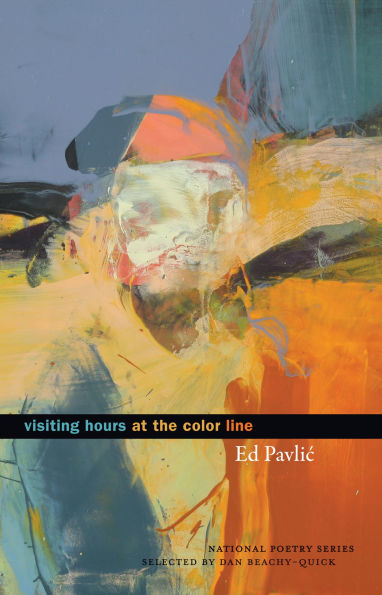
Visiting Hours at the Color Line
“I am incapable of succinctly praising this poet’s immense talent.” —TERRANCE HAYES

Often the most recognized, even brutal, events in American history are segregated by a politicized, racially divided “Color Line.” But how do we privately experience the most troubling features of American civilization? Where is the Color Line in the mind, in the body, between bodies, between human beings?

Selected for the National Poetry Series by Dan Beachy-Quick, Ed Pavlić’s Visiting Hours at the Color Line attempts to complicate this black and white, straight-line feature of our collective imagination, and to map its nonlinear, deeply colored timbres and hues. From daring prose poems to powerful free verse, Pavlić’s lines are musically infused, bearing tones of soul, R & B, and jazz. They link the influence of James Baldwin with a postmodern consciousness descended from Samuel Beckett, tracking the experiences of American characters through situations both mundane and momentous. The resulting poems are intense, ambitious, and psychological, making Visiting Hours at the Color Line a poetic tour de force.
1114110131
Visiting Hours at the Color Line
“I am incapable of succinctly praising this poet’s immense talent.” —TERRANCE HAYES

Often the most recognized, even brutal, events in American history are segregated by a politicized, racially divided “Color Line.” But how do we privately experience the most troubling features of American civilization? Where is the Color Line in the mind, in the body, between bodies, between human beings?

Selected for the National Poetry Series by Dan Beachy-Quick, Ed Pavlić’s Visiting Hours at the Color Line attempts to complicate this black and white, straight-line feature of our collective imagination, and to map its nonlinear, deeply colored timbres and hues. From daring prose poems to powerful free verse, Pavlić’s lines are musically infused, bearing tones of soul, R & B, and jazz. They link the influence of James Baldwin with a postmodern consciousness descended from Samuel Beckett, tracking the experiences of American characters through situations both mundane and momentous. The resulting poems are intense, ambitious, and psychological, making Visiting Hours at the Color Line a poetic tour de force.

16.0 In Stock
Visiting Hours at the Color Line

Visiting Hours at the Color Line

Visiting Hours at the Color Line

Visiting Hours at the Color Line

Paperback

$16.00 
  • SHIP THIS ITEM
    In stock. Ships in 1-2 days.
  • PICK UP IN STORE

    Your local store may have stock of this item.

Related collections and offers


Overview

“I am incapable of succinctly praising this poet’s immense talent.” —TERRANCE HAYES

Often the most recognized, even brutal, events in American history are segregated by a politicized, racially divided “Color Line.” But how do we privately experience the most troubling features of American civilization? Where is the Color Line in the mind, in the body, between bodies, between human beings?

Selected for the National Poetry Series by Dan Beachy-Quick, Ed Pavlić’s Visiting Hours at the Color Line attempts to complicate this black and white, straight-line feature of our collective imagination, and to map its nonlinear, deeply colored timbres and hues. From daring prose poems to powerful free verse, Pavlić’s lines are musically infused, bearing tones of soul, R & B, and jazz. They link the influence of James Baldwin with a postmodern consciousness descended from Samuel Beckett, tracking the experiences of American characters through situations both mundane and momentous. The resulting poems are intense, ambitious, and psychological, making Visiting Hours at the Color Line a poetic tour de force.


Product Details

ISBN-13: 9781571314604
Publisher: Milkweed Editions
Publication date: 07/30/2013
Series: National Poetry Series
Pages: 148
Product dimensions: 5.40(w) x 8.40(h) x 0.50(d)

About the Author

Ed Pavlic has been awarded the Honickman First Book Prize and is a National Poetry Series award winner, in addition to receiving fellowships from the Vermont Studio Center, the MacDowell Colony, Bread Loaf, and the W.E.B. DuBois Institute at Harvard University. He is the author of four previous collections of poems including, Winners Have Yet to be Announced: A Song for Donny Hathaway. He lives in Athens, GA.

Read an Excerpt

VERBATIM

By the time the second tower fell the Humanities lounge had filled up with staff and professors and students. I stood there and stared into the dust on TV. I was suddenly conscious that I’d spent years coaxing what I saw and heard, charting it as it traveled ox bow routes thru me. The dust disappeared the building. As I went thru the doorway, Bill said, “it’s gone.” I left the lounge and walked cross campus, the upstate sky unbroken blue. Kids on the library steps weeping in groups. I’d had a recurring dream where the students and faculty of the college paraded between classes holding their brains in glass jars, suspended in clear fluid. My thought then, “I guess neither approach is much good.” Jackson Garden is back behind the Campus Center. I walk thru the stone gates feeling the towers and the dust and the broken glass of bodies pulse in my arms and legs where I’d coaxed the world to go. I see Thanha Nguyen, an exchange fellow in Modern Languages. When we met she’d told me that she grew up in Hanoi during the American War.


ii

Last Spring, we read Dien Cai Dau in my seminar. I’d invited Ms. Nguyen to attend the class. I bought her a copy of the book and got Yusef to sign it for her. Her English wasn’t great. She said it was hard for her to read in English when she missed her children like she did. I asked. A boy and a girl, 9 and 13. She read the book and came to class. She didn’t say much. She turned to the poem “Tunnels” and told us that her school had been moved to a village outside Hanoi because of the bombings and that, for the first term, the teachers had worked with the students to dig tunnels like the ones in the poem. They were told to hide in the tunnels when they heard the sirens from the city. She said, after a few weeks, the tunnels filled with water and rats lived in them and none of the students would go in. Instead, they stood there around the opening to the tunnel listening to the sirens wishing the rain would stop. That’s what she said. And, she turned to the poem “Prisoners” and asked if this writer was for or against the war. She asked why he wanted to bow to the enemy. I explained that the book’s not really about enemies. It’s about kinds of power and how they interact. Military, cultural, ancestral, erotic, psychological, masculine, feminine. I could tell she wasn’t really listening. I pictured her standing in the rain. I stopped. She said, why did he want to bow to the enemy?


iii

By the time I entered the garden I’d concluded that only a real fool would coax this fucking world into his body like I have. Naïve. My legs feel like they were sketched in pencil and then, mistaken, worked over with a wide eraser. I walk up to Ms. Nguyen and say hello. I can’t decide if the burnt rubber smell is from the city or the scatter of tiny, hot twirls of the eraser burning my legs. She’s staring into flowerbeds that bristle and hum with bees in the perfect sun. She : how are you? I ask if she’d heard. Heard? I say terrorists attacked New York City. Terrible. Could be ten thousand dead. No one knows. Ms. Nguyen’s eyes turn to mine, she hands me her camera, “would you take my photo with these flowers?”


VISITING HOURS AT THE COLOR LINE

These Stateville phones won’t speak the words.
The night we slept together


in your cold furnace
of a project bedroom. Place so full of faces,
we drew circles around each


other. Love. Anger


thick as smoke from James Sr.’s chalk-faced


wife.
Her white sons down
the hall. Their metal gong in the air.


Your older brothers? I’m rolling thunder,
fire and rain. When it comes
to evil,


I’m a hurricane.
Sugarbear
in diapers with sand hair and ash legs.
Pre-Desert Storm Anthony


still had legs and ran low and
studied his French in a green


haze. Still sent us on dollar-a-joint runs
to 301 Building
B. This glass is bullet


proof.
You toss your head : “the white witch
of the north.”


We don’t talk about that first
frozen night on fire
with Sugarbear’s baby blanket. A smoke ring


curls in the empty air, I see her
lip-line draw up and I didn’t want to hear it


cock-suckers then and I don’t want to remember it now

Table of Contents

Verbatim 3

1 All American Erotica: A .38 Slug in My Vocal Chords and the One That Got Away 9

Flight 577 : Atlanta to Chicago : Seat 27 F 16

Waking Up in Chicago after Dream Song 29 19

Furlough Blues Sketchpad and My Abortive Stab at a Second Career in Interrogation and a Third at What I Get for Asking 22

Verbatim II 27

2 Written in Oakland, Written Down 35

Bright Blindness October 8, 1871 : A Chant 37

"Out" : June 11, 2011 2:24 a.m.-A Translation in Approaching Sonnets 44

Call It in the Air 47

And, But And : Decaying Sonnets 50

Freeze 53

Verbatim III 57

3 Basso Ostinato 65

Soul Music and Firearms and the Blue Light on My Stoop That's S'posed to Cool Motherfuckers Out but Maybe It Doesn't Work 77

63rd Street Station and / or a Quiz : Pronounce the Word Spelled : Close 81

Give and Go Gave and Gone 87

It's a Dream Wherein Finally-and by that I mean right away, which is to say, just in time-I Understand Circular Breathing 89

Verbatim IV 93

4 Visiting Hours at the Color Line 99

Ornette Coleman's Out-of-Office Reply 109

From : Arachnida Speak 113

Alibis for the Heavy Part of Rain That Stays in the Sky 116

Verbatim V: You Two Talk or In Flew Itity: Epilogue 121

Notes 141

From the B&N Reads Blog

Customer Reviews