
The purpose of this monograph is to offer an accessible and essentially self-contained presentation of some mathematical aspects of the Feynman path integral in non-relativistic quantum mechanics. In spite of the primary role in the advancement of modern theoretical physics and the wide range of applications, path integrals are still a source of challenging problem for mathematicians. From this viewpoint, path integrals can be roughly described in terms of approximation formulas for an operator (usually the propagator of a Schrödinger-type evolution equation) involving a suitably designed sequence of operators.
In keeping with the spirit of harmonic analysis, the guiding theme of the book is to illustrate how the powerful techniques of time-frequency analysis - based on the decomposition of functions and operators in terms of the so-called Gabor wave packets – can be successfully applied to mathematical path integrals, leading to remarkable results and paving the wayto a fruitful interaction.
This monograph intends to build a bridge between the communities of people working in time-frequency analysis and mathematical/theoretical physics, and to provide an exposition of the present novel approach along with its basic toolkit. Having in mind a researcher or a Ph.D. student as reader, we collected in Part I the necessary background, in the most suitable form for our purposes, following a smooth pedagogical pattern. Then Part II covers the analysis of path integrals, reflecting the topics addressed in the research activity of the authors in the last years.
1141347419
In keeping with the spirit of harmonic analysis, the guiding theme of the book is to illustrate how the powerful techniques of time-frequency analysis - based on the decomposition of functions and operators in terms of the so-called Gabor wave packets – can be successfully applied to mathematical path integrals, leading to remarkable results and paving the wayto a fruitful interaction.
This monograph intends to build a bridge between the communities of people working in time-frequency analysis and mathematical/theoretical physics, and to provide an exposition of the present novel approach along with its basic toolkit. Having in mind a researcher or a Ph.D. student as reader, we collected in Part I the necessary background, in the most suitable form for our purposes, following a smooth pedagogical pattern. Then Part II covers the analysis of path integrals, reflecting the topics addressed in the research activity of the authors in the last years.
Wave Packet Analysis of Feynman Path Integrals
The purpose of this monograph is to offer an accessible and essentially self-contained presentation of some mathematical aspects of the Feynman path integral in non-relativistic quantum mechanics. In spite of the primary role in the advancement of modern theoretical physics and the wide range of applications, path integrals are still a source of challenging problem for mathematicians. From this viewpoint, path integrals can be roughly described in terms of approximation formulas for an operator (usually the propagator of a Schrödinger-type evolution equation) involving a suitably designed sequence of operators.
In keeping with the spirit of harmonic analysis, the guiding theme of the book is to illustrate how the powerful techniques of time-frequency analysis - based on the decomposition of functions and operators in terms of the so-called Gabor wave packets – can be successfully applied to mathematical path integrals, leading to remarkable results and paving the wayto a fruitful interaction.
This monograph intends to build a bridge between the communities of people working in time-frequency analysis and mathematical/theoretical physics, and to provide an exposition of the present novel approach along with its basic toolkit. Having in mind a researcher or a Ph.D. student as reader, we collected in Part I the necessary background, in the most suitable form for our purposes, following a smooth pedagogical pattern. Then Part II covers the analysis of path integrals, reflecting the topics addressed in the research activity of the authors in the last years.
In keeping with the spirit of harmonic analysis, the guiding theme of the book is to illustrate how the powerful techniques of time-frequency analysis - based on the decomposition of functions and operators in terms of the so-called Gabor wave packets – can be successfully applied to mathematical path integrals, leading to remarkable results and paving the wayto a fruitful interaction.
This monograph intends to build a bridge between the communities of people working in time-frequency analysis and mathematical/theoretical physics, and to provide an exposition of the present novel approach along with its basic toolkit. Having in mind a researcher or a Ph.D. student as reader, we collected in Part I the necessary background, in the most suitable form for our purposes, following a smooth pedagogical pattern. Then Part II covers the analysis of path integrals, reflecting the topics addressed in the research activity of the authors in the last years.
69.99
In Stock
5
1

Wave Packet Analysis of Feynman Path Integrals
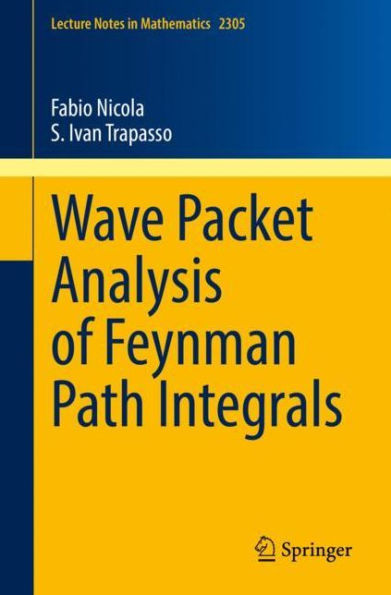
Wave Packet Analysis of Feynman Path Integrals
eBook (1st ed. 2022)
$69.99
Related collections and offers
69.99
In Stock

Product Details
| ISBN-13: | 9783031061868 |
|---|---|
| Publisher: | Springer-Verlag New York, LLC |
| Publication date: | 07/28/2022 |
| Series: | Lecture Notes in Mathematics , #2305 |
| Sold by: | Barnes & Noble |
| Format: | eBook |
| File size: | 16 MB |
| Note: | This product may take a few minutes to download. |
About the Author
From the B&N Reads Blog