
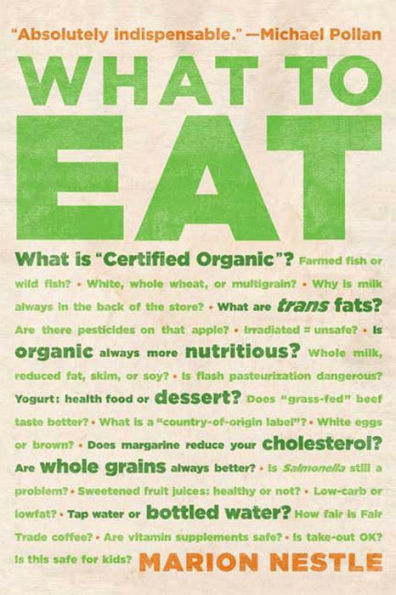
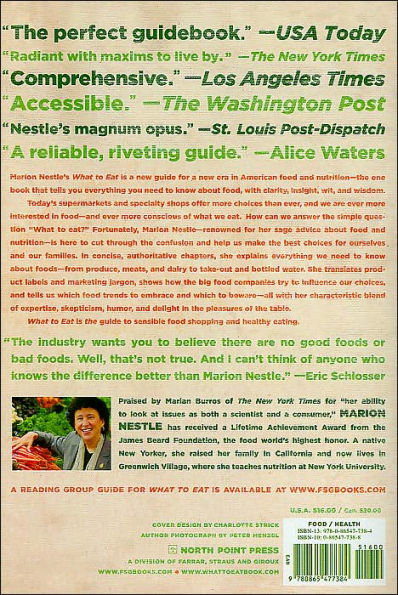
Since its publication in 2006, Marion Nestle's What to Eat has become the definitive guide to making healthy and informed choices about food. Praised as "radiant with maxims to live by" in The New York Times Book Review and "accessible, reliable and comprehensive" in The Washington Post, What to Eat is an indispensable resource, packed with important information and useful advice from the acclaimed nutritionist who "has become to the food industry what . . . Ralph Nader [was] to the automobile industry" (St. Louis Post-Dispatch).
How we choose which foods to eat is growing more complicated by the day, and the straightforward, practical approach of What to Eat has been praised as welcome relief. As Nestle takes us through each supermarket section—produce, dairy, meat, fish—she explains the issues, cutting through foodie jargon and complicated nutrition labels, and debunking the misleading health claims made by big food companies. With Nestle as our guide, we are shown how to make wise food choices—and are inspired to eat sensibly and nutritiously.
Since its publication in 2006, Marion Nestle's What to Eat has become the definitive guide to making healthy and informed choices about food. Praised as "radiant with maxims to live by" in The New York Times Book Review and "accessible, reliable and comprehensive" in The Washington Post, What to Eat is an indispensable resource, packed with important information and useful advice from the acclaimed nutritionist who "has become to the food industry what . . . Ralph Nader [was] to the automobile industry" (St. Louis Post-Dispatch).
How we choose which foods to eat is growing more complicated by the day, and the straightforward, practical approach of What to Eat has been praised as welcome relief. As Nestle takes us through each supermarket section—produce, dairy, meat, fish—she explains the issues, cutting through foodie jargon and complicated nutrition labels, and debunking the misleading health claims made by big food companies. With Nestle as our guide, we are shown how to make wise food choices—and are inspired to eat sensibly and nutritiously.


Paperback(First Edition)
-
SHIP THIS ITEMIn stock. Ships in 1-2 days.PICK UP IN STORE
Your local store may have stock of this item.
Available within 2 business hours
Related collections and offers
Overview
Since its publication in 2006, Marion Nestle's What to Eat has become the definitive guide to making healthy and informed choices about food. Praised as "radiant with maxims to live by" in The New York Times Book Review and "accessible, reliable and comprehensive" in The Washington Post, What to Eat is an indispensable resource, packed with important information and useful advice from the acclaimed nutritionist who "has become to the food industry what . . . Ralph Nader [was] to the automobile industry" (St. Louis Post-Dispatch).
How we choose which foods to eat is growing more complicated by the day, and the straightforward, practical approach of What to Eat has been praised as welcome relief. As Nestle takes us through each supermarket section—produce, dairy, meat, fish—she explains the issues, cutting through foodie jargon and complicated nutrition labels, and debunking the misleading health claims made by big food companies. With Nestle as our guide, we are shown how to make wise food choices—and are inspired to eat sensibly and nutritiously.

Product Details
| ISBN-13: | 9780865477384 |
|---|---|
| Publisher: | Farrar, Straus and Giroux |
| Publication date: | 04/17/2007 |
| Edition description: | First Edition |
| Pages: | 624 |
| Product dimensions: | 5.90(w) x 8.90(h) x 1.10(d) |
About the Author
Nestle lectures worldwide and was featured in the movie Super Size Me. A native New Yorker, she raised her family in California and now lives in Greenwich Village.
Read an Excerpt
What To Eat
THE PRODUCE SECTION
1
The Supermarket: Prime Real Estate
A visit to a large supermarket can be a daunting experience: so many aisles, so many brands and varieties, so many prices to keep track of and labels to read, so many choices to make. No wonder. To repeat: An astonishing 320,000 edible products are for sale in the United States, and any large supermarket might display as many as 40,000 of them. You are supposed to feel daunted—bewildered by all the choices and forced to wander through the aisles in search of the items you came to buy. The big companies that own most supermarkets want you to do as much searching as you can tolerate. It is no coincidence that one supermarket is laid out much like another: breathtaking amounts of research have gone into designing these places. There are precise reasons why milk is at the back of the store and the center aisles are so long. You are forced to go past thousands of other products on your way to get what you need.
Supermarkets say they are in the business of offering "choice." Perhaps, but they do everything possible to make the choice theirs, not yours. Supermarkets are not social service agencies providing food for the hungry. Their job is to sell food, and more of it. From their perspective, it is your problem if what you buy makes you eat more food than you need, and more of the wrong kinds of foods in particular.
And supermarket retailers know more than you could possibly imagine about how to push your "buy" buttons. Half a century ago, Vance Packard revealed their secrets in his book The Hidden Persuaders. His most shocking revelation? Corporations were hiring social scientists to study unconscious human emotions, not for the good of humanity but to help companies manipulate people into buying products. Packard's chapter on supermarket shopping, "Babes in Consumerland," is as good a guide as anything that has been written since to methods for getting you—and your children—to "reach out, hypnotically ... and grab boxes of cookies, candies, dog food, and everything else that delights or interests [you]."
At the supermarket, you exercise freedom of choice and personal responsibility every time you put an item in your shopping cart, but massive efforts have gone into making it more convenient and desirable for you to choose some products rather than others.
More recent research on consumer behavior not only confirms his observations but continues to be awe-inspiring in its meticulous attention to detail. Your local library has entire textbooks and academic journals devoted to investigations of consumer behavior and ways to use the results of that research to sell products. Researchers are constantly interviewing shoppers and listening carefully to what they are told. Because of scanners, supermarkets can now track your purchases and compare what you tell researchers to what you actually buy. If you belong to a supermarket discount "shoppers club," the store gains your loyalty but gets to track your personal buying habits in exchange. This research tells food retailers how to lay out the stores, where to put specific products, how to position products on shelves, and how to set prices and advertise products. At the supermarket, you exercise freedom of choice and personal responsibility every time you put an item in your shopping cart, but massive efforts have gone into making it more convenient and desirable for you to choose some products rather than others.
As basic marketing textbooks explain, the object of the game is to "maximize sales and profit consistent with customer convenience." Translated, this means that supermarkets want to expose you to the largest possible number of items that you can stand to see, without annoying you somuch that you run screaming from the store. This strategy is based on research proving that "the rate of exposure is directly related to the rate of sale of merchandise." In other words, the more you see, the more you buy. Supermarkets dearly wish they could expose you to every single item they carry, every time you shop. Terrific as that might be for your walking regimen, you are unlikely to endure having to trek through interminable aisles to find the few items you came in for—and retailers know it. This conflict creates a serious dilemma for the stores. They have to figure out how to get you to walk up and down those aisles for as long as possible, but not so long that you get frustrated. To resolve the dilemma, the stores make some compromises—but as few as possible. Overall, supermarket design follows fundamental rules, all of them based firmly on extensive research.
• Place the highest-selling food departments in the parts of the store that get the greatest flow of traffic—the periphery. Perishables—meat, produce, dairy, and frozen foods—generate the most sales, so put them against the back and side walls.
• Use the aisle nearest the entrance for items that sell especially well on impulse or look or smell enticing—produce, flowers, or freshly baked bread, for example. These must be the first things customers see in front or immediately to the left or right (the direction, according to researchers, doesn't matter).
• Use displays at the ends of aisles for high-profit, heavily advertised items likely to be bought on impulse.
• Place high-profit, center-aisle food items sixty inches above the floor where they are easily seen by adults, with or without eyeglasses.
• Devote as much shelf space as possible to brands that generate frequent sales; the more shelf space they occupy, the better they sell.
• Place store brands immediately to the right of those high-traffic items (people read from left to right), so that the name brands attract shoppers to the store brands too.
• Avoid using "islands." These make people bump into each other and want to move on. Keep the traffic moving, but slowly.
• Do not create gaps in the aisles that allow customers to cross over to the next one unless the aisles are so long that shoppers complain. If shoppers can escape mid-aisle, they will miss seeing half the products along that route.
Additional principles, equally well researched, guide every other aspect of supermarket design: product selection, placement on shelves, and display. The guiding principle of supermarket layout is the same: products seen most sell best. Think of the supermarket as a particularly intense real estate market in which every product competes fiercely against every other for precious space. Because you can see products most easily at eye level, at the ends of aisles, and at the checkout counters, these areas are prime real estate. Which products get the prime space? The obvious answer: the ones most profitable for the store.
The guiding principle of supermarket layout is the same: products seen most sell best.
But store profitability is not simply a matter of the price charged for a product compared to its costs. Stores also collect revenue by "renting" real estate to the companies whose products they sell. Product placement depends on a system of "incentives" that sometimes sound suspiciously like bribes. Food companies pay supermarkets "slotting fees" for the shelf space they occupy. The rates are highest for premium, high-traffic space, such as the shelves near cash registers. Supermarkets demand and get additional sources of revenue from food companies in "trade allowances," guarantees that companies will buy local advertising for the products for which they pay slotting fees. The local advertising, of course, helps to make sure that products in prime real estate sell quickly.
This unsavory system puts retail food stores in firm control of the marketplace. They make the decisions about which products to sell and, therefore, which products you buy. This system goes beyond a simple matter of supply and demand. The stores create demand by putting some products where you cannot miss them. These are often "junk" foods full of cheap, shelf-stable ingredients like hydrogenated oils and corn sweeteners, made and promoted by giant food companies that can afford slotting fees, trade allowances, and advertising. This is why entire aisles of prime supermarket real estate are devoted to soft drinks, salty snacks, and sweetened breakfast cereals, and why you can always find candy next to cash registers. Any new product that comes into a store must come with guaranteed advertising, coupons, discounts, slotting fees, and other such incentives.
Slotting fees emerged in the 1980s as a way for stores to cover the added costs of dealing with new products: shelving, tracking inventory, and removing products that do not sell. But the system is so corrupt and so secret that Congress held hearings about it in 1999. The industry people who testified at those hearings were so afraid of retribution that they wore hoods and used gadgets to prevent voice recognition. The General Accounting Office, the congressional watchdog agency (now called the Government Accountability Office), was asked to do its own investigation but got nowhere because the retail food industry refused to cooperate.
The defense of the current system by both the retailers who demand the fees and the companies that agree to pay them comes at a high cost—out of your pocket. You pay for this system in at least three ways: higher prices at the supermarket; taxes that in part compensate for business tax deductions that food companies are allowed to take for slotting fees and advertising; and the costs of treating illnesses that might result from consuming more profitable but less healthful food products.
In 2005, supermarkets sold more than $350 billion worth of food in the United States, but this level of sales does not stop them from complaining about low after-tax profit margins—just 1 to 3 percent of sales. One percent of $350 billion is $3.5 billion, of course, but by some corporate standards that amount is too little to count. In any case, corporations have to grow to stay viable, so corporate pressures on supermarkets to increase sales are unrelenting. The best way to expand sales, say researchers, is to increase the size of the selling area and the number of items offered. Supermarkets do both. In the last decade, mergers and acquisitions have turned the top-ranking supermarkets—Kroger, Albertsons, and Safeway—into companies with annual sales of $56, $40, and $36 billion, respectively. Small chains, like Whole Foods and Wegmans, have sales in the range of just $4 billion a year.
But sales brought in by these small chains are peanuts compared to those of the store that now dominates the entire retail food marketplace: Wal-Mart. Wal-Mart sold $284 billion worth of goods in 2005. Groceries accounted for about one-quarter of that amount, but that meant $64 billion, and rising. Many food companies do a third of their business with this one retailer. Wal-Mart does not have to demand slotting fees. If a food company wants its products to be in Wal-Mart, it has to offer rock-bottomprices. Low prices sound good for people without much money, but nutritionally, there's a catch. Low prices encourage everyone to buy more food in bigger packages. If you buy more, you are quite likely to eat more. And if you eat more, you are more likely to gain weight and become less healthy.
Food retailers argue that if you eat too much it is your problem, not theirs. But they are in the business of encouraging you to buy more food, not less. Take the matter of package size and price. I often talk to business groups about such matters and at a program for food executives at Cornell University, I received a barrage of questions about where personal responsibility fits into this picture. One supermarket manager insisted that his store does not force customers to buy Pepsi in big bottles. He also offers Pepsi in 8-ounce cans. The sizes and prices are best shown in a Table.
Low prices sound good for people without much money, but nutritionally, there's a catch. Low prices encourage everyone to buy more food in bigger packages. If you buy more, you are quite likely to eat more.
In this store, the 2-liter container and the special-for-members 6-pack of 24-ounce bottles were less than half the cost of the equivalent volume in 8-ounce cans. Supermarket managers tell me that this kind of pricing is not the store's problem. If you want smaller sizes, you should be willing to pay more for them. But if you care about how much you get for a price, you are likely to pick the larger sizes. And if you buy the largersizes, you are likely to drink more Pepsi and take in more calories; the 8-ounce cans of Pepsi contain 100 calories each, but the 2-liter bottle holds 800 calories.
Sodas of any size are cheap because they are mostly water and corn sweeteners—water is practically free, and your taxes pay to subsidize corn production. This makes the cost of the ingredients trivial compared to labor and packaging, so the larger sizes are more profitable to the manufacturer and to the stores. The choice is yours, but anyone would have a hard time choosing a more expensive version of a product when a cheaper one is right there. Indeed, you have to be strong and courageous to hold out for healthier choices in the supermarket system as it currently exists.
You could, of course, bring a shopping list, but good luck sticking to it. Research says that about 70 percent of shoppers bring lists into supermarkets, but only about 10 percent adhere to them. Even with a list, most shoppers pick up two additional items for every item on it. The additions are "in-store decisions," or impulse buys. Stores directly appeal to your senses to distract you from worrying about lists. They hope you will:
• Listen to the background music. The slower the beat, the longer you will tarry.
• Search for the "loss leaders" (the items you always need, like meat, coffee, or bananas, that are offered at or below their actual cost). The longer you search, the more products you will see.
• Go to the bakery, prepared foods, and deli sections; the sights and good smells will keep you lingering and encourage sales.
• Taste the samples that companies are giving away. If you like what you taste, you are likely to buy it.
• Put your kids in the play areas; the longer they play there, the more time you have to walk those tempting aisles.
If you find yourself in a supermarket buying on impulse and not minding it a bit, you are behaving exactly the way store managers want you to. You will be buying the products they have worked long and hard to make most attractive and convenient for you—and most profitable for them.
But, you may ask, what about all those beautiful fruits and vegetables? Aren't you supposed to eat more of them? Isn't the produce section the one place in the supermarket where the store's goal to sell more is exactly the same as the goals of healthy eating? Perhaps, but nothing in a supermarket is that simple. Collect a shopping cart, turn right or left at the entrance to the store, and let's take a look at the produce section.
Copyright © 2006 by Marion Nestle
Table of Contents
Introduction 3
The Supermarket: Prime Real Estate 17
The Produce Section
Fruits and Vegetables: The Price of Fresh 25
Organics: Hype or Hope 37
Produce: Safe at Any Price 46
Genetically Modified, Irradiated, and Politicized 56
The Dairy Section
Milk and More Milk 67
Milk: Subject to Debate 80
Dairy Foods: The Raw and the Cooked 91
Yogurt: Health Food or Dessert 99
The Dairy Substitutes
Margarine: Accept No Substitutes 108
Margarine: You Can Believe It's Not Butter 118
Soy Milk: Panacea, or Just Another Food 127
The Meat Section
A Range of Meaty Issues 138
Meat: Questions of Safety 151
Meat: Organic Versus "Natural" 165
The Fish Counter
Fish: Dilemmas and Quandaries 181
Fish: The Methylmercury Dilemma 190
The Fish-Farming Dilemma 203
The Fish-Labeling Quandaries 218
More Seafood Dilemmas: Safety and Sustainability 234
The Center Aisles: Cool and Frozen
Eggs: The "Incredible" Edibles 248
Eggs and the Salmonella Problem 264
Frozen Foods: DecodingIngredient Lists 274
A Digression into Calories and Diets 282
Frozen Foods: Reading Nutrition Facts 296
The Center Aisles: Processed
Processed Foods: Wheat Flour and the Glycemic Index 305
Sugar(s) 317
Cereals: Sweet and Supposedly Healthy 335
Packaged Foods: Health Endorsements 350
Snack Foods: Sweet, Salty, and Caloric 357
Foods Just for Kids 370
Oils: Fat and More Fat 385
The Beverage Aisles
Water, Water Everywhere: Bottled and Not 401
"Healthy" Drinks: Sugared and Artificially Sweetened 416
Teas and Coffees: Caffeine to Eco-Labels 435
The Special Sections
Infant Formula and Baby Food 451
Supplements and Health Food 466
Bread: The Bakery 481
Prepared Foods: Salads and More 497
Conclusion: Taking Action 510
Food Measures: Conversion Factors 527
Terms Used to Describe Fats and Oils in Foods 529
Notes 533
Acknowledgments 589
Index 591
Reading Group Guide
Questions for Discussion
1. How have mealtimes and snacks changed since you were a child? Are your eating habits different from those of your parents? In what ways have they improved or gotten worse?
2. Did anything surprise you about what is involved in bringing foods to market and selling them? Did anything in what you read change your opinion about the role of food companies in government advice or action about food?
3. What were the most enlightening or reassuring facts you discovered in What to Eat?
4. Chapter five provides evidence that fresh fruits and vegetables are quite affordable, contradicting the frequent claim that Americans don't eat enough fresh produce because it costs too much. How does this finding compare with your own experience? What do you think accounts for any differences you observe?
5. Did reading What to Eat change your understanding of the meaning of terms such as "organic" and "trans fat" and "natural"? What are your top priorities when making food choices? What are the best ways to determine whether certain foods really do meet your criteria?
6. In the introduction, Nestle writes, "The foods that sell best and bring in the most profits are not necessarily the ones that are best for your health, and the conflict between health and business goals is at the root of public confusion about food choices." Can you think of some examples from your own experience?
7. Did the book change your opinion about eating foods that have been genetically modified or irradiated? On what basis would you decide whether to eat foods treated in these ways?
8. Which weight-loss diets have any of your reading-group members tried? Did reading this book change your opinion of diets that eliminate a particular type of food (from no carbs to no sugar—not even in carrots)? Why do you suppose it is so difficult for many Americans to apply Nestle's simple principle of "eat less, move more" when attempting to lose weight?
9. Discuss Nestle's overall approach to the food dilemmas confronting us today (e.g., Is green tea really a wonder drug, or should we avoid the caffeine in tea and coffee? Are the omega-3 fats in fish worth the risk of methylmercury? etc.). What is the most reliable and rational way to resolve conflicting advice about food? Has reading this book changed the way you view the media's "breakthrough" reports of new discoveries in nutrition?
10. What benefits and limitations does the book present about being vegetarian, vegan, or omnivorous? Did the book in any way affect your attitude about consuming dairy products, meat, or fish?
11. Nestle has been a vocal crusader against food marketing aimed at children, particularly for products that have a high sugar content. What can parents do to counter the effects of advertising and packaging on children's food preferences? What is the best way to raise a child who eats healthfully and is eager to try new "adult" foods? Did reading this book make you curious about the quality of meals served in schools? What are the best ways to make school lunch programs more nutritious?
12. Do you routinely take nutritional supplements? If so, discuss which ones you take and why. Do you think they are effective? Explain how you know. Do you believe that new legislation is needed to reform the nutritional-supplement industry? If so, what types of rules would you want to see in place?
13. Does the success of publicly traded "organic food" corporations such as Whole Foods make you hopeful? Or must corporations always be at odds with healthful food choices and sustainable methods of food production?
14. What did you discover about frozen foods and packaged snacks? Can consumers balance the need for time management with foods that enhance long-term health?
15. Who should be responsible for ensuring that food is safe? You? Food companies? The government? What is the best defense against eating contaminated food? What is needed to prevent food safety problems such as those involving produce (spinach and lettuce in particular) as well as meat?
16. What sort of water do you usually drink—tap or bottled? What influences your decisions about beverages? What do you know about the quality of water in your community, and how could you find out more?
17. Do you believe that food choices are mostly a matter of personal responsibility? Or do you think that factors in the food environment—such as portion size, variety, and ubiquity—can influence what you eat?
18. Would you describe yourself as an optimist or a pessimist when it comes to eating well? What might need to happen to make you feel more optimistic?
19. Some readers have reacted to What to Eat by losing weight without even trying. What principles of weight loss does the book propose? What dietary changes might you make as a result of reading this book?
20. One of Nestle's goals is to restore the joy of eating. Can American culture reconcile fears of food with the sheer pleasure of eating well?