
Where's Your Argument?
From first steps to final submission, this accessible guide takes students through each stage of the assignment-writing process and equips them with the skills they need to construct and develop convincing academic arguments.
Concise and compact, it offers practical advice on forming ideas, structuring arguments and finding your academic voice. The authors, both of whom are experienced in working directly with students, also provide valuable guidance on a number of important subtleties in academic writing, including expressing reservations or enthusiasm in academic writing and using evidence to convey different viewpoints.
The second edition contains new material on synthesizing ideas from different sources, as well as more varied examples of what 'finding your academic voice means' in the context of different assignments, including blogs and observations.
Applicable to different types of assignment, this is an essential resource for all undergraduates and postgraduates who are looking to communicate their arguments effectively and improve the quality of their academic writing.
1140922056
Concise and compact, it offers practical advice on forming ideas, structuring arguments and finding your academic voice. The authors, both of whom are experienced in working directly with students, also provide valuable guidance on a number of important subtleties in academic writing, including expressing reservations or enthusiasm in academic writing and using evidence to convey different viewpoints.
The second edition contains new material on synthesizing ideas from different sources, as well as more varied examples of what 'finding your academic voice means' in the context of different assignments, including blogs and observations.
Applicable to different types of assignment, this is an essential resource for all undergraduates and postgraduates who are looking to communicate their arguments effectively and improve the quality of their academic writing.
Where's Your Argument?
From first steps to final submission, this accessible guide takes students through each stage of the assignment-writing process and equips them with the skills they need to construct and develop convincing academic arguments.
Concise and compact, it offers practical advice on forming ideas, structuring arguments and finding your academic voice. The authors, both of whom are experienced in working directly with students, also provide valuable guidance on a number of important subtleties in academic writing, including expressing reservations or enthusiasm in academic writing and using evidence to convey different viewpoints.
The second edition contains new material on synthesizing ideas from different sources, as well as more varied examples of what 'finding your academic voice means' in the context of different assignments, including blogs and observations.
Applicable to different types of assignment, this is an essential resource for all undergraduates and postgraduates who are looking to communicate their arguments effectively and improve the quality of their academic writing.
Concise and compact, it offers practical advice on forming ideas, structuring arguments and finding your academic voice. The authors, both of whom are experienced in working directly with students, also provide valuable guidance on a number of important subtleties in academic writing, including expressing reservations or enthusiasm in academic writing and using evidence to convey different viewpoints.
The second edition contains new material on synthesizing ideas from different sources, as well as more varied examples of what 'finding your academic voice means' in the context of different assignments, including blogs and observations.
Applicable to different types of assignment, this is an essential resource for all undergraduates and postgraduates who are looking to communicate their arguments effectively and improve the quality of their academic writing.
10.95
In Stock
5
1


Where's Your Argument?
136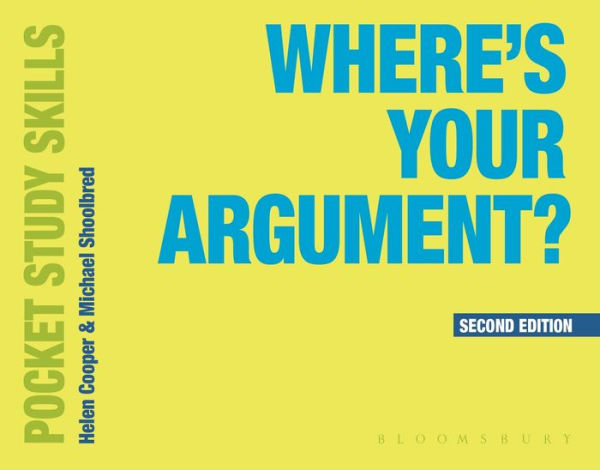
Where's Your Argument?
136Paperback(2nd ed.)
$10.95
10.95
In Stock

Product Details
| ISBN-13: | 9781350932623 |
|---|---|
| Publisher: | Bloomsbury Academic |
| Publication date: | 08/25/2022 |
| Series: | Pocket Study Skills , #20 |
| Edition description: | 2nd ed. |
| Pages: | 136 |
| Product dimensions: | 5.30(w) x 4.20(h) x 0.50(d) |
About the Author
From the B&N Reads Blog