Improve your morals: eat less meat.
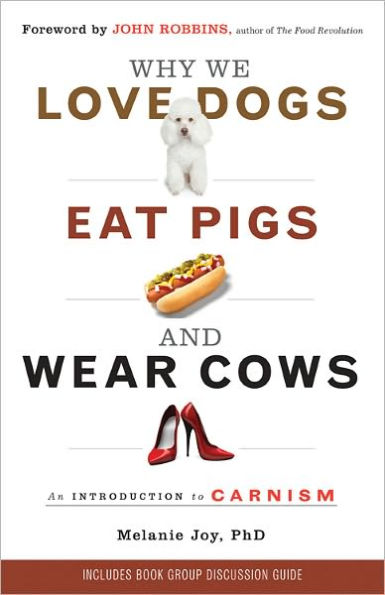
Dr Melanie Joy's book subtitled AN INTRODUCTION TO CARNISM is a very good read. Its stated goals are clear, few and simple. They are also attained. *** By book's end we have been asked many questions. They revolve around why humans eat or decline to eat the flesh of fish and animals. And why do we eat only a few creatures such as pigs, sheep, cows, chickens and turkeys? Why would it take imminent starvation before most us would be willing to sample the meat of porcupine, sea slug, hippopotamus or our pet cat? Why, in general, do we exempt pets, others' and well as our own, from inclusinon on our menu? ***
What are vegetarians? For Melanie Joy this term is not apt for people who decline to eat meat or fish for reasons simply of health. Rather vegetarians, in the author's jargon, are people who think meat eating is morally evil. The moral reasons vegetarians reject eating animals and fish are varied. But Melanie Joy builds a case that we do not eat the flesh animals for whom we have "empathy." If the animal has a name or is known to us personally and affectionately, even a pet goldfish, we won't dream of eating it. ***
Biologically, humans are omnivores, not just carnivores. We can eat animal and fish flesh without harm. But we can also live without animal flesh. Most animal flesh we reject. We are fussy and selective in our meal choices. Dr Joy argues that various social pressures have placed a thick veil between the burger or Wienerschnitzel on our plate and the bull or calf that was systematically slaughtered to provide us our meal. Even if we don't know the pig in question, we are at least vaguely put off if its anonymous head is before us on a platter. We simply would not eat meat if we tore down the veil created by society, history and the animal raising and slaughtering industries. ***
And who are "we?" We are "carnists." We are the opposite of Joy's ethically defined "vegetarians." If Melanie Joy were inclined to pray to her God for the vast majority of Americans who are "carnists," she might implore: "Forgive them, Father, for they know not what they do." Like Socrates, Dr Joy seems to believe that the first step from carnism to vegetarianism will be taken after her book tears down the veil between a Chicken McNuggett and Joe the rooster whose body we are munching on. Old Joe was once a living being, with interests of his own -- if left to his own devices. But he wasn't left alone. His mother was bred up to produce him. He was not allowed to roam free and seek out a mate. Carnism is possible only because human meateaters do not put faces on the sources of their meat. ***
Bottom line: through myriad examples of food production industry's cruelty to turkeys, baby calves and other meat sources, Melanie Joy skilfully and relentlessly makes a case that eating meat is a moral evil. Once a carnist has seen the light and agrees with the author, he is ready for the three-step self-healing process Dr Joy recommends: (1) eat less meat, for starters; (2) join or support organizations that uncover the cruelties of the food industry; and (3) keep on learning more and more about nutrition and our ability to live happy, healthy lives without eating meat. -OOO-
Was this review helpful? Yes NoThank you for your feedback.
Report this reviewThank you, this review has been flagged.
Overview
In her groundbreaking new book, Why We Love Dogs, Eat Pigs, and Wear Cows, Melanie Joy explores the invisible system that shapes our perception of the meat we eat, so that we love some animals and eat others without knowing why. She calls this system carnism. Carnism is the belief system, or ideology, that allows us to selectively choose which animals become our meat, and it is sustained by complex psychological and social mechanisms. Like other "isms" (racism, ageism, etc.), carnism is most harmful when it is unrecognized and unacknowledged. Why We Love Dogs, Eat Pigs, and Wear Cows names and explains this phenomenon and offers it up for examination. Unlike the many books that explain ...