
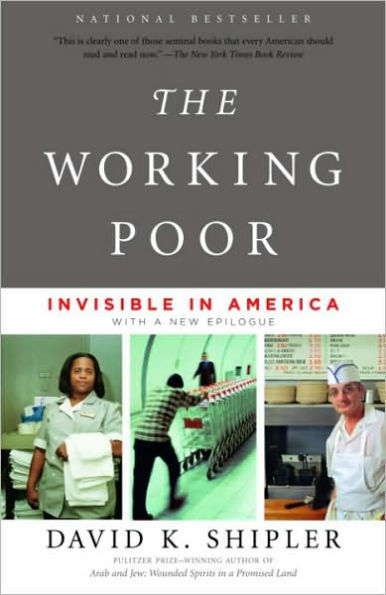
NATIONAL BESTSELLER • From the author of the Pulitzer Prize–winning Arab and Jew, an intimate portrait unfolds of working American families struggling against insurmountable odds to escape poverty.
"This is clearly one of those seminal books that every American should read and read now." —The New York Times Book Review
As David K. Shipler makes clear in this powerful, humane study, the invisible poor are engaged in the activity most respected in American ideology—hard, honest work. But their version of the American Dream is a nightmare: low-paying, dead-end jobs; the profound failure of government to improve upon decaying housing, health care, and education; the failure of families to break the patterns of child abuse and substance abuse. Shipler exposes the interlocking problems by taking us into the sorrowful, infuriating, courageous lives of the poor—white and black, Asian and Latino, citizens and immigrants. We encounter them every day, for they do jobs essential to the American economy.
This impassioned book not only dissects the problems, but makes pointed, informed recommendations for change. It is a book that stands to make a difference.
NATIONAL BESTSELLER • From the author of the Pulitzer Prize–winning Arab and Jew, an intimate portrait unfolds of working American families struggling against insurmountable odds to escape poverty.
"This is clearly one of those seminal books that every American should read and read now." —The New York Times Book Review
As David K. Shipler makes clear in this powerful, humane study, the invisible poor are engaged in the activity most respected in American ideology—hard, honest work. But their version of the American Dream is a nightmare: low-paying, dead-end jobs; the profound failure of government to improve upon decaying housing, health care, and education; the failure of families to break the patterns of child abuse and substance abuse. Shipler exposes the interlocking problems by taking us into the sorrowful, infuriating, courageous lives of the poor—white and black, Asian and Latino, citizens and immigrants. We encounter them every day, for they do jobs essential to the American economy.
This impassioned book not only dissects the problems, but makes pointed, informed recommendations for change. It is a book that stands to make a difference.

eBook
Available on Compatible NOOK devices, the free NOOK App and in My Digital Library.
Related collections and offers
Overview
NATIONAL BESTSELLER • From the author of the Pulitzer Prize–winning Arab and Jew, an intimate portrait unfolds of working American families struggling against insurmountable odds to escape poverty.
"This is clearly one of those seminal books that every American should read and read now." —The New York Times Book Review
As David K. Shipler makes clear in this powerful, humane study, the invisible poor are engaged in the activity most respected in American ideology—hard, honest work. But their version of the American Dream is a nightmare: low-paying, dead-end jobs; the profound failure of government to improve upon decaying housing, health care, and education; the failure of families to break the patterns of child abuse and substance abuse. Shipler exposes the interlocking problems by taking us into the sorrowful, infuriating, courageous lives of the poor—white and black, Asian and Latino, citizens and immigrants. We encounter them every day, for they do jobs essential to the American economy.
This impassioned book not only dissects the problems, but makes pointed, informed recommendations for change. It is a book that stands to make a difference.

Product Details
| ISBN-13: | 9780307493408 |
|---|---|
| Publisher: | Knopf Doubleday Publishing Group |
| Publication date: | 11/12/2008 |
| Sold by: | Random House |
| Format: | eBook |
| Pages: | 352 |
| File size: | 2 MB |
About the Author
DAVID K. SHIPLER reported for The New York Times from 1966 to 1988 in New York, Saigon, Moscow, Jerusalem, and Washington, D.C. He is the author of six previous books, including the best sellers Russia and The Working Poor, as well as Arab and Jew, which won the Pulitzer Prize. He has been a guest scholar at the Brookings Institution and a senior associate at the Carnegie Endowment for International Peace, and has taught at Princeton, American University, and Dartmouth. He writes online at The Shipler Report.
Read an Excerpt
Chapter One
Money and Its Opposite
You know, Mom, being poor is very expensive. —Sandy Brash, at age twelve
Tax time in poor neighborhoods is not April. It is January. And “income tax” isn’t what you pay; it’s what you receive. As soon as the W-2s arrive, working folks eager for their checks from the Internal Revenue Service hurry to the tax preparers, who have flourished and gouged impoverished laborers since the welfare time limits enacted by Congress in 1996. The checks that come from Washington include not only a refund of taxes withheld, but an additional payment known as the Earned Income Tax Credit, which is designed to subsidize low-wage working families. The refunds and subsidies are sometimes banked for savings toward a car, a house, an education; but they are often needed immediately for overdue bills and large purchases that can’t be funded from the trickle of wages throughout the year.
Christie, a child-care worker in Akron, earned too little to owe taxes but got $1,700 as an Earned Income Credit one year, which enabled her to avoid the Salvation Army’s used-furniture store and instead buy a new matching set of comfortable black couches and loveseats for her living room in public housing.
Caroline Payne’s check went for a down payment on her house in New Hampshire. “I used my income tax and paid a thousand down,” she said proudly. When she sold it five and a half years later and her daughter lent her money to rent a truck for her move, she planned to pay her back “when I get my taxes.”
“I’m waitin’ for my income tax to come in so I can pay my real estate taxes,” said Tom King, a single father and lumberjack who lived in a trailer on his own land.
Debra Hall, who had started at a Cleveland bakery, was keen with anticipation after filing her first tax return. “I’ll get $3,079 back! What am I gonna do with it? Pay all my bills off,” she declared, “and I haven’t had anything new in the house. Do some good with it, that’s for sure. Minor repairs on my car. The bills are first, for my credit [rating], to get all my back debts paid. It will be well spent.”
The Earned Income Tax Credit is one of those rare anti-poverty programs that appeal both to liberals and conservatives, invoking the virtue of both government help and self-help. You don’t get it unless you have some earned income, and since its payments are linked to your tax return, you don’t get it unless you file one. That leaves out low-wage workers—especially undocumented immigrants—who get paid under the table in cash and think they’re better off avoiding the IRS. By filing, however, they would end up ahead, because they’d get to keep everything they earned and would receive a payment on top of that. The benefits kick in at fairly high levels—at earnings of less than $33,692, for example, for a worker who supported more than one child in 2003. At the lower income levels, the Earned Income Tax Credit can add the equivalent of a dollar or two an hour to a worker’s wage.
Enacted in 1975, the program was expanded under Presidents Reagan, Bush, and Clinton, and in 2003 paid more than $32 billion to 18 million households. Treasury officials worry about erroneous claims, honest or fraudulent, which may rise to 27 to 32 percent of the total.1 On the other hand, an estimated 10 to 15 percent of those eligible don’t file for it,2 partly because employers and unions often don’t tell workers that it exists. The presidents of two local unions in Washington, D.C., for example, one representing janitors and the other parking garage attendants, had never heard of the Earned Income Tax Credit until I mentioned it to them. And I have not yet come across a single worker or boss who knew that with a simple form called a W-5, filed with the employer, a low-wage employee could get some of the payments in advance during the year. When I mentioned the W-5 to Debra Hall and she then asked at her bakery, the woman who handled the payroll waved her away impatiently and said she knew nothing about it. Later, the tax preparer told Debra it was better just to wait and get the payment in one lump sum after she filed her return.
It sure is better—if you’re the preparer. With cunning creativity, the preparers have devised schemes to separate low-wage workers from as much of their refunds and Earned Income Credits as feasible. The marvel of electronic filing, the speedy direct deposit into a bank account, the high-interest loan masquerading as a “rapid refund” all promise a sudden flush of dollars to cash-starved families. The trouble is, getting money costs money.
The preparers operate from sleazy check-cashing joints and from street-level outposts of respectable corporations. They do for a hefty fee what their clients could do for themselves for free with the math skills and the courage to tackle a 1040, or with a computer and a bank account to speed filing and receipt. But most low-wage workers don’t have the math, the courage, or the computer, and many don’t even have the bank account. They are so desperate for the check that they give up a precious $100 or so to get everything done quickly and correctly. “You get so scared,” said Debra Hall, who paid $95 to have her simple return done after ending twenty-one years of welfare. “I don’t know why it’s so scary, but I’d rather have it done right the first time.”
She was probably wise, because another disadvantage of being poor is that you’ve been more likely since 1999 to face an audit by the IRS. In that year, 1.36 percent of the returns filed by taxpayers making under $25,000 were audited, compared with 1.15 percent of those making $100,000 or more. The scrutiny was instigated by Republican congressional leaders who feared abuses of the Earned Income Tax Credit. In the face of bad publicity, the IRS shifted the balance in 2000 by auditing 0.6 percent of those under $25,000 versus 1.0 percent of those over $100,000. Thereafter, the audit rate tilted back and forth, to .86 and .69 percent, respectively, in 2001, then to .64 and .75 in 2002.3 In other words, as the IRS lost enforcement personnel, it dramatically reduced its scrutiny of well-to-do taxpayers, whose returns were once audited at the rate of 10 percent. This despite the fact that audits at the upper levels of income naturally tend to recover more dollars in lost revenue.
Evon Johnson never dared do another return herself after the IRS charged her $2,072 in taxes, penalties, and interest. Newly arrived from Honduras, she was working from 5 a.m. for a cleaning service in Boston that never withheld taxes and never sent her a W-2. She didn’t know they were supposed to do either. “I did my taxes, I fill it out, fine,” she said. But not so fine, evidently. “Three years after or four years after, IRS contact me saying that I owe them . . . like, $2,072. ‘Why do I owe you?’ And they say: because I didn’t declare my taxes. I say I did. . . . They say no. . . . I sent them a letter saying I was sending them $1,072 I think it was, ’cause I didn’t have no money at the time, and I was going to make small installments for the rest of the money. . . . You know what they did? I had a bank account, and they took the money from my bank account—every penny I had.” Ever since, she has happily paid $100 a year to a tax preparer, $100 a year for peace of mind. “I don’t want the IRS back on me,” she explained. “He do it and he sign it and put everything, so if any mistake, he gonna be the one who will have to deal with them.”
By the end of February, H&R Block’s storefront office on a dismal stretch of Washington’s 14th Street looked like a well-used campaign headquarters a week after Election Day. Most computer screens were dark, and the place was quiet and cavernous. All the desks were empty but one, occupied by Claudia Rivera, who used to prepare returns without charge at a library in Virginia. She and the manager, Carl Caton, didn’t have much to do now that the rush had passed, so they were happy to sit at a keyboard and explain.
Each form the taxpayer needed carried a fee: $41 for a 1040, $10 for an EIC (the Earned Income Credit), $1 for each W-2, and so on. Electronic filing cost another $25. So a simple return with two W-2s filed electronically would run $78. But it didn’t stop there. Block had a smorgasbord of services for people who lived on the edge. If you had no bank account, your refund could be loaded onto an ATM card that charged $2 per withdrawal. Or a temporary account could be opened into which the IRS payment could be deposited for a fee of $24.95. If you were enticed by Block’s offer of a “rapid refund” and wanted a check in a day or two, you paid H&R Block an additional $50 to $90, depending on the amount you were getting. The fee on 14th Street could be as much as $50 on a $200 refund, up to $90 for $2,000 or more.4
This was actually a loan, and for a very short time. Filing electronically usually gets you a check in two and a half weeks, according to the IRS, and five days sooner if it’s deposited directly into a bank account. At the most, then, the “rapid refund” loan, issued a day or two after filing, would run about fifteen days, which made the $90 fee on a $2,000 payment equivalent to an annual interest rate of 108 percent. At the least, the loan could run as little as four days, propelling the annualized rate to 410 percent on $2,000, and 2,281 percent on $200. (The highest percentage is incurred if the timing occurs perfectly: the return is filed by the IRS’s weekly deadline of noon Thursday, the loan check is not issued until after banks close Friday, the taxpayer can’t put it into his account until Monday, and the IRS is fast enough to deposit the refund directly with the lending bank the following Friday.)5
After a spate of lawsuits, a federal judge in Norfolk ordered Block to stop using the misleading term “rapid refund” in advertising loans, but Block continued with the ads by redefining “rapid refund” as a reference to electronic filing only. The company called its loan program a “refund anticipation loan,” a distinction lost on many of the low-wage workers who ventured into Block offices in search of a rapid refund. In 2000 such loans went to 4.8 million taxpayers.
Among all the working people I interviewed who used the loan service, not one understood the terms or the options. Hector and Maribel Delgado, who earned about $28,000 a year picking and packing vegetables in North Carolina, were stunned when I sat with them in their trailer, looked over their tax return, and explained how it all worked. They had paid Block $109 to prepare their return, file it electronically, and give them an advance on their payment from the IRS of $1,307.05. The form they had signed disclosed a finance charge of 69.888 percent annually, but they had not understood it. Even as Block employees presented a contract in fine print, they were trained to avoid the word “loan,” and say “two-day refunds” instead, a Maryland judge found in hearing a lawsuit on the lending practices. And the refund loans were lucrative enough to provide 8 percent of Block’s entire profits in 1999, mainly because a Block subsidiary owned a 49.99 percent interest in the loans, made by Household Bank.
Something else illicit happened to the Delgados in the Block offices. Although they filed electronically in January, a time when the IRS promises checks within a couple of weeks, “We were told we’d have to wait six to eight weeks,” Maribel said. This was patently false. “We needed the money to pay bills,” she explained. “We send one part to Mexico, another part to here. We usually send $100 every two weeks to Mexico. We have a big family.”
In 2000, after facing a decade of class-action lawsuits alleging misleading lending practices, H&R Block agreed to a $25 million settlement without admitting any wrongdoing. The only practice the company changed was to present the federally required truth-in-lending disclosures earlier in the process, according to a spokeswoman. Do employees at least explain the terms verbally? “A lot of it depends on questions customers ask,” she said. “If they ask questions, preparers are supposed to answer.” Many customers simply do not know what questions to ask.
Poverty is like a bleeding wound. It weakens the defenses. It lowers resis- tance. It attracts predators. The loan sharks operate not only from bars and street corners, but also legally from behind bulletproof glass. Their beckoning signs are posted at some 10,000 locations across the country: “Payday Loans,” “Quick Cash,” “Easy Money.” You see them in check-cashing joints and storefront offices in poor and working-class neighborhoods. They have organized themselves into at least a dozen national chains, and they charge fees equivalent to more than 500 percent annualized interest.
They also provide a much needed service. Say you’re short of cash, and the bills are piling up, along with some disconnection notices. Payday is two weeks away, and your phone and electricity will be shut off before then. The guy at the local convenience store, who has a booth for cashing checks, throws you a lifeline. If you need $100 now, you write him a check for $120, postdated by two weeks. He’ll give you the $100 in cash today, hold your check until your wages are in your bank account, and then put the check through. Or you can give him the $120 in cash when you get it, and he’ll return your check. Either way, 20 percent interest for two weeks equals 1.428 percent a day, or 521 percent annually.
If you’re still stuck after payday, if your paycheck doesn’t quite cover your needs, or if your check for $120 bounces, no problem. The guy behind the bulletproof glass will gladly roll over your loan—for another $20. This pattern prevails in Illinois, for example, where state examiners found that rollovers made up 77 percent of all payday loan transactions. The average customer had ten such renewals, which meant paying fees totaling up to twice the amount borrowed.6 Eventually, you may have to borrow from another payday loan merchant to pay the fees at the first. And so on and on and on.
Table of Contents
| Preface | ix | |
| Introduction: At the Edge of Poverty | 3 | |
| Chapter 1 | Money and Its Opposite | 13 |
| Chapter 2 | Work Doesn't Work | 39 |
| Chapter 3 | Importing the Third World | 77 |
| Chapter 4 | Harvest of Shame | 96 |
| Chapter 5 | The Daunting Workplace | 121 |
| Chapter 6 | Sins of the Fathers | 142 |
| Chapter 7 | Kinship | 174 |
| Chapter 8 | Body and Mind | 201 |
| Chapter 9 | Dreams | 231 |
| Chapter 10 | Work Works | 254 |
| Chapter 11 | Skill and Will | 285 |
| Notes | 301 | |
| Index | 307 |
Interviews
An Interview with David K. Shipler
Barnes & Noble.com: You have written about Russia, Arabs and Jews in the Middle East, and blacks and whites in America. What made you want to write this book?
David K. Shipler: After many years overseas working as a foreign correspondent for The New York Times, I came back to America and continued to write about foreign policy. I finally began to feel that I wanted to write about the country I was living in, and I delved into the most vexing problems we face. So I began to deal with race relations and wrote Country of Strangers: Blacks and Whites in America. This book led me, naturally, to the problem of poverty, which I have always felt was a scar on America's well-being. I see The Working Poor: Invisible in America as the second in a trilogy about America. The next book will be about civil liberties in America. It is my way of trying to understand my own country.
B&N.com: There is a striking phrase in your book. You suggest that because the working poor have so many difficulties to endure, they do not have the "luxury of rage." What do you mean by that?
DKS: One might suppose that because people trapped in poverty have to work so hard, they would be angry. Perhaps some of them are, but they don't express the anger one might expect them to express, to their employers or political leaders. Nor do they express their anger at the economy or the government in general for not helping them adequately. They don't get angry at the system of privilege or the private enterprise system. Rather, most people I followed for some time were so consumed with their own personal trials that they had no energy left for rage. They were just trying to make ends meet on very low wages, trying to juggle childcare, transportation difficulties, hardships at the workplace, housing problems, and so forth. They simply didn't have room in their lives to express anger at the circumstances they found themselves in. Those few people who did show rage misdirected it, I thought. They were short tempered with their children, they were angry with their partners or spouses or other relatives, they were sometimes angry at their coworkers or the grocer who runs the corner store. Sometimes they got mad at their bosses, but that is as far as the rage reached.
B&N.com: How do you define for contemporaries what it means to be a member of the "working poor"? Is this a term that must be redefined every generation?
DKS: Poverty is a collection of characteristics that define a life. The most obvious is income. And that is a measure the federal government uses. Right now a single adult with three children has to earn more that $18,725 a year to be above the poverty level. That comes out to $9 per hour if the person has a full-time job of 40 hours a week for 52 weeks a year. It is fair to say that some people earning $19,000 a year are still poor, even though, technically, they are not poor according to the government. The federal poverty measurement does not vary by region, and that is one of its flaws. It is an inadequate tool for many reasons. There is no regional variation, and the formula used for it was developed back in the 1950s, when the average American family spent one-third of its income on food. Now Americans spend a much lower percentage on food and a much higher percentage on housing. Poverty is financial, but it is also relative and psychological. If you really want to understand the essence of poverty, you must understand the notion of income with debt. Families might rise above poverty with a job but still be in debt, and that debt precludes them from getting decent car loans or mortgages to buy motor homes.
Then there are the relativity questions. I asked the people if they were poor. Some said no because their families are rich in love. And there were some, not especially poor, who were above the poverty line but had a huge amount of debt and could not get ahead because of that. They had no hope. Lack of hope and its corollary of not being able to participate fully in society are also psychological aspects of poverty. Because of television, many poor people have desires for material things similar to those of the middle class. Seeing these things creates a gap between expectations and abilities to have them, and this creates frustrations. People cannot afford to buy what is advertised, use and abuse credit cards, and get into financial trouble. They feel they have failed, and it leads to a cycle of frustration and self-denunciation.
B&N.com: What do today's working poor have in common with the working poor of previous eras, and what is different about them?
DKS: Maybe we have become more sensitive to the fact that so many in America have worked but remain in poverty. Many have worked under the table even though they are on welfare. This is not really new, but we are tuning in to it. In the American ethic, work is moral. We attach virtue to hard work because, in our American dream and our American myth, we believe anyone can prosper in the land of opportunity. The opposite of this is the belief that people who don't work hard have a sense of immorality attached to them. So, there is an element of condescension toward the poor. What I wanted to do was to defang the criticism of the poor. I wanted to concentrate on what the American ethic says they must do. That is, that they must work. But they still are not making it.
B&N.com: You show that sweatshops are not only overseas but also here at home. Where did you find them? And who works in them?
DKS: Sweatshops in L.A. are in the garment district. They exist elsewhere, too. There are a lot of people in sewing shops in L.A. who are often undocumented immigrants. They are afraid to complain about their harsh working conditions because they are afraid of being deported. I met one woman from Mexico who was paid 3/4 of a cent for each fly that she sewed into a pair of jeans. It was done on an assembly-line basis. She was fast, but she had to do 100 flies to get just 75 cents. In order to make just minimum wage -- in California, it is $5.75 per hour -- she had to sew a fly into a pair of pants in less than 5 seconds. She was in her late 40s and worked with only a few breaks. Also, there isn't always work at her factory. Sometimes the boss just calls the workers and tells them to stay home because there is not enough work that day.
B&N.com: Exactly who are the working poor in terms of gender, age, ethnic groups, and race? What regions are they from? Are they predominantly rural or urban? And how many are immigrants?
DKS: It is hard to get that kind of data. You have to match the wage with family numbers to determine who is poor. Many people work fewer than 40 hours a week. There are working poor in every part of the country. They are in Idaho and New Hampshire. I found them in the rural towns of New Hampshire, the tobacco fields of North Carolina, the sweatshops of Los Angeles, the inner city of Washington, D.C., and the slums of Boston. I saw it in malnutrition clinics for people, in factories, among blacks, whites, Asians, Latinos. There were also union members who were stuck in working poverty. For example, I saw Ethiopian parking garage attendants in Washington, D.C., who were unionized, yet they were still part of the working poor.
B&N.com: Why is it so difficult for the working poor to get out of poverty? Why is the problem so intractable?
DKS: I chose people who were at the edge of poverty and wanted to see if they could get out. Getting out is not like showing a passport at the border. Instead, you have to traverse a broad landscape like a minefield where people are shooting at you and one misstep can kill you. I think the point here is that, for families who are trying to get out of poverty, a single reversal in almost any aspect of their lives can be catastrophic. For someone in the middle class or above, a car breaking down can be annoying. But for someone who depends on that car to get to an essential job, its breaking down can result in a long absence from work with the result of getting fired. That is how such things can be catastrophic for the working poor.
B&N.com: The economic problems breed social problems of tremendous magnitude for the working poor such as drug abuse, domestic abuse, and debt. But aren't a lot of these problems also prevalent, though in a different manner, in the middle class?
DKS: Many of the problems the poor have can be found among middle-class and affluent people as well. The difference is that the poor have less insulation from the problems and less wherewithal and less financial ability and less education to partition, so to speak, such problems off from the rest of their lives. One example is that sexual abuse is a widespread problem among poor working women. Now, if a child is abused in the upper classes, she has therapy and can come out of it whole. The same can be said about attention deficit disorder. A poor child might get treatment but suffers from the financial inability to pay for a therapist. Even if a working poor family has insurance, there are limits on how it can be used. The working poor often do not know how to use insurance, and often do not understand the intricacies of insurance claims.
Certain problems the working poor face interact with one another and magnify one another. A chain reaction takes place. For example, I knew a young mother in New Hampshire who lives in an old, drafty, damp apartment in a wooden house. The conditions there exacerbate her son's asthma. Twice he was rushed to a hospital because he couldn't breathe. Insurance wouldn't cover the ambulance, and she didn't have the experience or knowledge on how to appeal it. The ambulance charges were $490, and this went on to her credit report. When she applied for a mobile home, she was denied. When she had to replace her dying car she could not get credit for a reasonable car loan. She went to a used car lot, but she was charged 15-3/4 percent for a car there. They did not do a credit check. The car had 82,000 miles, cost $5,800, and required an additional $100 to $200 a month to keep it in repair. This is what I mean by the "chain reaction." The bad housing leads to bad credit and a crummy car.
B&N.com: It often seems that people don't care about the working poor.
DKS: People care. People are reacting to my book. It is important to remember that low-income people don't vote in high numbers. As income drops, so does voting. If more people with family incomes less than $25,000 voted, politicians would have to fight for their votes. But it is a vicious circle. Many I spoke to said they didn't vote because it didn't matter to them.
B&N.com: What is the main idea you want your readers to take from your book?
DKS: I want them to look for human stories about real people caught in real problems so that these folks can be seen -- because they are not seen now. I hope readers will think seriously about the problems in a constructive way so that they can be informed about what should be a very important discussion in this country.
B&N.com: What will be your next project?
DKS: As I said earlier, I have begun working on a book on civil liberties in the United States. Race and poverty are among the two most difficult problems we face. It will be several years before I finish this next book. The whole reason for doing these books is to learn. My basic motivation is to try to figure things out for myself. It is a great pleasure for me because the greatest thing about life is to learn.