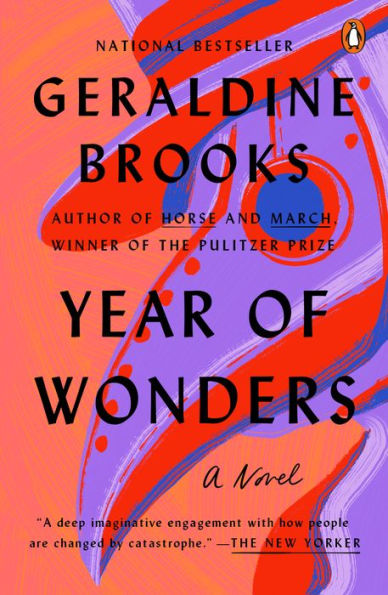
Year of Wonders: A Novel of the Plague

( 195 )

Pick Up in Store

Reserve and pick up in 60 minutes at your local store

Paperback (Reprint)
$13.98
BN.com price
$15.00 List Price (Save 7%)
Marketplace (New and Used)
from
$2.50
$15.00 List Price (Save 83%)
Usually ships within 1-2 business days
All (64)  
Used (43)  
New (21)  
Close
Sort by
Page 1 of 7
Showing 1 – 10 of 64 (7 pages)
$2.50
(Save 83%)
Seller since 2009

Feedback rating:

(228)

Condition:

New — never opened or used in original packaging.

Like New — packaging may have been opened. A "Like New" item is suitable to give as a gift.

Very Good — may have minor signs of wear on packaging but item works perfectly and has no damage.

Good — item is in good condition but packaging may have signs of shelf wear/aging or torn packaging. All specific defects should be noted in the Comments section associated with each item.

Acceptable — item is in working order but may show signs of wear such as scratches or torn packaging. All specific defects should be noted in the Comments section associated with each item.

Used — An item that has been opened and may show signs of wear. All specific defects should be noted in the Comments section associated with each item.

Refurbished — A used item that has been renewed or updated and verified to be in proper working condition. Not necessarily completed by the original manufacturer.

Acceptable
2002 Paperback Fair Book is heavily worn but in readable condition. More worn and used than most. Give this book a good home.

Ships from: Englewood, CO

Usually ships in 1-2 business days

  • Canadian
  • International
  • Standard, 48 States
  • Standard (AK, HI)
  • Express, 48 States
  • Express (AK, HI)
$2.63
(Save 82%)
Seller since 2012

Feedback rating:

(120)

Condition: Good
Minimal highlighting! 1st. Still in good condition with only minor wear and tear from general use. No damage to any of the pages, with no or minimal highlighting. A great value at ... this price! Ships fast. Expedited shipping 2-4 business days; Standard shipping 7-14 business days. Read more Show Less

Ships from: Arlington, TX

Usually ships in 1-2 business days

  • Standard, 48 States
  • Standard (AK, HI)
  • Express, 48 States
  • Express (AK, HI)
$3.00
(Save 80%)
Seller since 2011

Feedback rating:

(241)

Condition: Good
Used - Good May contain highlighting/underlining/notes/etc. May have used stickers on cover. Ships same or next day. Expedited shipping takes 2-3 business days; standard shipping ... takes 4-14 business days. Read more Show Less

Ships from: Fayetteville, AR

Usually ships in 1-2 business days

  • Standard, 48 States
  • Standard (AK, HI)
  • Express, 48 States
  • Express (AK, HI)
$3.99
(Save 73%)
Seller since 2009

Feedback rating:

(228)

Condition: Good
2002 Paperback Good Used book with normal wear and tear and may contain writing. Stock photo may be different from actual book cover.

Ships from: Englewood, CO

Usually ships in 1-2 business days

  • Canadian
  • International
  • Standard, 48 States
  • Standard (AK, HI)
  • Express, 48 States
  • Express (AK, HI)
$3.99
(Save 73%)
Seller since 2009

Feedback rating:

(262)

Condition: Good

Ships from: Skokie, IL

Usually ships in 1-2 business days

  • Canadian
  • International
  • Standard, 48 States
  • Standard (AK, HI)
  • Express, 48 States
  • Express (AK, HI)
$3.99
(Save 73%)
Seller since 2009

Feedback rating:

(262)

Condition: Good

Ships from: Skokie, IL

Usually ships in 1-2 business days

  • Canadian
  • International
  • Standard, 48 States
  • Standard (AK, HI)
  • Express, 48 States
  • Express (AK, HI)
$3.99
(Save 73%)
Seller since 2009

Feedback rating:

(262)

Condition: Good

Ships from: Skokie, IL

Usually ships in 1-2 business days

  • Canadian
  • International
  • Standard, 48 States
  • Standard (AK, HI)
  • Express, 48 States
  • Express (AK, HI)
$4.00
(Save 73%)
Seller since 2008

Feedback rating:

(147)

Condition: Good
2002 Paperback [USED/GOOD: Copy may contain writing and/or highlighting, store stickers, and show normal wear. Does NOT include access codes or other perishable components. ... Contains CD/DVD/etc **if originally provided by publisher** unless listed as text only. ] [PROCESSING: Allow two business days. ][SHIPPING TIME (After Processing): Varies by destination and shipping method selected at checkout. ][Free tracking on all orders. Professional booksellers. Inquiries welcome. ] Read more Show Less

Ships from: State College, PA

Usually ships in 1-2 business days

  • Canadian
  • International
  • Standard, 48 States
  • Standard (AK, HI)
  • Express, 48 States
  • Express (AK, HI)
$4.48
(Save 70%)
Seller since 2011

Feedback rating:

(39)

Condition: Acceptable
PAPERBACK Fair 0142001430 New publishers overstocks which sustained minimal damage in shipping. Covers may be torn, etc. Damages do not affect book readabillity. Great customer ... service. Read more Show Less

Ships from: Murfreesboro, TN

Usually ships in 1-2 business days

  • Canadian
  • International
  • Standard, 48 States
  • Standard (AK, HI)
  • Express, 48 States
  • Express (AK, HI)
$4.95
(Save 67%)
Seller since 2005

Feedback rating:

(1146)

Condition: Good
2002-04-30 Softcover Good Clean pages. Spine creased. Light shelf wear. Good condition overall.

Ships from: Cambridge, MA

Usually ships in 1-2 business days

  • Canadian
  • International
  • Standard, 48 States
  • Standard (AK, HI)
  • Express, 48 States
  • Express (AK, HI)
Page 1 of 7
Showing 1 – 10 of 64 (7 pages)
Close
Sort by
NOOK Book (eBook)
$12.99
BN.com price

Available on NOOK devices and apps

  • Nook Devices
  • NOOK
  • NOOK Color
  • NOOK Tablet
  • Tablet/Phone
  • NOOK for iPad
  • NOOK for iPhone
  • NOOK for Android
  • NOOK for Android (Tablet)
  • NOOK Kids for iPad
  • PC/Mac
  • NOOK Study
  • NOOK for PC
  • NOOK for Mac

Need a NOOK? Explore Now

All Available Formats + Editions

Marketplace From
BN.com
 

Overview

When an infected bolt of cloth carries plague from London to an isolated village, a housemaid named Anna Frith emerges as an unlikely heroine and healer. Through Anna's eyes we follow the story of the fateful year of 1666, as she and her fellow villagers confront the spread of disease and superstition. As death reaches into every household and villagers turn from prayers to murderous witch-hunting, Anna must find the strength to confront the disintegration of her community and the lure of illicit love. As she struggles to survive and grow, a year of catastrophe becomes instead annus mirabilis, a "year of wonders."

Inspired by the true story of Eyam, a village in the rugged hill country of England, Year of Wonders is a richly detailed evocation of a singular moment in history. Written with stunning emotional intelligence and introducing "an inspiring heroine" (The Wall Street Journal), Brooks blends love and learning, loss and renewal into a spellbinding and unforgettable read.

"The novel glitters . . . A deep imaginative engagement with how people are changed by catastrophe." (The New Yorker)

"Year of Wonders is a vividly imagined and strangely consoling tale of hope in a time of despair." (O, The Oprah Magazine)

"Brooks proves a gifted storyteller as she subtly reveals how ignorance, hatred and mistrust can be as deadly as any virus. . . . Year of Wonders is itself a wonder." (People )

Editorial Reviews

From Barnes & Noble
Barnes & Noble Discover Great New Writers
In Year of Wonders, Geraldine Brooks chronicles life in a tiny English village in the year 1666. What makes this "year of wonders" so fascinating is that it was the year in which an outbreak of bubonic plague struck England. Brooks's novel is based on the historical village of Eyam in the Pennine Mountains, whose denizens were challenged by their local vicar to quarantine themselves to avoid further spread of the disease throughout the countryside. As the villagers doom themselves to near-eradication (two-thirds of them will perish before year's end), the story raises compelling questions about human nature.

The harrowing story of these brave souls is recounted by one Anna Frith, a maid in the charismatic vicar's household. Having watched helplessly as her own family succumbs one by one to the virulent plague, Anna is utterly devoted to the minister's teachings; but as the virus begins to recede, she begins to doubt his entreaty. Like many great historical novels, Year of Wonders will leave readers mulling over its essential questions long after they've finished the book. (Fall 2001 Selection)

Arthur Golden
...leaves us with the memory of vivid characters struggling in timeless human ways with the hardships confronting them....An engaging story.
From The Critics
In 1666 the bubonic plague appeared in a small mountain village in England, where it took hold and spread. In a novel and courageous effort to keep the disease from extending beyond the village, the local minister and his congregation took a sacred oath to quarantine themselves until the illness was spent. Brooks has used this piece of history as a framework for her fictional account of what it might have been like to live through the event. Told by Anna Frith, the housemaid for the minister and his wife, this is a tale of devastation, grief, and madness as well as the attempts, both medicinal and spiritual, by the townspeople to combat the disease. The author has captured the various human responses to grief, fear, hopelessness, and exhaustion. Characters are well drawn, showing both the good and evil sides of human nature. Compelling and believable, the unabridged version is masterfully read by Josephine Bailey; the abridged set is equally well narrated by Stina Nielsen. Recommended. Joanna M. Burkhardt, Coll. of Continuing Education Lib., Univ. of Rhode Island, Providence Copyright 2002 Cahners Business Information.

Product Details

  • ISBN-13: 9780142001431
  • Publisher: Penguin Group (USA) Incorporated
  • Publication date: 4/30/2002
  • Edition description: Reprint
  • Pages: 352
  • Sales rank: 25,010
  • Lexile: 1080L (what's this?)
  • Product dimensions: 5.13 (w) x 7.78 (h) x 0.70 (d)

Meet the Author

Geraldine Brooks
Geraldine Brooks
Journalist and author Geraldine Brooks won the Pulitzer Prize in fiction in 2006 for March, a novel that imagines the wartime experiences of the absent father in Louisa May Alcott's beloved classic Little Women.

Biography

Australian-born Geraldine Brooks is an author and journalist who grew up in the Western suburbs of Sydney and attended Bethlehem College Ashfield and the University of Sydney. She worked as a reporter for The Sydney Morning Herald for three years as a feature writer with a special interest in environmental issues.

In 1982 she won the Greg Shackleton Australian News Correspondents scholarship to the journalism master's program at Columbia University in New York City. Later she worked for The Wall Street Journal, where she covered crises in the the Middle East, Africa, and the Balkans.

Her first novel, Year of Wonders: A Novel of the Plague was an international bestseller. In 2006, she was awarded the Pulitzer Prize in fiction in 2006 for March, a story that imagines the Civil War experiences of the absent father in Louisa May Alcott's beloved classic Little Women. She has also written nonfiction, including Foreign Correspondence, an award-winning memoir about her search for the international penpals who enriched her childhood.

Read an Excerpt

Apple-picking Time

I used to love this season. The wood stacked by the door, the tang of its sap still speaking of forest. The hay made, all golden in the low afternoon light. The rumble of the apples tumbling into the cellar bins. Smells and sights and sounds that said this year it would be all right: there'd be food and warmth for the babies by the time the snows came. I used to love to walk in the apple orchard at this time of the year, to feel the soft give underfoot when I trod on a fallen fruit. Thick, sweet scents of rotting apple and wet wood. This year, the hay stooks are few and the woodpile scant, and neither matters much to me.

They brought the apples yesterday, a cartload for the rectory cellar. Late pickings, of course: I saw brown spots on more than a few. I had words with the carter over it, but he told me we were lucky to get as good as we got, and I suppose it's true enough. There are so few people to do the picking. So few people to do anything. And those of us who are left walk around as if we're half asleep. We are all so tired.

I took an apple that was crisp and good and sliced it, thin as paper, and carried it into that dim room where he sits, still and silent. His hand is on the Bible, but he never opens it. Not anymore. I asked him if he'd like me to read it to him. He turned his head to look at me, and I started. It was the first time he'd looked at me in days. I'd forgotten what his eyes could do-what they could make us do-when he stared down from the pulpit and held us, one by one, in his gaze. His eyes are the same, but his face has altered so, drawn and haggard, each line etched deep.When he came here, just three years since, the whole village made a jest of his youthful looks and laughed at the idea of being preached at by such a pup. If they saw him now, they would not laugh, even if they could remember how to do so.

"You cannot read, Anna."

"To be sure, I can, Rector. Mrs. Mompellion taught me."

He winced and turned away as I mentioned her, and instantly I regretted it. He does not trouble to bind his hair these days, and from where I stood the long, dark fall of it hid his face, so that I could not read his expression. But his voice, when he spoke again, was composed enough. "Did she so? Did she so?" he muttered. "Well, then, perhaps one day I'll hear you and see what kind of a job she made of it. But not today, thank you, Anna. Not today. That will be all."

A servant has no right to stay, once she's dismissed. But I did stay, plumping the pillow, placing a shawl. He won't let me lay a fire. He won't let me give him even that little bit of comfort. Finally, when I'd run out of things to pretend to do, I left him.

In the kitchen, I chose a couple of the spotted apples I'd culled from the buckets and walked out to the stables. The courtyard hadn't been swept in a sennight. It smelled of rotting straw and horse piss. I had to hitch up my skirt to keep it off the muck. Before I was halfway across, I could hear the thud of his horse's rump as he turned and strutted in his confinement, gouging clefts into the floor of the stall. There's no one strong or skilled enough now to handle him.

The stable boy, whose job it was to keep the courtyard raked, was asleep on the floor of the tack room. He jumped when he saw me, making a great show of searching for the snath that had slipped from his hand when he'd dozed off. The sight of the scythe blade still upon his workbench vexed me, for I'd asked him to mend it long since, and the timothy now was naught but blown seed head and no longer worth the cutting. I was set to scold him about this, and about the filth outside, but his poor face, so pinched and exhausted, made me swallow the words.

Dust motes sparkled in the sudden shaft of sunlight as I opened the stable door. The horse stopped his pawing, holding one hoof aloft and blinking in the unfamiliar glare. Then he reared up on his muscled haunches and punched the air, saying, as plainly as he could, "If you aren't him, get out of here." Although I don't know when a brush was last laid on him, his coat still gleamed like bronze where the light touched it. When Mr. Mompellion had arrived here on this horse, the common talk had been that such a fine stallion was no fit steed for a priest. And people liked not to hear the rector calling him Anteros, after one of the old Puritans told them it was the name of a pagan idol. When I made so bold as to ask Mr. Mompellion about it, he had only laughed and said that even Puritans should recall that pagans, too, are children of God and their stories part of His creation.

I stood with my back pressed against the stall, talking gently to the great horse. "Ah, I'm so sorry you're cramped up in here all day. I brought you a small something." Slowly, I reached into the pocket of my pinafore and held out an apple. He turned his massive head a little, showing me the white of one liquid eye. I kept prattling, softly, as I used to with the children when they were scared or hurt. "You like apples. I know you do. Go on, then, and have it." He pawed the ground again, but with less conviction. Slowly, his nostrils flaring as he studied the scent of the apple, and of me, he stretched his broad neck toward me. His mouth was soft as a glove, and warm, as it brushed my hand, taking the apple in a single bite. As I reached into my pocket for the second one, he tossed his head and the apple juice sprayed. He was up now, angrily boxing the air, and I knew I'd lost the moment. I dropped the other apple on the floor of the stall and slid out quickly, resting my back against the closed door, wiping a string of horse spittle from my face. The stable boy slid his eyes at me and went silently on with his mending.

Well, I thought, it's easier to bring a small comfort to that poor beast than it is to his master. When I came back into the house, I could hear the rector out of his chair, pacing. The rectory floors are old and thin, and I could follow his steps by the creak of the boards. Up and back he walked, up and back, up and back. If only I could get him downstairs, to do his pacing in the garden. But once, when I suggested it, he looked as if I'd proposed something as ambitious as a trek up the White Peak. When I went to fetch his plate, the apple slices were all there, untouched, turning brown. Tomorrow, I'll start to work with the cider press. He'll take a drink without noticing sometimes, even when I can't get him to eat anything. And it's no use letting a cellar full of fruit go bad. If there's one thing I can't stand anymore, it's the scent of a rotting apple.

* * *

At day's end, when I leave the rectory for home, I prefer to walk through the orchard on the hill rather than go by the road and risk meeting people. After all we've been through together, it's just not possible to pass with a polite, "Good night t'ye." And yet I haven't the strength for more. Sometimes, not often, the orchard can bring back better times to me. These memories of happiness are fleeting things, reflections in a stream, glimpsed all broken for a second and then swept away in the current of grief that is our life now. I can't say that I ever feel what it felt like then, when I was happy. But sometimes something will touch the place where that feeling was, a touch as slight and swift as the brush of a moth's wing in the dark.

In the orchard of a summer night, if I close my eyes, I can hear the small voices of children: whispers and laughter, running feet and rustling leaves. Come this time of year, it's Sam that I think of-strong Sam Frith grabbing me around the waist and lifting me into the low, curved branch of a gnarly, old tree. I was just fifteen. "Marry me," he said. And why wouldn't I? My father's croft had ever been a joyless place. My father loved a pot better than he loved his children, though he kept on getting them, year passing year. To my stepmother, Aphra, I was always a pair of hands before I was a person, someone to toil after her babies. Yet it was she who spoke up for me, and it was her words that swayed my father to give his assent. In his eyes I was but a child still, too young to be handfasted. "Open your eyes, husband, and look at her," said Aphra. "You're the only man in the village who doesn't. Better she be wedded early to Frith than bedded untimely by some youth with a prick more upright than his morals."

Sam Frith was a miner with his own good lead seam to work. He had a fine small cottage and no children from a first wife who'd died. It did not take him long to give me children. Two sons in three years. Three good years. I should say, for there are many now too young to remember it, that it was not a time when we were raised up thinking to be happy. The Puritans, who are few amongst us now, and sorely pressed, had the running of this village then. It was their sermons we grew up listening to in a church bare of adornment, their notions of what was heathenish that hushed the Sabbath and quieted the church bells, that took the ale from the tavern and the lace from the dresses, the ribands from the Maypole and the laughter out of the public lanes. So the happiness I got from my sons, and from the life that Sam provided, burst on me as sudden as the first spring thaw. When it all turned to hardship and bleakness again, I was not surprised. I went calmly to the door that terrible night with the torches smoking and the voices yelling and the men with their faces all black so that they looked headless in the dark. The orchard can bring back that night, too, if I let my mind linger there. I stood in the doorway with the baby in my arms, watching the torches bobbing and weaving crazy lines of light through the trees. "Walk slow," I whispered. "Walk slow, because it won't be true until I hear the words." And they did walk slow, trudging up that little hill as if it were a mountain. But slow as they came, in the end they arrived, jostling and shuffling. They pushed the biggest one, Sam's friend, out in front. There was a mush of rotten apple on his boot. Funny thing to notice, but I suppose I was looking down so that I wouldn't have to look into his face.

They were four days digging out Sam's body. They took it straight to the sexton's instead of bringing it home to me. They tried to keep me from it, but I wouldn't be kept. I would do that last thing for him. She knew. "Tell them to let her go to him," Elinor Mompellion said to the rector in that gentle voice of hers. Once she spoke, it was over. She so rarely asked anything of him. And once Michael Mompellion nodded, they parted, those big men, moving aside and letting me through.

To be sure, there wasn't much there that was him. But what there was, I tended. That was two years ago. Since then, I've tended so many bodies, people I loved and people I barely knew. But Sam's was the first. I bathed him with the soap he liked, because he said it smelled of the children. Poor slow Sam. He never quite realized that it was the children who smelled of the soap. I washed them in it every night before he came home. I made it with heather blooms, a much gentler soap than the one I made for him. His soap was almost all grit and lye. It had to be, to scrape that paste of sweat and soil from his skin. He would bury his poor tired face in the babies' hair and breathe the fresh scent of them. It was the closest he got to the airy hillsides. Down in the mine at daybreak, out again after sundown. A life in the dark. And a death there, too.

And now it is Elinor Mompellion's Michael who sits all day in the dark, with the shutters closed. And I try to serve him, although sometimes I feel that I'm tending just another in that long procession of dead. But I do it. I do it for her. I tell myself I do it for her. Why else would I do it, after all?

—From Year of Wonders: A Novel of the Plague by Geraldine Brooks. (c) August 2001, Viking, a division of Penguin Putnam, Inc. used by permission.

Interviews & Essays

Exclusive Author Essay
In the summer of 1990, my husband, Tony Horwitz, and I were based in London, working as foreign correspondents for The Wall Street Journal. While I went off to cover harrowing conflicts in the Middle East, Tony ranged around the English countryside, looking into earthshaking issues such as why so many towns had silly names like Great Snoring, North Piddle, and Upperup.

"You should do something about the footpath wars," I suggested one gray morning.

"Sidewalks? That sounds boring," he replied.

"No, not sidewalks, footpaths," I said, explaining that English tradition allowed people to ramble all over private property, so long as they kept to paths agreed on in ancient times. An article in that morning's paper reported that some landowners were getting tired of this and had started planting crops or building fences over the footpaths, fences that militant ramblers -- a description I found charmingly oxymoronic -- then promptly tore down.

A week or so later, we were rambling ourselves, among the gritstone villages of the Peak District in England's rugged mountain spine. Tony had interviewed farmers and hikers, and now we were free to explore on our own.

A book, Ernest Hemingway once noted, may come out of something a writer is lucky enough to overhear, or it may be the wreck of his whole damn life. On that beautiful June day, my book came out of looking up and seeing a finger post to a village called Eyam, with a note beneath: "Plague Village." To me, this was too intriguing to bypass, and so we went there. In the parish church was set out the story of how bubonic plague had arrived in Eyam in 1665; how the villagers had taken a heroic decision to quarantine themselves, and how two-thirds of them had died in the following year.

I did not quit my job that day and run off to a garret to write a novel. It was four more years before I left journalism and a further four, in which I wrote two books of nonfiction, before I found the courage to slip the surly bonds of fact.

But finally, in 1999, I sat down and began to imagine what it might have been like to be a young woman in Eyam in that year of 1666 -- that year of wonders, when witches were still being tried for their lives even as Isaac Newton was laying the foundations of modern scientific thought.

Sometimes, I would look up from my writing, through the wavy old glass of my study window, and forget for an instant whether the apple orchard I was looking at was here, in Virginia, or there, in Eyam, climbing the green hill behind Anna's cottage. I began to speak in the old Derbyshire dialect words that my characters used.

"Take an umbrella, it's siling down out there," I'd say to Tony. "And wear your gloves or your hands will be cluzened."

Since he has read the book -- many times, in draft and galley -- he has learned the meaning of those words. And all because, a decade ago, he discovered that a footpath wasn't a sidewalk. (Geraldine Brooks)

Customer Reviews
Average Rating 4
( 195 )

Rating Distribution

If you've bought this product, tell the world how you liked it.
Write a Review
See All Sort by: Showing 1 – 20 of 195 Customer Reviews
  • Posted December 30, 2008

    One of the best reads ever!!!

    I just this moment finished reading Year of Wonder. Anytime I find myself talking to the pages as if they would me in reply I know it¿s a great read. I was elated to get to the end as the ending was not at all what I expected. As a matter of fact I scarcely imagined Anna & Michael¿s rendezvous, though I hoped for it once Elinor was gone.

    The story is fluid & engaging & it drew me in like a friend confessing a her truth to me in confidence. I am glad that I generally choose what I read based on the way the cover looks. Year of Wonder like the painting on the cover is a sensual, full-bodied tale chocked full of historical references & language (including idioms that I had to research)that made the story most believable. I was swept into the story & enjoyed it immensely. I plan to add this to my own library so that I may read it again.

    I highly recommend the book to anyone - man or woman, who has a taste for brilliant literary storytelling.

    8 out of 8 people found this review helpful.

    Was this review helpful? Yes  No   Report this review
  • Posted April 6, 2010

    more from this reviewer

    I Really Wanted TO Love This Book

    I went into this read really wanting to love it since I've heard such great reviews. While there were aspects I greatly appreciated, I was sorely disappointed. The main reason lies in the plausibility of a multitude of circumstances. Don't get me wrong, I appreciate the concept of suspension of disbelief. However, for me, I tolerate it less in historical fiction than other genres.

    Inspired by actual events that occured when residents of Eyam Derbyshire voluntarily quarantined themselves in response to an outbreak of The Plague, Brooks allows the full range of human responses to play out. Some residents see the outbreak as a punishment from God and commit to extreme penitence such as self flagellation, others turn on their neighbors, others collapse under their own greed, and some focus on service.

    There are some things with which Brooks does an excellent job. Within a fairly short novel, Brooks aptly develops rich characters that truly reflects human nature. Her protagonists have flaws. That was refreshing, particularly when contrasted with their extreme heroic actions. The story itself is well developed, and she is able to portray the emotions of the characters in a vivid manner.

    Where she lost me was in the intuitive knowledge that Anna is imbued with. It just really irritated me. I couldn't figure out why Anna had not discovered a cure for The Plague. Further, the historical context for some of the medical knowledge seems a bit stretched by about 100 years.

    6 out of 6 people found this review helpful.

    Was this review helpful? Yes  No   Report this review
  • Posted May 15, 2010

    more from this reviewer

    I Also Recommend:

    Great Read

    I am innately suspicious of any historical novel with a woman on the cover. If you are looking for the sort of escapism found in a bodice ripper you are in for a disappointment. It is a well researched literary novel that only sags into sappy sentimentality a few times towards the end. Women are the majority of literary fiction readers. Yet 'Year of Wonders' escapes being a classic 'woman's' novel despite the fact that the main protagonist is a strong woman. Because of its interesting historical detail and plot it may even be of interest to some very enlightened men. It reminded me of Arthur Miller's play 'The Crucible' and some of the other fiction about the Salem witch hunt. It seems like a very good choice for book clubs as it raises some good questions. Enjoy.

    3 out of 4 people found this review helpful.

    Was this review helpful? Yes  No   Report this review
  • Posted April 9, 2010

    I Also Recommend:

    Surprise Pleasure!

    A friend in book club suggested this to me. I was a little hesitant, having heard bad things about _March_, but am SO glad I read it! This book is phenomenal, beautiful, thought-provoking, and rich in detail. In spite of its subject matter (a village whose citizens voluntarily place themselves in quarantine to save those living near them from the Plague, which has infested their numbers), this book highlights the beauty (and depravity) of humanity, proving that what matters is how to meet the challenges that come before us. The details of life in a rural English village of the 1600s are exquisite, and the author does a fantastic job of walking the thin line between enough sadness to communicate the situation and so much sadness you can't help but tune out. I highly recommend this!

    2 out of 2 people found this review helpful.

    Was this review helpful? Yes  No   Report this review
  • Posted February 20, 2010

    I Also Recommend:

    Thought provoking

    We read this in our book club, which has as many men as women. All enjoyed it and commented on the fine writing by Brooks, who won a Pulitzer Prize for her next book.
    "Year of Wonders" is inspired by one real-life 17th century town's unusual and noble response (self-quarantine) to the appearance of bubonic plague within the town. Interesting in itself, the book also raises issues for today, when pandemics still threaten.
    A useful companion book to Thomas Mullen's "The Last Town on Earth," also history-based, about an opposite response to a similar dilemma (in this case, the Spanish flue pandemic of this century). See also, Daniel Defoe's "A Journal of the Plague Year" and Camus's "The Plague" ("La Peste").
    Altogether, a very meaty and contemporary subject. Highly recommended!

    2 out of 2 people found this review helpful.

    Was this review helpful? Yes  No   Report this review
  • Posted February 20, 2010

    Amazing Book

    After reading March and People of the Book by Geraldize Brooks, I had to read her first novel, Year of Wonders. She is now one of my favorite authors. Her ability to portray the realities of life during the the 17th century and the difficulties faced by the characters was fascinating. I highly recommend this to anyone, but especially those who like to learn about history.

    1 out of 1 people found this review helpful.

    Was this review helpful? Yes  No   Report this review
  • Posted September 8, 2009

    Wonderful historical novel

    This really gave me a good idea what it was like with the plague. And the ending was not at all what I expected which if great for me. I liked it more that her prize winning novel "March" but "March" was good also

    1 out of 1 people found this review helpful.

    Was this review helpful? Yes  No   Report this review
  • Posted August 31, 2009

    more from this reviewer

    A Young Maid's Story of Quarantine, Love, and the Plague

    A moving portrait of a woman from 1666 in a London town in which the town purposely quarantines themselves to ensure that the Plague does not extend and pass from their town to others. I enjoy Geraldine Brooks' work, particularly "People of the Book," and I would call this a close second to that work. Again, the author has blended fictional and actual events of a town in London, and has written the book from the perspective of a maid that served the town's minister through the quarantine. A simple reference of the maid in an actual letter from the actual minister of the town that quarantined themselves is what propelled the author to begin thinking about what life must have been like for this woman, and she creates a thorough account of that one year from this maid's eyes, drawing on events and actions that are documented from the actual town. I struggled only with the language of the way it was written, as it was written in the same speech as what someone from that time would speak as and write, but once you get used to it, you do not notice it again. It is a moving story, one that you cannot put down.

    1 out of 1 people found this review helpful.

    Was this review helpful? Yes  No   Report this review
  • Anonymous

    Posted May 23, 2009

    Great thought provoking book

    If you like historical fiction this is a great choice. Not just another romantic history of some famous figure. This book really makes you grateful that you live in this day and age.

    1 out of 1 people found this review helpful.

    Was this review helpful? Yes  No   Report this review
  • Anonymous

    Posted August 29, 2008

    True, the end was kind of hokey...

    but this book was still awesome. I loved the description and I think that Geraldine Brooks is truly talented and I wish she would write more historical fiction. I love Anna as well as a lot of other characters. This was thought-provoking and haunting at the same time.

    1 out of 1 people found this review helpful.

    Was this review helpful? Yes  No   Report this review
  • Posted January 30, 2012

    I highly recommend that you read this one!

    This was a great read with well developed characters. The author kept my interest and kept me reading. I had a hard time putting this one down. Ms. Brooks wove a lot of depth into the storyline. This is her second book for me and I look forward to the third.

    Was this review helpful? Yes  No   Report this review
  • Anonymous

    Posted December 27, 2011

    Great read

    I could not put this book down. Great reading,page turner,wish there were more books like this!

    Was this review helpful? Yes  No   Report this review
  • Posted December 24, 2011

    Highly recommend

    Beatifully written with great insight into the best in us and the worst. I cannot wait to read more of her books.

    Was this review helpful? Yes  No   Report this review
  • Anonymous

    Posted August 13, 2011

    Great book!

    Loved this book! However, some parts were so heartbreaking, I had to put it down and come back to it later.

    Was this review helpful? Yes  No   Report this review
  • Posted June 9, 2011

    Couldn't put it down - twice!

    Couldn't put it down while reading it the first time, and then immediately read it again to catch some of the more subtle details and character development I may have missed the first time.
    Even though the ending seemed a bit rushed, after the detail of the majority of the book, definitely recommend it. Not your typical historical fiction - better.

    Was this review helpful? Yes  No   Report this review
  • Posted May 12, 2011

    Great reading

    I found myself beinng transported back in time and place. I could smell the rotten appels and feel their mush under my feet. You will feel your heart go out to anna.. Glenda

    Was this review helpful? Yes  No   Report this review
  • Posted May 6, 2011

    that one

    alrighty so this book is a a long book and words are cramped on the page. But i have to say this book is very inspiring and a truly great novel. But the only thing is when reading it dint rush and enjoy it ir yiu will get confused :)

    0 out of 1 people found this review helpful.

    Was this review helpful? Yes  No   Report this review
  • Posted November 23, 2010

    "Sample" is a waste of space

    You get 15 pages to sample the book. After the copyright page, Table of Contents, exaustive pages of "reviews", you get a whoping 1 or 2 paragraphs of the story to read.

    0 out of 2 people found this review helpful.

    Was this review helpful? Yes  No   Report this review
  • Posted October 3, 2010

    more from this reviewer

    Must. Read.

    This was a fantastic book! It was heart breaking but offered the reader redemption. If you're looking for a book club book, this is it. I will definitely read another book by this author.

    Was this review helpful? Yes  No   Report this review
  • Posted September 13, 2010

    I appreciate an unexpected ending, but this ending was just disconnected.

    For the most part the body of this work was fairly interesting and well written. While I appreciate an unexpected ending, this ending was just disconnected. Very disappointing.

    Was this review helpful? Yes  No   Report this review
See All Sort by: Showing 1 – 20 of 195 Customer Reviews

If you find inappropriate content, please report it to Barnes & Noble
Why is this product inappropriate?
Comments (optional)
500 character limit