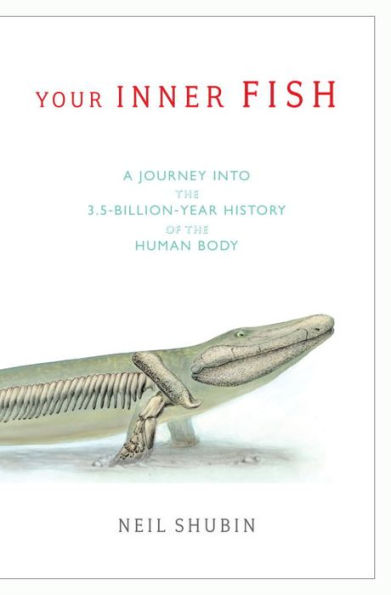
Your Inner Fish: A Journey into the 3.5-Billion-Year-History of the Human Body [NOOK Book]

NOOK Book (eBook)
$11.99
BN.com price

Available on NOOK devices and apps

  • Nook Devices
  • NOOK
  • NOOK Color
  • NOOK Tablet
  • Tablet/Phone
  • NOOK for iPad
  • NOOK for iPhone
  • NOOK for Android
  • NOOK for Android (Tablet)
  • NOOK Kids for iPad
  • PC/Mac
  • NOOK Study
  • NOOK for PC
  • NOOK for Mac

Want a NOOK? Explore Now

Overview

Why do we look the way we do? What does the human hand have in common with the wing of a fly? Are breasts, sweat glands, and scales connected in some way? To better understand the inner workings of our bodies and to trace the origins of many of today's most common diseases, we have to turn to unexpected sources: worms, flies, and even fish.
Neil Shubin, a leading paleontologist and professor of anatomy who discovered Tiktaalik--the "missing link" that made headlines around the world in April 2006--tells the story of evolution by tracing the organs of the human body back millions of years, long before the first creatures walked the earth. By examining fossils and DNA, Shubin shows us that...
See more details below

Overview

Why do we look the way we do? What does the human hand have in common with the wing of a fly? Are breasts, sweat glands, and scales connected in some way? To better understand the inner workings of our bodies and to trace the origins of many of today's most common diseases, we have to turn to unexpected sources: worms, flies, and even fish.
Neil Shubin, a leading paleontologist and professor of anatomy who discovered Tiktaalik--the "missing link" that made headlines around the world in April 2006--tells the story of evolution by tracing the organs of the human body back millions of years, long before the first creatures walked the earth. By examining fossils and DNA, Shubin shows us that our hands actually resemble fish fins, our head is organized like that of a long-extinct jawless fish, and major parts of our genome look and function like those of worms and bacteria.
Shubin makes us see ourselves and our world in a completely new light. Your Inner Fish is science writing at its finest--enlightening, accessible, and told with irresistible enthusiasm.
Editorial Reviews

Publishers Weekly

Fish paleontologist Shubin illuminates the subject of evolution with humor and clarity in this compelling look at how the human body evolved into its present state. Parsing the millennia-old genetic history of the human form is a natural project for Shubin, who chairs the department of organismal biology and anatomy at the University of Chicago and was co-discoverer of Tiktaalik, a 375-million-year-old fossil fish whose flat skull and limbs, and finger, toe, ankle and wrist bones, provide a link between fish and the earliest land-dwelling creatures. Shubin moves smoothly through the anatomical spectrum, finding ancient precursors to human teeth in a 200-million-year-old fossil of the mouse-size "part animal, part reptile" tritheledont; he also notes cellular similarities between humans and sponges. Other fossils reveal the origins of our senses, from the eye to that "wonderful Rube Goldberg contraption" the ear. Shubin excels at explaining the science, making each discovery an adventure, whether it's a Pennsylvania roadcut or a stony outcrop beset by polar bears and howling Arctic winds. "I can imagine few things more beautiful or intellectually profound than finding the basis for our humanity... nestled inside some of the most humble creatures that ever lived," he writes, and curious readers are likely to agree. Illus. (Jan. 15)

Copyright 2007 Reed Business Information
Library Journal

For his first book, Shubin (anatomy, Univ. of Chicago) has written a lively little volume for a general readership on the evolutionary legacy, bequeathed to us by our ancestors, of our bodies. The author is especially qualified to address this topic: an evolutionary developmental biologist with groundbreaking research programs in both paleontology and developmental genetics, Shubin also teaches human anatomy to medical students. One of the main players of the book is Tiktaalik, a 375 million-year-old fossil fish from the Arctic that Shubin and his research team discovered in 2004. This fish, the fish of the book title, had fins but also is the earliest known creature to have a neck and wrists, features usually associated with land vertebrates such as ourselves. Other chapters on the hand, the head, general body plans, the teeth, the sense organs, and various ailments address their evolutionary origins and the evidence of their beginnings within our bodies. This book is a wonder-filled introduction to our evolutionary heritage for lower-level undergraduates and the general public. This reviewer also hopes that Shubin will eventually write a book for more academic and advanced readers (in the manner of Sean Carroll). Highly recommended.
—Walter L. Cressler

The Barnes & Noble Review
I wish I had chanced upon Neil Shubin's captivating guided tour through "the 3.5-billion-year history of the human body" while recovering from my hernia-repair operation. The pain might have been momentarily mitigated by Shubin's revelation that the tendency of the human male to herniate "results from taking a fish body and morphing it into a mammal." In short, whereas the gonads of our ancestor the Ur-shark were safely tucked away in its torso, evolution prompted those of humans to drop down, resulting in a congenital weakness in the abdominal wall. Shubin's simple yet powerful method is to trace the intricate marvels of the human body as it currently exists through a survey of all those creatures whose DNA contributed to our own Darwinically mandated creation. As a paleontologist and professor of anatomy, Shubin is the ideal person to bop back and forth from fossils to genes, from the Devonian swamps to the genome-deciphering laboratories of today. The mechanics of evolution, inheritance, and bodily structures and organs are elegantly laid out, as Shubin draws on both milestone scientific research and his own considerable fieldwork. Aided by his facility for sprightly metaphors (cartilage is memorably described as a piece of Jell-O banded by collagen ropes), Shubin's prose goes down as smoothly as that of Stephen Jay Gould, as he earnestly conveys his appreciation for the often phantasmagorical and ironic results of Darwin's dead hand on our kludged-together organisms. But the crucial subtext is more profound: all artificial and troubling distinctions and divisions among humans disappear in light of our common heritage. Our intimacy with the rest of creation, he implies, should always be uppermost in our minds. --Paul DiFilippo

Product Details

  • ISBN-13: 9780307377166
  • Publisher: Knopf Doubleday Publishing Group
  • Publication date: 1/15/2008
  • Sold by: Random House
  • Format: eBook
  • Sales rank: 41,738
  • File size: 3 MB

Meet the Author

NEIL SHUBIN is provost of The Field Museum as well as a professor of anatomy at the University of Chicago, where he also serves as an associate dean. Educated at Columbia, Harvard, and the University of California at Berkeley, he lives in Chicago.

Read an Excerpt

Your Inner Fish
A Journey into the 3.5-Billion-Year History of the Human Body
By Neil Shubin
Pantheon
Copyright © 2008 Neil Shubin
All right reserved.

ISBN: 9780375424472


FINDING YOUR INNER FISH

Typical summers of my adult life are spent in snow and sleet, cracking rocks on cliffs well north of the Arctic Circle. Most of the time I freeze, get blisters, and find absolutely nothing. But if I have any luck, I find ancient fish bones. That may not sound like buried treasure to most people, but to me it is more valuable than gold.

Ancient fish bones can be a path to knowledge about who we are and how we got that way. We learn about our own bodies in seemingly bizarre places, ranging from the fossils of worms and fish recovered from rocks from around the world to the DNA in virtually every animal alive on earth today. But that does not explain my confidence about why skeletal remains from the past—and the remains of fish, no less—offer clues about the fundamental structure of our bodies.

How can we visualize events that happened millions and, in many cases, billions of years ago? Unfortunately, there were no eyewitnesses; none of us was around. In fact, nothing that talks or has a mouth or even a head was around for most of this time. Even worse, the animals that existed back then have been dead and buried for so long their bodies are only rarelypreserved. If you consider that over 99 percent of all species that ever lived are now extinct, that only a very small fraction are preserved as fossils, and that an even smaller fraction still are ever found, then any attempt to see our past seems doomed from the start.


DIGGING FOSSILS—SEEING OURSELVES

I first saw one of our inner fish on a snowy July afternoon while studying 375-million-year-old rocks on Ellesmere Island, at a latitude about 80 degrees north. My colleagues and I had traveled up to this desolate part of the world to try to discover one of the key stages in the shift from fish to land-living animals. Sticking out of the rocks was the snout of a fish. And not just any fish: a fish with a flat head. Once we saw the flat head we knew we were onto something. If more of this skeleton were found inside the cliff, it would reveal the early stages in the history of our skull, our neck, even our limbs.

What did a flat head tell me about the shift from sea to land? More relevant to my personal safety and comfort, why was I in the Arctic and not in Hawaii? The answers to these questions lie in the story of how we find fossils and how we use them to decipher our own past.

Fossils are one of the major lines of evidence that we use to understand ourselves. (Genes and embryos are others, which I will discuss later.) Most people do not know that finding fossils is something we can often do with surprising precision and predictability. We work at home to maximize our chances of success in the field. Then we let luck take over.

The paradoxical relationship between planning and chance is best described by Dwight D. Eisenhower’s famous remark about warfare: “In preparing for battle, I have found that planning is essential, but plans are useless.” This captures field paleontology in a nutshell. We make all kinds of plans to get us to promising fossil sites. Once we’re there, the entire field plan may be thrown out the window. Facts on the ground can change our best-laid plans.

Yet we can design expeditions to answer specific scientific questions. Using a few simple ideas, which I’ll talk about below, we can predict where important fossils might be found. Of course, we are not successful 100 percent of the time, but we strike it rich often enough to make things interesting. I have made a career out of doing just that: finding early mammals to answer questions of mammal origins, the earliest frogs to answer questions of frog origins, and some of the earliest limbed animals to understand the origins of land-living animals.

In many ways, field paleontologists have a significantly easier time finding new sites today than we ever did before. We know more about the geology of local areas, thanks to the geological exploration undertaken by local governments and oil and gas companies. The Internet gives us rapid access to maps, survey information, and aerial photos. I can even scan your backyard for promising fossil sites right from my laptop. To top it off, imaging and radiographic devices can see through some kinds of rock and allow us to visualize the bones inside.

Despite these advances, the hunt for the important fossils is much what it was a hundred years ago. Paleontologists still need to look at rock—literally to crawl over it—and the fossils within must often be removed by hand. So many decisions need to be made when prospecting for and removing fossil bone that these processes are difficult to automate. Besides, looking at a monitor screen to find fossils would never be nearly as much fun as actually digging for them.

What makes this tricky is that fossil sites are rare. To maximize our odds of success, we look for the convergence of three things. We look for places that have rocks of the right age, rocks of the right type to preserve fossils, and rocks that are exposed at the surface. There is another factor: serendipity. That I will show by example.

Our example will show us one of the great transitions in the history of life: the invasion of land by fish. For billions of years, all life lived only in water. Then, as of about 365 million years ago, creatures also inhabited land. Life in these two environments is radically different. Breathing in water requires very different organs than breathing in air. The same is true for excretion, feeding, and moving about. A whole new kind of body had to arise. At first glance, the divide between the two environments appears almost unbridgeable. But everything changes when we look at the evidence; what looks impossible actually happened.

In seeking rocks of the right age, we have a remarkable fact on our side. The fossils in the rocks of the world are not arranged at random. Where they sit, and what lies inside them, is most definitely ordered, and we can use this order to design our expeditions. Billions of years of change have left layer upon layer of different kinds of rock in the earth. The working assumption, which is easy to test, is that rocks on the top are younger than rocks on the bottom; this is usually true in areas that have a straightforward, layer-cake arrangement (think the Grand Canyon). But movements of the earth’s crust can cause faults that shift the position of the layers, putting older rocks on top of younger ones. Fortunately, once the positions of these faults are recognized, we can often piece the original sequence of layers back together.

The fossils inside these rock layers also follow a progression, with lower layers containing species entirely different from those in the layers above. If we could quarry a single column of rock that contained the entire history of life, we would find an extraordinary range of fossils. The lowest layers would contain little visible evidence of life. Layers above them would contain impressions of a diverse set of jellyfish-like things. Layers still higher would have creatures with skeletons, appendages, and various organs, such as eyes. Above those would be layers with the first animals to have backbones. And so on. The layers with the first people would be found higher still. Of course, a single column containing the entirety of earth history does not exist. Rather, the rocks in each location on earth represent only a small sliver of time. To get the whole picture, we need to put the pieces together by comparing the rocks themselves and the fossils inside them, much as if working a giant jigsaw puzzle.

That a column of rocks has a progression of fossil species probably comes as no surprise. Less obvious is that we can make detailed predictions about what the species in each layer might actually look like, by comparing them with species of animals that are alive today; this information helps us to predict the kinds of fossils we will find in ancient rock layers. In fact, the fossil sequences in the world’s rocks can be predicted by comparing ourselves with the animals at our local zoo or aquarium.

How can a walk through the zoo help us predict where we should look in the rocks to find important fossils? A zoo offers a great variety of creatures that are all distinct in many ways. But let’s not focus on what makes them distinct; to pull off our prediction, we need to focus on what different creatures share. We can then use the features common to all species to identify groups of creatures with similar traits. All the living things can be organized and arranged like a set of Russian nesting dolls, with smaller groups of animals comprised in bigger groups of animals. When we do this, we discover something very fundamental about nature.

Every species in the zoo and the aquarium has a head and two eyes. Call these species “Everythings.” A subset of the creatures with a head and two eyes has limbs. Call the limbed species “Everythings with limbs.” A subset of these headed and limbed creatures has a huge brain, walks on two feet, and speaks. That subset is us, humans. We could, of course, use this way of categorizing things to make many more subsets, but even this threefold division has predictive power.

The fossils inside the rocks of the world generally follow this order, and we can put it to use in designing new expeditions. To use the example above, the first member of the group “Everythings,” a creature with a head and two eyes, is found in the fossil record well before the first “Everything with limbs.” More precisely, the first fish (a card-carrying member of the “Everythings”) appears before the first amphibian (an “Everything with limbs”). Obviously, we refine this by looking at more kinds of animals and many more characteristics that groups of them share, as well as by assessing the actual age of the rocks themselves.

In our labs, we do exactly this type of analysis with thousands upon thousands of characteristics and species. We look at every bit of anatomy we can, and often at large chunks of DNA. There are so much data that we often need powerful computers to show us the groups within groups. This approach is the foundation of biology, because it enables us to make hypotheses about how creatures are related to one another.

Besides helping us refine the groupings of life, hundreds of years of fossil collection have produced a vast library, or catalogue, of the ages of the earth and the life on it. We can now identify general time periods when major changes occurred. Interested in the origin of mammals? Go to rocks from the period called the Early Mesozoic; geochemistry tells us that these rocks are likely about 210 million years old. Interested in the origin of primates? Go higher in the rock column, to the Cretaceous period, where rocks are about 80 million years old.

The order of fossils in the world’s rocks is powerful evidence of our connections to the rest of life. If, digging in 600-million-year-old rocks, we found the earliest jellyfish lying next to the skeleton of a woodchuck, then we would have to rewrite our texts. That woodchuck would have appeared earlier in the fossil record than the first mammal, reptile, or even fish—before even the first worm. Moreover, our ancient woodchuck would tell us that much of what we think we know about the history of the earth and life on it is wrong. Despite more than 150 years of people looking for fossils—on every continent of earth and in virtually every rock layer that is accessible—this observation has never been made.

Let’s now return to our problem of how to find relatives of the first fish to walk on land. In our grouping scheme, these creatures are somewhere between the “Everythings” and the “Everythings with limbs.” Map this to what we know of the rocks, and there is strong geological evidence that the period from 380 million to 365 million years ago is the critical time. The younger rocks in that range, those about 360 million years old, include diverse kinds of fossilized animals that we would all recognize as amphibians or reptiles. My colleague Jenny Clack at Cambridge University and others have uncovered amphibians from rocks in Greenland that are about 365 million years old. With their necks, their ears, and their four legs, they do not look like fish. But in rocks that are about 385 million years old, we find whole fish that look like, well, fish. They have fins, conical heads, and scales; and they have no necks. Given this, it is probably no great surprise that we should focus on rocks about 375 million years old to find evidence of the transition between fish and land-living animals.

We have settled on a time period to research, and so have identified the layers of the geological column we wish to investigate. Now the challenge is to find rocks that were formed under conditions capable of preserving fossils. Rocks form in different kinds of environments and these initial settings leave distinct signatures on the rock layers. Volcanic rocks are mostly out. No fish that we know of can live in lava. And even if such a fish existed, its fossilized bones would not survive the superheated conditions in which basalts, rhyolites, granites, and other igneous rocks are formed. We can also ignore metamorphic rocks, such as schist and marble, for they have undergone either superheating or extreme pressure since their initial formation. Whatever fossils might have been preserved in them have long since disappeared. Ideal to preserve fossils are sedimentary rocks: limestones, sandstones, siltstones, and shales. Compared with volcanic and metamorphic rocks, these are formed by more gentle processes, including the action of rivers, lakes, and seas. Not only are animals likely to live in such environments, but the sedimentary processes make these rocks more likely places to preserve fossils. For example, in an ocean or lake, particles constantly settle out of the water and are deposited on the bottom. Over time, as these particles accumulate, they are compressed by new, overriding layers. The gradual compression, coupled with chemical processes happening inside the rocks over long periods of time, means that any skeletons contained in the rocks stand a decent chance of fossilizing. Similar processes happen in and along streams. The general rule is that the gentler the flow of the stream or river, the better preserved the fossils.

Continues...

Excerpted from Your Inner Fish by Neil Shubin Copyright © 2008 by Neil Shubin. Excerpted by permission.
All rights reserved. No part of this excerpt may be reproduced or reprinted without permission in writing from the publisher.
Excerpts are provided by Dial-A-Book Inc. solely for the personal use of visitors to this web site.

Table of Contents


Preface     ix
Finding Your Inner Fish     3
Getting a Grip     28
Handy Genes     44
Teeth Everywhere     60
Getting Ahead     81
The Best-Laid (Body) Plans     97
Adventures in Bodybuilding     116
Making Scents     139
Vision     148
Ears     158
The Meaning of It All     173
Epilogue     199
Notes, References, and Further Reading     203
Acknowledgments     215
Index     219

Customer Reviews

Average Rating 4.5
( 65 )

Rating Distribution

5 Star

(42)

4 Star

(12)

3 Star

(4)

2 Star

(3)

1 Star

(4)

Your Rating:

Your Name: Create a Pen Name or Leave Anonymously

Barnes & Noble.com Review Rules

Our reader reviews allow you to share your comments on titles you liked, or didn't, with others. By submitting an online review, you are representing to Barnes & Noble.com that all information contained in your review is original and accurate in all respects, and that the submission of such content by you and the posting of such content by Barnes & Noble.com does not and will not violate the rights of any third party. Please follow the rules below to help ensure that your review can be posted.

Reviews by Our Customers Under the Age of 13

We highly value and respect everyone's opinion concerning the titles we offer. However, we cannot allow persons under the age of 13 to have accounts at BN.com or to post customer reviews. Please see our Terms of Use for more details.

What to exclude from your review:

Please do not write about reviews, commentary, or information posted on the product page. If you see any errors in the information on the product page, please send us an email.

Reviews should not contain any of the following:

  • - HTML tags, profanity, obscenities, vulgarities, or comments that defame anyone
  • - Time-sensitive information such as tour dates, signings, lectures, etc.
  • - Single-word reviews. Other people will read your review to discover why you liked or didn't like the title. Be descriptive.
  • - Comments focusing on the author or that may ruin the ending for others
  • - Phone numbers, addresses, URLs
  • - Pricing and availability information or alternative ordering information
  • - Advertisements or commercial solicitation

Reminder:

  • - By submitting a review, you grant to Barnes & Noble.com and its sublicensees the royalty-free, perpetual, irrevocable right and license to use the review in accordance with the Barnes & Noble.com Terms of Use.
  • - Barnes & Noble.com reserves the right not to post any review -- particularly those that do not follow the terms and conditions of these Rules. Barnes & Noble.com also reserves the right to remove any review at any time without notice.
  • - See Terms of Use for other conditions and disclaimers.
Search for Products You'd Like to Recommend

Recommend other products that relate to your review. Just search for them below and share!

Create a Pen Name

Your Pen Name is your unique identiy on BN.com. It will appear on the reviews you write and other website activities. Your Pen Name cannot be edited, changed or deleted once submitted.

Your Pen Name can be any combination of alphanumeric characters (plus - and _), and must be at least two characters long.

Continue Anonymously

We're sorry, but penname is already taken.

Please select one of the following:
Your Pen Name can be any combination of alphanumeric characters (plus - and _), and must be at least two characters long.

Continue Anonymously

penname is available!

By visiting the BN.com website or marking a purchase on BN.com, a User is deemed to have accepted the Terms of Use.

Continue Anonymously

Welcome, penname

You have successfully created your Pen Name. Start enjoying the benefits of the BN.com Community today.

See All Sort by: Showing 1 – 20 of 65 Customer Reviews
  • Anonymous

    Posted January 28, 2008

    A reviewer

    Dr. Schubin has truly succeeded in tracing a fun and informative account of human evolution by looking at fossil and extant homologues. Drawing (especially) from paleontology, but also from fields such as molecular genetics, Schubin takes the reader on an introductory ride through vertebrate form, function, and genetics. I would highly recommend this title as a must-have to any person interested in the biological, medical, or paleontological sciences, whether professional or avocational.

    5 out of 5 people found this review helpful.

    Was this review helpful? Yes  No   Report this review
  • Posted May 5, 2010

    more from this reviewer

    I Also Recommend:

    The Examination of a Beautiful Pedigree

    The prominent University of Chicago Paleontologist and Professor of Anatomy Neil Shubin graciously narrates the long Geological journey that has led to the structure and function of our current biological system. Shubin's account of his discovery of the 375 million year fish from Ellesmere Island is a warm tale of modern science in one of its finest lights. The timeline he provides of the 375 million years passed since Tiktaalik is thoroughly engaging and bound to have any curious reader interested in our life history and common ancestry hooked until the end. Shubin's work is certain to enlighten all. Scientist or non-scientist, you will learn something new, and at the very least you are destined to gain a greater appreciate of life!

    1 out of 1 people found this review helpful.

    Was this review helpful? Yes  No   Report this review
  • Anonymous

    Posted March 8, 2009

    Evolution at It's Best

    This book by Neil Shubin was an easy read, although I was not convinced with the author's opinions of how the human body came to be. Neil Shubin talked about how the human body was related to ancient fish found in fossils. He explores all over the world and shares his findings in this book. This book was an easy read with great pictures and graphs to explain each thought. The author had definite opinions about how the human form came to be. The author left no room for any religious theory.

    -OSU Comp. Student 2009

    1 out of 4 people found this review helpful.

    Was this review helpful? Yes  No   Report this review
  • Anonymous

    Posted February 21, 2008

    A MUST-READ FOR ALL EVOLUTION BUFFS ...

    A fascinating read that really makes you think. So interesting to see an esteemed scientist like Shubin taking on this subject so successfully, getting into the nitty gritty of what evolution is and what it is not. The only problem was that at times it could be quite dry and sometimes slow to read. On that note, I just finished another book that also really made me think. NATURAL SELECTION by Dave Freedman. It's a Jurassic Park type book - a science-based action-thriller about the evolution of a new species of flying predator. What made it special - besides how incredibly fast those pages turned - was how fun, relatable and easy-to-understand it made evolution, a great 'fictional compliment' to anything by Shubin.

    1 out of 1 people found this review helpful.

    Was this review helpful? Yes  No   Report this review
  • Posted March 28, 2012

    evolutionary biology for everyone

    This small-sized book teaches many of the key aspects of evolution by focusing features of you and me, like our hands and eyes and necks, and shows how they developed over the millennia from more ancient critters, not just earlier mammals or vertebrates but all the way back to bacteria. A really fun book to read, and nonetheless solidly accurate and never over-simplifying complex issues.

    Was this review helpful? Yes  No   Report this review
  • Anonymous

    Posted March 25, 2012

    Nice read.

    I would recommend it to anyone who is an environmentalist since it really allows us to see how related we really are to all animals not just chimps.

    Was this review helpful? Yes  No   Report this review
  • Posted November 4, 2011

    What a thought!

    My comments should be received in light of the fact that I'm a self-admitted science nerd. However, this book was liked by my wife also (English degree). Any person curious about the history of life on Earth will find this book fascinating. This fish (Tiktaalik) establishes an anatomical connection between it and goes all the way up the chain to mammals.

    Was this review helpful? Yes  No   Report this review
  • Posted May 21, 2011

    more from this reviewer

    A great exposition of the evolutionary development of the human body

    Among many reasons that make evolution of life such a fascinating subject to study, the fact that we can learn more about how we humans have become what we are today must rank close to the top. This is the basic premise behind Neil Shubin's "Your Inner Fish." Shubin's day job is field paleontologist, but the idea for this book came about when he taught some laboratory exercises in human anatomy. It turns out that his training in recognizing and categorizing bones of long-extinct creatures is an excellent preparation for understanding of how the human body works.

    The book is a fascinating and insightful journey into the 3.5 billion years of evolution. It combines scientific facts and information with personal stories and anecdotes. The scientific information is fresh and relevant, and it is not just a regurgitation of the material that can be found in a myriad other books on evolution. These facts really help you with gaining insight into how exactly all life on Earth is related.

    The last major chapter is probably the most interesting. It is an examination of the way that many of our chronic diseases and illnesses can be traced to the very restricted design options that evolution had. There really is a price that we pay for getting to where we are in the evolutionary development.

    Was this review helpful? Yes  No   Report this review
  • Anonymous

    Posted April 18, 2011

    Excellent read

    This is a great book for the Everyman. Short, sweet and to the point, the author really puts the vast evolutionary history of modern life into tangible perspective.

    Was this review helpful? Yes  No   Report this review
  • Posted April 8, 2011

    wow

    seriously pa28!!! where does god come from?

    0 out of 1 people found this review helpful.

    Was this review helpful? Yes  No   Report this review
  • Anonymous

    Posted March 7, 2011

    I love it.

    This book is great for anyone that wants to learn more about where we came from, and why we are the way we are. It take's you back to when we were all swimming around, and beyond. It contains all the logic and evidence that it needs to support its claims, and puts it all out there in an easy to read, easy to understand way. What a great book. I have it in paperback, and nookbook format.

    Was this review helpful? Yes  No   Report this review
  • Posted February 25, 2011

    Great Book!!!!!

    This book is not about faith please put that behind you and you enjoy it.

    Was this review helpful? Yes  No   Report this review
  • Anonymous

    Posted November 22, 2010

    Excellent read

    I like how the author explains technicalities in plain language. I enjoyed this book.

    Was this review helpful? Yes  No   Report this review
  • Posted November 1, 2010

    Boring!

    This was a book club choice so I had no idea what I was buying.
    As a Christian I find that it is sad that a person would dedicate so much time and research into proving "Where we come from"!
    It all comes down to faith....Fish don't talk or have feelings, so where does that come from????

    0 out of 8 people found this review helpful.

    Was this review helpful? Yes  No   Report this review
  • Posted March 13, 2010

    a good read.

    reading it put me in the mind set of the old natural history journals, translating well between the clinical scientific mind set and the more common workings mans logic that you don't always see. all in all a good book.

    Was this review helpful? Yes  No   Report this review
  • Anonymous

    Posted January 26, 2010

    Breaking the mold of science writing

    This is a fascinating book on a topic that is typically presented dryly: paleontology. A very readable and layperson assessable book, Dr. Neil Shubin has great story telling skills. He successfully incorporates a behind the scenes personal view of his research with facts from the fossil world and the paleontological thought process.
    A great introduction to the researchers and fossil record supporting evolution!

    Was this review helpful? Yes  No   Report this review
  • Posted December 20, 2009

    A Wonderful Book Connecting Human Evolution and Physiology

    This book is an excellent description of the the development of human physiology by the man who found the "missing link". For those interested in the scientific process it is great story to read. A refutation of all of the "creationist" arguments.

    Was this review helpful? Yes  No   Report this review
  • Posted October 10, 2009

    more from this reviewer

    Poorly written

    Many scientists think they have a great story to tell but unfortunately their writing skills do not match their enthusiasm. When I read this book I felt like the author was trying to make his research sound exciting and not achieving his goal. I think there is a story to be told here but Mr. Shubin should have let someone else tell it.

    0 out of 1 people found this review helpful.

    Was this review helpful? Yes  No   Report this review
  • Posted August 17, 2009

    more from this reviewer

    Will really make you think about where you came from!

    In this book, Mr. Shubin describes how various facets of our anatomy are derived from early evolutionary waypoints in animals such as sharks, fish, even worms and jellyfish. It is really amazing to think that our larynx is derived from the gills of fish and our ear bones can be traced to sharks. The books is well written and humorous at times, while always being easily understandable to the general reader like myself. A fascinating read and a very enjoyable book. I came away from it thinking how interconnected all life on earth really is. Recommended.

    Was this review helpful? Yes  No   Report this review
  • Posted May 25, 2009

    more from this reviewer

    I Also Recommend:

    You are a Zoo!

    This is a wonderfully written and engaging book which takes one on a paleontologist's journey to undersrtand the human body. The story line of discovery is quite enganging and the writing is basic and accessible to general readers yet makes accurate connections to recent discoveries and work. I highly recommend this book as essential reading for those who have a human body or know any human bodies. For Human Anatomy and Physiology students: it is a great way to quiz yourself!

    Was this review helpful? Yes  No   Report this review
See All Sort by: Showing 1 – 20 of 65 Customer Reviews

If you find inappropriate content, please report it to Barnes & Noble
Why is this product inappropriate?
Comments (optional)
500 character limit