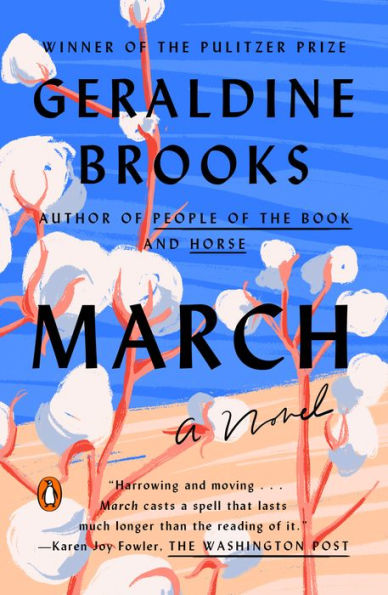
March

( 104 )

Pick Up in Store

Reserve and pick up in 60 minutes at your local store

Paperback (Reprint)
$13.98
BN.com price
$16.00 List Price (Save 13%)
Marketplace (New and Used)
from
$0.99
$16.00 List Price (Save 94%)
Usually ships within 1-2 business days
All (156)  
Used (134)  
New (22)  
Close
Sort by
Page 1 of 16
Showing 1 – 10 of 156 (16 pages)
$0.99
(Save 94%)
Seller since 2009

Feedback rating:

(777)

Condition:

New — never opened or used in original packaging.

Like New — packaging may have been opened. A "Like New" item is suitable to give as a gift.

Very Good — may have minor signs of wear on packaging but item works perfectly and has no damage.

Good — item is in good condition but packaging may have signs of shelf wear/aging or torn packaging. All specific defects should be noted in the Comments section associated with each item.

Acceptable — item is in working order but may show signs of wear such as scratches or torn packaging. All specific defects should be noted in the Comments section associated with each item.

Used — An item that has been opened and may show signs of wear. All specific defects should be noted in the Comments section associated with each item.

Refurbished — A used item that has been renewed or updated and verified to be in proper working condition. Not necessarily completed by the original manufacturer.

Good
Acceptable Book is in good reading condition. Cover has wear at edges and corners, and may have creases. Spine has wear at edges and may have creases.

Ships from: Washington, DC

Usually ships in 1-2 business days

  • Canadian
  • Standard, 48 States
  • Standard (AK, HI)
  • Express, 48 States
  • Express (AK, HI)
$0.99
(Save 94%)
Seller since 2007

Feedback rating:

(2538)

Condition: Good
2006 Paperback Good A copy that has been read, but remains in clean condition. All pages are intact, and the cover is intact (including dustcover, if applicable). The spine ... may show signs of wear. Pages can include limited notes and highlighting, and the copy can include "from the library of" labels. Read more Show Less

Ships from: Los Angeles, CA

Usually ships in 1-2 business days

  • Canadian
  • International
  • Standard, 48 States
  • Standard (AK, HI)
  • Express, 48 States
  • Express (AK, HI)
$1.01
(Save 94%)
Seller since 2011

Feedback rating:

(15)

Condition: Acceptable
2006 Paperback Fair ACCEPTABLE-Any or all listed conditions may apply: Covers may show wear( cracks, bends, rips, etc. )binding may show wear ( yet still intact) Pages May be ... worn, bent, dirty, yellowed with age, stained, etc. Item may include notations, underlining, highlighting, inscription. GOOD READING COPY-not typically collection worthy-USED CONDITION. WNYBOOKS Appreciates Your Patronage And Support. Thank You for Shopping With Us and Supporting The Goodwill Mission. Read more Show Less

Ships from: Buffalo, NY

Usually ships in 1-2 business days

  • Canadian
  • International
  • Standard, 48 States
  • Standard (AK, HI)
  • Express, 48 States
  • Express (AK, HI)
$1.49
(Save 91%)
Seller since 2010

Feedback rating:

(1047)

Condition: Good
2006 Paperback Good Cover and pages may have some wear or writing. Binding is tight. We ship daily Monday-Friday.

Ships from: Powder Springs, GA

Usually ships in 1-2 business days

  • Canadian
  • International
  • Standard, 48 States
  • Standard (AK, HI)
  • Express, 48 States
  • Express (AK, HI)
$1.79
(Save 89%)
Seller since 2009

Feedback rating:

(4409)

Condition: Acceptable
Some wear to the cover and pages. Text appears unmarked. Book is bent. Cover corners are worn. Ships the next business day, with tracking and delivery confirmation sent to your ... email. Read more Show Less

Ships from: Beaverton, OR

Usually ships in 1-2 business days

  • Standard, 48 States
  • Standard (AK, HI)
  • Express, 48 States
  • Express (AK, HI)
$1.89
(Save 88%)
Seller since 2009

Feedback rating:

(4409)

Condition: Acceptable
First several pages are wavy with water damage. Pages discolored due to aging. Some wear to the cover and pages. Text appears unmarked. Ships the next business day, with tracking ... and delivery confirmation sent to your email. Read more Show Less

Ships from: Beaverton, OR

Usually ships in 1-2 business days

  • Standard, 48 States
  • Standard (AK, HI)
  • Express, 48 States
  • Express (AK, HI)
$1.89
(Save 88%)
Seller since 2009

Feedback rating:

(4409)

Condition: Acceptable
Slight water damage. Some wear to the cover. Pages appear unmarked. Ships the next business day, with tracking and delivery confirmation sent to your email.

Ships from: Beaverton, OR

Usually ships in 1-2 business days

  • Standard, 48 States
  • Standard (AK, HI)
  • Express, 48 States
  • Express (AK, HI)
$1.89
(Save 88%)
Seller since 2009

Feedback rating:

(4409)

Condition: Acceptable
Small cover tear. Name written on outside page edges. Text appears unmarked. Ships the next business day, with tracking and delivery confirmation sent to your email.

Ships from: Beaverton, OR

Usually ships in 1-2 business days

  • Standard, 48 States
  • Standard (AK, HI)
  • Express, 48 States
  • Express (AK, HI)
$1.99
(Save 88%)
Seller since 2007

Feedback rating:

(450)

Condition: Good
used library discard w/ library markings and barcode, clean pgs, wear to book cover,

Ships from: Kokomo, IN

Usually ships in 1-2 business days

  • Canadian
  • International
  • Standard, 48 States
  • Standard (AK, HI)
  • Express, 48 States
  • Express (AK, HI)
$1.99
(Save 88%)
Seller since 2009

Feedback rating:

(4409)

Condition: Acceptable
Cover is creased. Some wear to the cover and pages. Has some underlining and writing. Water damage and staining on some pages. Ships the next business day, with tracking and ... delivery confirmation sent to your email. Read more Show Less

Ships from: Beaverton, OR

Usually ships in 1-2 business days

  • Standard, 48 States
  • Standard (AK, HI)
  • Express, 48 States
  • Express (AK, HI)
Page 1 of 16
Showing 1 – 10 of 156 (16 pages)
Close
Sort by
NOOK Book (eBook)
$12.99
BN.com price

Available on NOOK devices and apps

  • Nook Devices
  • NOOK
  • NOOK Color
  • NOOK Tablet
  • Tablet/Phone
  • NOOK for iPad
  • NOOK for iPhone
  • NOOK for Android
  • NOOK for Android (Tablet)
  • NOOK Kids for iPad
  • PC/Mac
  • NOOK Study
  • NOOK for PC
  • NOOK for Mac

Need a NOOK? Explore Now

Overview

From Louisa May Alcott's beloved classic Little Women, Geraldine Brooks has animated the character of the absent father, March, and crafted a story “filled with the ache of love and marriage and with the power of war upon the mind and heart of one unforgettable man” (Sue Monk Kidd). With “pitch-perfect writing” (USA Today), Brooks follows March as he leaves behind his family to aid the Union cause in the Civil War. His experiences will utterly change his marriage and challenge his most ardently held beliefs. A lushly written, wholly original tale steeped in the details of another time, March secures Geraldine Brooks's place as a renowned author of historical fiction.

“A very great book... It breathes new life into the historical fiction genre [and] honors the best of the imagination.” —Chicago Tribune
“A beautifully wrought story about how war dashes ideals, unhinges moral certainties and drives a wedge of bitter experience and unspeakable memories between husband and wife.” —Los Angeles Times Book Review
“Inspired... A disturbing, supple, and deeply satisfying story, put together with craft and care and imagery worthy of a poet.” —The Cleveland Plain Dealer
“Louisa May Alcott would be well pleased.” —The Economist

Winner of the 2006 Pulitzer Prize for Fiction

Editorial Reviews

Karen Joy Fowler
Brooks has taken a chance in evoking it so strongly at the end, but the chance pays off beautifully. March is an altogether successful book, casting a spell that lasts much longer than the reading of it.
— The Washington Post
From The Critics
Geraldine Brook's second novel is in every important way less accomplished than her first, Year of Wonders (2001). That book, which dealt with the assaults of plague on a 17th-century English village, derived some of its power from the way its resourceful heroine came to suspect the biological essence of the calamity she was up against: ''Perhaps the Plague was neither of God nor the Devil, but simply a thing in Nature, as the stone on which we stub a toe.'' Fearlessness -- and experimentation with herbs -- saw her through and won a reader's respect. In March, the ferocious nemeses conjured by Brooks are war and slavery, which, unlike impersonal disease, end up prompting the author and her characters toward a prolonged moral exhibitionism.
— The New York Times

Product Details

  • ISBN-13: 9780143036661
  • Publisher: Penguin Group (USA)
  • Publication date: 1/31/2006
  • Edition description: Reprint
  • Pages: 304
  • Sales rank: 29,257
  • Product dimensions: 5.12 (w) x 7.83 (h) x 0.61 (d)

Meet the Author

Geraldine Brooks
Geraldine Brooks
Journalist and author Geraldine Brooks won the Pulitzer Prize in fiction in 2006 for March, a novel that imagines the wartime experiences of the absent father in Louisa May Alcott's beloved classic Little Women.

Biography

Australian-born Geraldine Brooks is an author and journalist who grew up in the Western suburbs of Sydney and attended Bethlehem College Ashfield and the University of Sydney. She worked as a reporter for The Sydney Morning Herald for three years as a feature writer with a special interest in environmental issues.

In 1982 she won the Greg Shackleton Australian News Correspondents scholarship to the journalism master's program at Columbia University in New York City. Later she worked for The Wall Street Journal, where she covered crises in the the Middle East, Africa, and the Balkans.

Her first novel, Year of Wonders: A Novel of the Plague was an international bestseller. In 2006, she was awarded the Pulitzer Prize in fiction in 2006 for March, a story that imagines the Civil War experiences of the absent father in Louisa May Alcott's beloved classic Little Women. She has also written nonfiction, including Foreign Correspondence, an award-winning memoir about her search for the international penpals who enriched her childhood.

Read an Excerpt

chapter one

Virginia Is a Hard Road

October 21, 1861

This is what I write to her: The clouds tonight embossed the sky. A dipping sun gilded and brazed each raveling edge as if the firmament were threaded through with precious filaments. I pause there to mop my aching eye, which will not stop tearing. The line I have set down is, perhaps, on the florid side of fine, but no matter: she is a gentle critic. My hand, which I note is flecked with traces of dried phlegm, has the tremor of exhaustion. Forgive my unlovely script, for an army on the march provides no tranquil place for reflection and correspondence. (I hope my dear young author is finding time amid all her many good works to make some use of my little den, and that her friendly rats will not grudge a short absence from her accustomed aerie.) And yet to sit here under the shelter of a great tree as the men make their cook fires and banter together provides a measure of peace. I write on the lap desk that you and the girls so thoughtfully provided me, and though I spilled my store of ink you need not trouble to send more, as one of the men has shown me an ingenious receipt for a serviceable substitute made from the seasonís last blackberries. So am I able to send ìsweet wordsî to you!


Do you recall the marbled endpapers in the Spenser that I used to read to you on crisp fall evenings just such as this? If so, then you, my dearest one, can see the sky as I saw it here tonight, for the colors swirled across the heavens in just such a happy profusion.

And the blood that perfused the silted eddies of the boot-stirred river also formed a design that is not unlike those fine endpapers.Oróbetterólike that spill of carmine ink when the impatient hand of our little artist overturned the well upon our floorboards. But these lines, of course, I do not set down. I promised her that I would write something every day, and I find myself turning to this obligation when my mind is most troubled. For it is as if she were here with me for a moment, her calming hand resting lightly upon my shoulder. Yet I am thankful that she is not here, to see what I must see, to know what I am come to know. And with this thought I exculpate my censorship: I never promised I would write the truth.

I compose a few rote words of spousal longing, and follow these with some professions of fatherly tenderness: All and each of you I have in my mind, in parlor, study, chambers, lawn; with book or with pen, or hand in hand with sister dear, or holding talk the while of father, a long way off, and wondering where he is and how he does. Know that I can never leave you quite; for while my body is far away my mind is near and my best comfort is in your affection...Then I plead the press of my duties, closing with a promise soon to send more news.

My duties, to be sure, are pressing enough. There are needful men all around me. But I do not immediately close my lap desk. I let it lie across my knees and continue to watch the clouds, their knopped masses blackened now in the almost lightless sky. No wonder simple men have always had their gods dwell in the high places. For as soon as a man lets his eye drop from the heavens to the horizon, he risks setting it on some scene of desolation.

Downriver, men of the burial party wade chest deep to retrieve bodies snagged on fallen branches. Contra what I have written, there is no banter tonight, and the fires are few and ill tended, so that the stinging smoke troubles my still-weeping eye. There is a turkey vulture staring at me from a limb of sycamore. They have been with us all day, these massive birds. Just this morning, I had thought them stately, in the pearly predawn light, perched still as gargoyles, wings widespread, waiting for the rising sun. They did not move through all the long hours of our Potomac crossing, first to our muster on this island, which sits like a giant barge in the midstream, splicing the wide water into rushing narrows. They watched, motionless still, as we crossed to the farther shore and made our silent ascent up the slippery cow path on the face of the bluff. Later, I noticed them again. They had taken wing at last, inscribing high, graceful arcs over the field. From up there, at least, our predicament must have been plain: the enemy in control of the knoll before us, laying down a withering fire, while through the woods to our left more troops moved in stealthy file to flank us. As chaplain, I had no orders, and so placed myself where I believed I could do most good. I was in the rear, praying with the wounded, when the cry went up: Great God, they are upon us!

I called for bearers to carry off the wounded men. One private, running, called to me that any who tried it would be shot full of more bullets than he had fingers and toes. Silas Stone, but lightly injured then, was stumbling on a twisted knee, so I gave him my arm and together we plunged into the woods, joining the chaos of the rout. We were trying to recover the top of the cow pathóthe only plain way down to the riverówhen we came upo another turkey vulture, close enough to touch it. It was perched on the chest of a fallen man and turned its head sharply at our intrusion. A length of organ, glossy and brown, dangled from its beak. Stone raised his musket, but he was already so spent that his hands shook violently. I had to remind him that if we didnít find the river and get across it, we, too, would be vulture food.

We thrashed our way out of the thicket atop a promontory many rods short of the cow path. From there, we could see a mass of our men, pushed by advancing fire to the very brow of the bluff. They hesitated there, and then, of a sudden, seemed to move as one, like a herd of beasts stampeded. Men rolled, leaped, stumbled over the edge. The drop is steep: some ninety feet of staggered scarps plunging to the river. There were screams as men, bereft of reason, flung themselves upon the heads and bayonets of their fellows below. I saw the heavy boot of one stout soldier land with sickening force onto the skull of a slight youth, mashing the bone against rock. There was no point now in trying to reach the path, since any footholds it might once have afforded were worn slick by the frenzied descent. I crawled to the edge of the promontory and dangled from my hands before dropping hard onto a narrow ledge, all covered with black walnuts. These sent me skidding. Silas Stone rolled and fell after me. It wasnít until we reached the water-laved bank that he told me he could not swim.

The enemy was firing from the cliff top by then. Some few of our men commenced tying white rags to sticks and climbing back up to surrender. Most flung themselves into the river; many, in their panic, forgetting to shed their cartri boxes and other gear, the weight of which quickly dragged them under. The only boats were the two mud scows that had ferried us across. For these, men flung themselves until they were clinging as a cluster of bees dangling from a hive, and slipping off in clumps, four or five together. Those that held on were plain targets and did not last long.

I dragged off my boots and made Stone do the same, and bade him hurl his musket far out, to the deepest channel, so as to put it from reach of our enemies. Then we plunged into the chill water and struck out toward the island. I thought we could wade most of the way, for crossing at dawn, the poles had seemed to go down no significant depth. But I had not accounted for the strength of the current, nor the cold. ìI will get you across,î I had promised him, and I might have done, if the bullet hadnít found him, and if he hadnít thrashed so, and if his coat, where I clutched it, hadnít been shoddily woven. I could hear the rip of thread from thread, even over the tumbling water and the yelling. His right hand was on my throat, his fingersócallused tradesmanís fingersódepressing the soft, small bones around my windpipe. His left hand clutched for my head. I ducked, trying vainly to refuse him a grip, knowing he would push me under in his panic. He managed to snatch a handful of my hair, his thumb, as he did so, jabbing into my left eye. I went under, and the mass of him pushed me down, deep. I jerked my head back, felt a burn in my scalp as a handful of hair ripped free, and my knee came up, hard, into something that gave like marrow. His hand slid from my throat, the jagged nail of his middle finger tearing away a piece of my skin.

We broke surface, spewing red-brown water. I still had a grip on his tearing jacket, and if he had stopped his thrashing, even then, I might have seized a stouter handful of cloth. But the current was too fast there, and it tugged apart the last few straining threads. His eyes changed when he realized. The panic just seemed to drain away, so that his last look was a blank, unfocused thingóthe kind of stare a newborn baby gives you. He stopped yelling. His final sound was more of a long sigh, only it came out as a gargle because his throat was filling with water. The current bore him away from me feet first. He was prone on the surface for a moment, his arms stretched out to me. I swam hard, but just as I came within reach a wave, turning back upon a sunken rock, caught his legs and pushed the lower half of his body under, so that it seemed he stood upright in the river for a moment. The current spun him round, a full turn, his arms thrown upward with the abandon of a Gypsy dancer. The firing, high on the bluff, had loosed showers of foliage, so that he swirled in concert with the sunshine-colored leaves. He was face to face with me again when the water sucked him under. A ribbon of scarlet unfurled to mark his going, widening out like a sash as the current carried him, down and away. When I dragged myself ashore, I still had the torn fragment of wet wool clutched in my fist.

I have it now: a rough circle of blue cloth, a scant six inches across. Perhaps the sum total of the mortal remains of Silas Stone, wood turner and scholar, twenty years old, who grew up by the Blackstone River and yet never learned to swim. I resolved to send it to his mother. He was her only son.

I wonder where h Wedged under a rock, with a thousand small mouths already sucking on his spongy flesh. Or floating still, on and down, on and down, to wider, calmer reaches of the river. I see them gathering: the drowned, the shot. Their hands float out to touch each other, fingertip to fingertip. In a day, two days, they will glide on, a funeral flotilla, past the unfinished white dome rising out of its scaffolds on a muddy hill in Washington. Will the citizens recognize them, the brave fallen, and uncover in a gesture of respect? Or will they turn away, disgusted by the bloated mass of human rot?

I should go now and find out where upon this island they are tending to the wounded. Naturally, the surgeon has not seen fit to send me word. The surgeon is a Calvinist, and a grim man, impatient with unlabeled brands of inchoate faith. In his view, a man should be a master of his craft, so that a smith should know his forge, a farmer his plow, and a chaplain his creed. He has made plain his disregard for me and my ministry. The first time I preached to the company, he observed that in his view a sermon that did not dwell on damnation was scant service to men daily facing death, and that if he wanted to hear a love poem he would apply to his wife.

I dragged a hand through my hair, which has dried out in tangled mats, like discarded corn silks at a husking. Even to raise my arm for that slight effort is a misery. Every muscle aches. My aunt was right, perhaps, in her bitter denunciation of my coming here: the cusp of a manís fortieth year is no season for such an enterprise as this. And yet what manner of man would I be, who has had so much to say in the contest of words, if now I shirked this contest of blood? So I will stand here with those who stand in arms, as long as my legs can support me. But, as a private from Millbury observed to me today, ìVirginia is a hard road, reckon.î

I stowed the lap desk in my rucksack. We had left the main part of our gear here on the island, but my blanket was sodden from the use of it to dry myself and to blot my soaking clothes. Still, there is some warmth in wool, wet or no. I carried it to a youth who lay, curled and keening, on the riverbank. The boy was dripping wet and shivering. I expected he would be on fire with fever by morning. ìWill you not come up the bank with me to some drier ground?î I asked. He made no reply, so I tucked the blanket around him where he lay. We will both sleep cold tonight. And yet not, I think, as cold as Silas Stone.

I made my way a few rods through the mud and then, where the bank dipped a little, scrambled with some difficulty into a mown field. In the flicker of firelight I discerned a small band of walking wounded sitting listless in the hollows of a haystack where they would shiver out the night. I inquired from them where the hospital tents had been established. ìThere ainít no tents: theyíre using some old secesh house,î said a private, nursing a bandaged arm. ìStrange place it is, with big white statues all nekked, and rooms filled up with old books. Thereís an old secesh lives there, cracked as a clay pot dropped on rock, seemingly, with just one slave doing for him. Sheís helping our surgeon, if youíd credit it. She probed out my wound for me and bound it up fine, like you see,î he said, proudly raising his sling, then wincing as he did so. ìShe tolí me they was more than a dozen slaves o the place before, and she the only one ainít ran off.î

I donít think the private knew his left from right, for his directions to the house were less than coherent, and his friend, whose neck was bandaged and who couldnít speak, kept waving his hands in objection at every turn the other man described. So I blundered on in the dark, finding myself at the riverbank again, uncertain whether the farther shore was Maryland or Virginia. I turned back and found a line of snake-rail fence that led past the ruins of what must have once been a gristmill. I continued following the fence line until it turned in at a gate. Beyond stretched a drive lined with dogwoods, and a gravel of river stone that was hard on my bootless feet.

And then I knew I was on the right path, for I smelled it. If only field hospitals did not always have the selfsame reek as latrine trenches. But so it is when metal lays open the bowels of living men and the wastes of digestion spill about. And there is, too, the lesser stink, of fresh-butchered meat, which to me is almost equally rank. I stopped, and turned aside into the bushes, and heaved up bitter fluid. Something about my state just then, bent double and weak, brought to my mind the recollection of my father, caning me, for refusing my share of salt pork. He believed a meatless diet such as mine made me listless at my chores. But what I shirked were the tasks themselves, foul and cruel. No soul should be asked to toil all day with the yellow oxen yoked up, unwilling, their hide worn raw by the harness, their big blank eyes empty of hope. It drains the spirit, to trudge sunup till sundown at the arse-end of beasts, sinking into piles of their steaming ordure. And t pigs! How could anyone eat pork who has heard the screams at slaughter when the black blood spurts?

Perhaps it was the darkness, or the different season. Perhaps my biliousness and grief and exhaustion. Perhaps simply that twenty years is a very long time for an active mind to retain any memory, much less one with dark and troubled edges, begging to be forgot. Whatever the case, I was halfway up the wide stone steps before I recognized the house. I had been there before.

Interviews & Essays

AN INTERVIEW WITH GERALDINE BROOKS In your afterword, you make an amusing apology to your husband, a well-known writer and Civil War afficionado, for your previous lack of appreciation for his passion. Although you say you're not sure "when or where" it happened, would you talk a bit about your change of heart and what led to your new and profound interest in the American Civil War and eventually to the writing of March ?

In the early 1990s we came to live in a small Virginia village where Civil War history is all around us. There are bullet scars on the bricks of the Baptist church where a skirmish took place; we have a Union soldier's belt buckle that was unearthed near the old well in our courtyard. The village was Quaker, and abolitionist, but in the midst of the Confederacy. The war brought huge issues of conscience for the townsfolk, a few of whom sacrificed their nonviolent principles to raise a regiment to fight on the Union side. It was thinking about the people who once lived in our house, and the moral challenges the war presented for them, that kindled my interest in imagining an idealist adrift in that war. I am gripped by the stories of individuals from the generation Oliver Wendell Holmes so eloquently described when he said: "In our youth our hearts were touched with fire." I'm still not all that interested in the order of battles, I still drive Tony crazy by failing to keep the chronology straight, and offered the choice between a trip to the dentist and another midsummer reenactment, it'd be a hard call. But sometimes, alone on a battlefield as the mists rise over the grass, I feel like a time traveler, born back by the ghosts of all those vivid, missing boys.

Grace Clement is such an extraordinary character and is pivotal in shaping March's life. You tell us that her voice was inspired by an 1861 autobiography, but what inspired you to create a romantic relationship between Grace and March? Were there any historical hints that Alcott had had such a relationship?

The idea of an attraction between March and Grace is entirely imagined and not at all suggested by Bronson Alcott's biography. It grew naturally out of the narrative: they are young and attractive when they first meet, he is an idealist, she is a compelling person in a dramatic and moving situation. It seemed inevitable to me.

A year after March enlists he says, "One day I hope to go back. To my wife, to my girls, but also to the man of moral certainty that I was . . . that innocent man, who knew with such clear confidence exactly what it was that he was meant to do." Do you think he can go back? Is it even possible? Would you discuss how you think March changes by the end of the novel and what parts of him remain intact?

I don't think he can go back. Nor do I think it is necessarily desirable. Moral certainty can deafen people to any truth other than their own. By the end of the book, March is damaged, but he is still an idealist; it's just that he sees more clearly the cost of his ideals, and understands that he is not the only one who must pay for them.

Your book Nine Parts of Desire deals with the issues of Muslim women. Year of Wonders had a female heroine, Anna Frith. How was it different writing principally from a man's point of view this time?

I have always believed that the human heart is the human heart, no matter what century we live in, what country we inhabit, or what gender we happen to be. This is a book about strong feelings: love and fear. I can't believe there's much difference in how a man or a woman experiences them. And then, I had the journals and letters of Bronson Alcott, which are perhaps as complete a record of a Victorian man's interior life as any you could find. It is quite a surprise to suddenly hear Marmee's voice in Part Two. Can you talk about how and why you decided to change the point of view here?

The structure of March was laid down for me before the first line was written, because my character has to exist within Louisa May Alcott's Little Women plotline. That meant March has to go to the hospital gravely ill and Marmee has to arrive to tend him. The alternative to switching voices would have been to continue the narrative in March's voice, disoriented by his delirium. But giving Marmee a voice seemed like an opportunity to me to better explore some of the themes of communication, and miscommunication, in a marriage. Also, the book was written against the tumult of my own feelings about the war with Iraq, and as I started to write in Marmee's voice I found that she could naturally articulate a frustration, grief, and confusion that seemed in common between us.

The American Civil War was enormously complex with different political, social, economic, and psychological factors all playing a role. What did you learn from your research that may have surprised you and, other than your obvious newfound interest, is your opinion of the war any different now than when you started?

Nations inevitably fall into the trap of romanticizing their militaries and are always astonished when the truth of awful atrocities is revealed, as it inevitably is in almost every war. There were plenty of hate-filled racists in Lincoln's army, fighting side by side with the celebrated idealists. March's growing dismay as he learns this in a way reflects my own journey to a more complete understanding.

Would you talk a bit about how your past work as a foreign correspondent informs your current writing? What do you think historical fiction can achieve that nonfiction cannot? Would you ever entertain the idea of writing a novel about current events?

Write what you know. It's the first advice given to writers. I did draw on some experiences of war from my correspondent years. You see things during war, and you can never unsee them. The thing that most attracts me to historical fiction is taking the factual record as far as it is known, using that as scaffolding, and then letting imagination build the structure that fills in those things we can never find out for sure. And to do that you use all the experiences you can. While I love to read contemporary fiction, I'm not drawn to writing it. Perhaps it's because the former journalist in me is too inhibited by the press of reality; when I think about writing of my own time I always think about nonfiction narratives. Or perhaps it's just that I find the present too confounding.

What are you working on now?

Another historical novel based on a true story, but one where the truth is not completely known, and so there are intriguing voids for the imagination to fill. Like March and Year of Wonders it has a lot to do with faith and catastrophe.

Reading Group Guide

INTRODUCTION FROM THE PUBLISHER
With her critically acclaimed and bestselling novel Year of Wonders, Geraldine Brooks was praised for her passionate rendering and careful research in vividly imagining the effects of the bubonic plague on a small English village in the seventeenth century. Now, Brooks turns her talents to exploring the devastation and moral complexities of the Civil War through her brilliantly imagined tale of Mr. March, the absent father from Louisa May Alcott's Little Women . In Mr. March, Brooks has created a conflicted and deeply sensitive man, a father who is struggling to reconcile duty to his fellow man with duty to his family against the backdrop of one of the most grim periods in American history.

October 21, 1861. March, an army chaplain, has just survived a brush with death as his unit crossed the Potomac and experienced the small but terrible battle of Ball's Bluff. But when he sits down to write his daily missive to his beloved wife, Marmee, he does not talk of the death and destruction around him, but of clouds "emboss[ing] the sky," his longing for home, and how he misses his four beautiful daughters. "I never promised I would write the truth," he admits, if only to himself.

When he first enlisted, March was an idealistic man. He knew, above all else, that fighting this war for the Union cause was right and just. But he had not expected he would begin a journey through hell on earth, where the lines between right and wrong, good and evil, were too often blurred.

For now, however, he has no choice but to press on. He is directed to a makeshift hospital, an old estate he finds strangely familiar. It was here, more than twenty years earlier, that he first met Grace, a beautiful, literate slave. She was the woman who provided his first kiss and who changed the course of his life.

Now, he finds himself back at the Clement estate, and what was once the most beautiful place he had ever seen has been transformed by the ugliness of war. However, March's sojourn there is brief and he finds himself reassigned to set up a school on one of the liberated plantations, Oak Landing-a disastrous posting that leaves him all but dead.

Though rescued and delivered to a Washington hospital where his physical health improves, March is a broken man, haunted by all he has witnessed and "a conscience ablaze with guilt" over the many people he feels he has failed. And when it is time for him to leave he finds he does not want to return home. He turns to Grace, whom he has encountered once again, for guidance. "None of us is without sin," she tells him. "Go home, Mr. March." So, March returns to his wife and daughters, and though he is tormented by the past and worried for his country's future, the present, at least, is certain: he is home, he is a father again, and for now, that will be enough.

ABOUT GERALDINE BROOKS
Geraldine Brooks is the author of Year of Wonders and the nonfiction works Nine Parts of Desire and Foreign Correspondence . Previously, Brooks was a correspondent for The Wall Street Journal , stationed in Bosnia, Somalia, and the Middle East.

DISCUSSION QUESTIONS FROM THE PUBLISHER
1. Throughout the novel, March and Marmee, although devoted to one another, seem to misunderstand each other quite a bit and often do not tell each other the complete truth. Discuss examples of where this happens and how things may have turned out differently, for better or worse, had they been completely honest. Are there times when it is best not to tell our loved ones the truth?

2. The causes of the American Civil War were multiple and overlapping. What was your opinion of the war when you first came to the novel, and has it changed at all since reading March ?

3. March's relationships with both Marmee and Grace are pivotal in his life. Discuss the differences between these two relationships and how they help to shape March, his worldview, and his future. What other people and events were pivotal in shaping March's beliefs?

4. Do you think it was the right decision for March to have supported, financially or morally, the northern abolitionist John Brown? Brown's tactics were controversial, but did the ends justify the means?

5. "If war can ever be said to be just, then this war is so; it is action for a moral cause, with the most rigorous of intellectual underpinnings. And yet everywhere I turn, I see injustice done in the waging of it," says March (p. 65). Do you think that March still believes the war is just by the end of the novel? Why or why not?

6. What is your opinion of March's enlisting? Should he have stayed home with his family? How do we decide when to put our principles ahead of our personal obligations?

7. When Marmee is speaking of her husband's enlisting in the army, she makes a very eloquent statement: "A sacrifice such as his is called noble by the world. But the world will not help me put back together what war has broken apart" (p. 210). Do her words have resonance in today's world? How are the people who fight our wars today perceived? Do you think we pay enough attention to the families of those in the military? Have our opinions been influenced at all by the inclusion of women in the military?

8. The war raged on for several years after March's return home. How do you imagine he spent those remaining years of the war? How do you think his relationship with Marmee changed? How might it have stayed the same?

Customer Reviews
Average Rating 4
( 104 )

Rating Distribution

If you've bought this product, tell the world how you liked it.
Write a Review
See All Sort by: Showing 1 – 20 of 104 Customer Reviews
  • Posted July 12, 2009

    more from this reviewer

    I Also Recommend:

    What Ever Happened with Mr. March, Father and Husband of the Little Women?

    I loved reading this book, the key word here being "reading". It has been a long time since I have thoroughly enjoyed the process of reading, per se. I approached March with some trepidation, having previously read Geraldine Brooks' book, People of the Book, which I bought in hard cover, thus spending a chunk of change on it, and in the end was somewhat disappointed. March does not disappoint. It is the story of what happened to the father in Louisa May Alcott's classic Little Women. To enjoy this book, you don't need to have read Little Women, however, I've heard it said that in March, one can find echoes of Little Women. It is written in language, styled from its day, early 1860's, and at times it reads as poetry. The book is about the father's experiences in his position as a Chaplain in the Union army, positioned below the Mason-Dixon line. It moves between New England, where the family lives, and the places of war. There is no lack of demonstrating the savagery of war and the savagery of Slavery and racism. War is neither idealized, nor demonized in the book.

    The author uses two techniques that I love to find in fiction. The first is mixing in real historical characters among her fictional ones (reminiscent of E.L. Doctorow's Ragtime and The Book of Daniel) so you feel you are getting to personally know them, in this case... Henry David Thoreau and Ralph Waldo Emerson are neighbors of the March family. You get to see John Brown, the famous abolitionist who advocated insurrection as his means of ridding the country of slavery, as basically having tricked Dr. March into lending him a huge sum of money and consequently losing it all, which proved to be the financial downfall of March and his family. It is a very interesting interplay of fact and fiction. The other device, that I have always loved, is the use of letter writing as a means of moving the story along ( this for me is reminiscent of one of my all time favorite novels, A Woman of Independent Means, by Elizabeth Forsyth Hailey). It is in March's letters that some of the most beautiful descriptions and eloquent use of language can be found. Here is but one example...

    "There was a little barge-ferry then, that would stop on request, at a jetty on the island's northern tip. I had alighted there on a whim and walked the mile and a half to the house whistling the song of the boatman who had poled the crossing. The white dogwoods were in flower all the way up the drive, and the air seemed viscous and honey-fragrant, unlike the mud-scent of a chill May morning on Spindle Hill."

    I highly recommend this book.

    4 out of 5 people found this review helpful.

    Was this review helpful? Yes  No   Report this review
  • Anonymous

    Posted November 5, 2006

    Astoundingly disappointing.

    When I heard about the premise of this book--a novel about the father of the March Sisters from that perennial favorite 'Little Women'--I was tremendously excited. When that novel shortly thereafter received the Pulitzer, I rushed right out to get it from the library, even though I thought I would probably end up buying it. I'm so glad I didn't. I've been interested in Bronson Alcott and his community for some time, and was rabid to know how Brooks based Mr. March on him. My first problem with the book was this: in elementary school, I was a historical novel fan, and read a great many civil war books, and as I read I realized to my disappointment that there was nothing new in 'March.' I felt like I had read such similar happenings, such similar moral dilemmas before that I was left bewildered. My second problem was this: Brooks, apparently unable to write the character of Marmee as Louisa May Alcott created her, chose instead to make her into a completely different person, and one who I strongly disliked. I was left feeling like Brooks hadn't taken 'Little Women' itself very seriously, but had rather used it as a gimmick. All in all, I think there are many better books available, and urge you to read those.

    4 out of 7 people found this review helpful.

    Was this review helpful? Yes  No   Report this review
  • Posted April 30, 2009

    more from this reviewer

    Impacting Poetic Writing Style

    Geraldine Brooks has written such a full and rich story in so small a book. I almost put it down after reading the first few pages because the writing was so descriptive that I felt as if I was amongst the wounded soldiers in the civil war (and I am very squeamish). I am glad that I pressed on though because the book was unique and enlightening. It tells the imagined story of Mr March of Alcott's Little Women. It is by no means an imitation of Alcott's style or content though. Brooks story is tragic, intense and 'real' in it's portrayal of the human condition. "March" examines the morality of the intellect alongside the passions and failings of human nature.

    2 out of 2 people found this review helpful.

    Was this review helpful? Yes  No   Report this review
  • Anonymous

    Posted December 6, 2009

    thoughtful and inventive

    took Mr. March out of Little Women scenerio and gave him a life of his own. Brings the Cival War to life thru Mr. March in a different way. Also deals with racism and the ethos of slavery and how it relates to where we are today in our nation. quite inventive and insightful. A bit hard to read at first until you get used to the manner of the prose. But worth the read. Good for a book club.

    1 out of 1 people found this review helpful.

    Was this review helpful? Yes  No   Report this review
  • Posted July 9, 2009

    I loved this book

    Many other people have reviewed this book, so you do not need another plot summary. All I can say is --READ THIS BOOK. It is wonderful.

    1 out of 1 people found this review helpful.

    Was this review helpful? Yes  No   Report this review
  • Posted March 24, 2009

    March by Geraldine Brooks (Katie)

    March by Geraldine Brooks takes us on a journey back in time, and into the middle of hell; the civil war where a brother may come to kill a brother. She begins with Mr. March's wonderful letters, being a compassionate man he writes to his wife often on his "lap desk" however, even though he is in the middle of a war, that is not entirely the picture he sends to her. For her he centers the conversation within his letter on the concept that his ink is in fact made of black berries. Instead of telling his wife of war he gives her "sweet words" showing us how his love can drive him to see only a little blood on the table of a butcher. Somehow he had to gain the strength to whisper a prayer so close into a young man's; a Childs ear, as the surgeons blade soon came down upon that part of him which could now only serve to be a Burdon.
    This is not entirely a love story, not at all! But it is a story of war, and why people fight them; the freedom of that child who no longer has a mother to fight for him. Geraldine gives this child a true voice not educated in proper grammar; he is not allowed to learn it as a slave. She describes pain even in happy moments, the forbidden love, or ambition Mr. March has to educate those who are not lucky enough to know their ABC's, or perhaps are not allowed to know them. Mr. March did profoundly love his wife a conductor of the Underground Railroad and his love for her is no doubt a part of his ambition to go on this dreadful journey.
    March by Geraldine Brooks is both a heart wrenching and inspiring story, it depicts Mr. March constantly surrounded by death or suffering "For as soon as a man lets his eye drop from the heavens to the horizon, he risks setting it on some scene of desolation." However Mr. March appears strong, though humanly so, he does not cease to inspire.

    1 out of 1 people found this review helpful.

    Was this review helpful? Yes  No   Report this review
  • Posted March 9, 2009

    Not MY Mr.March!

    While I can appreciate the author's desire to write a Civil War book from a unique angle, I feel Geraldine Brooks did not study her literary research carefully enough. I consider myself fairly knowledgeable about Louisa May Alcott, having read all of her works (Little Women repeatedly) and books concerning her life. Therefore, I approached Ms. Brooks' March with interest, seeking to find what Mr. March, the father of Little Women, might have done during his stint in the Civil War. From the first, though, I kept thinking: who is she writing about? Having Mr. March gush about his first meetings with Marmee (mentioning her gorgeous voice, although she never notably sang in Little Women) was too much. Suddenly Marmee had this wild temper and was politically involved in major issues of the day. Louisa May Alcott always presented Marmee in a light of quiet wisdom--yes, she told Jo she had had her own wild streak, but one had the feeling it had long been assimilated into a more constructive form. Ms. Brooks also seems to have borrowed heavily from Bronson Alcott (Louisa's actual father) for her portrayal of Mr. March. L.M Alcott, on the other hand, tempered the depiction of her Little Women's father with intelligence: Mr. March was a respected, wise man. But in Ms. Brooks' rendition, he seems to have been taken over by a demon striving for a best-seller.

    1 out of 1 people found this review helpful.

    Was this review helpful? Yes  No   Report this review
  • Anonymous

    Posted January 15, 2008

    Little Women for the grown-up

    When a book is written about a family, the perspective change will inevitably create a vast change in the tale: how many of us could reflect accurately of the intimacy of another's marriage, while we could expound forever on the nuances of our own. Readers must be willing to make this shift--- Lest you overlook an intimate, wonderful story, and lose the chance to place yourself in those times for a moment or two. Unlike one review which cites Brooks as 'ruining' Marmee, I felt wholeheartedly that what Brooks provides the reader is a glimpse of the MOTHER as she feels within her own heart while 'Little Women' portrays her as she is seen BY her daughter. What woman would wish for her child to see or hear or observe her doubts about her marriage, her struggle for self-discipline, her moments of anguish, or even the mixed underlayment of the 'public' victories? At least none of us would wish for our child to witness them raw, only perhaps deduce a more subtle version of the effects of the 'tough times'. I felt that Brooks was honest to this difference of view point and NAILED the frequent misperceptions between the spouses, at times almost humorously. For those who like me are modestly sensitive to the legacy of MS Alcott, Brooks does, 'I feel', keep intact the faithfulness and steadfast NATURE of the characters. In the end they typically choose the noble way to act, even if you must 'forgive' them their humanness in their thoughts. I felt this novel reflects how many people have kept their marriages together across time, in tough times, and relayed a depth to the characters that could OFTEN be omitted due to carrying the plot as high priority. Here the character development WAS the plot. Well done.

    1 out of 1 people found this review helpful.

    Was this review helpful? Yes  No   Report this review
  • Anonymous

    Posted July 25, 2007

    Falls very short...

    The premise of this book is amazing itself, but in Brooks' hands, it was ruined. Instead of writing a book as a continuation of Little Women, Brooks destroyed the characters I so love from the literary classic. Marmee is everything in March that she is not in Little Women Brooks would have done better to just create a new woman all together. There were several repetitive passages as well. I often felt like I had just read what I was reading. Frankly, Brooks promises much more than she delivers.

    1 out of 2 people found this review helpful.

    Was this review helpful? Yes  No   Report this review
  • Posted January 31, 2012

    more from this reviewer

    Very good read -- recommended

    I loved Little Women. In fact, I would go so far as to say it shaped my moral landscape as a child. So I read this book with great anticipation, and I will say that I feel that Brooks did an excellent job of portraying Mr. March. His voice completely fits in with the March family. My one criticism is her portrayal of Marmee. Although she explains her choices in the Afterword, I feel she overplayed her hand. That said, this is still most definitely a recommended read.

    Was this review helpful? Yes  No   Report this review
  • Anonymous

    Posted January 29, 2012

    Great read!

    I read one of her books last year and she quickly became one of my favorite authors. I love her characters, because despite being overall good people they are usually greatly flawed in some way, and they struggle to accept the mistakes they have made in their lives.

    Was this review helpful? Yes  No   Report this review
  • Posted October 17, 2011

    If you're going to ride the coattails of an American Classic, show a little respect to the author's efforts.

    Although Brooks has a talent for description and tempo in general, the entire premise of this novel is, to me, arrogant.

    If you're going to write a civil war story, use your own characters. Don't knock off of beloved characters from a book designed to create hope and courage by slinging it through the gutter.

    Most of the characters I read in March were so dissimilar it made me feel ashamed that this book would ever be associated with Little Women. Pulitzer Prize or no, this author needs to grow a backbone and let a novel stand on it's own.

    Was this review helpful? Yes  No   Report this review
  • Posted September 29, 2011

    Deserves another Pulitzer.....Excellent

    Beautifully written historical story of a familiar American family during and preceding the Civil War. Geraldine Brooks creates a wonderful window looking backward onto this time period and presents it like a beautiful poem. Very believable. I love the way she writes. I also thoroughly enjoyed reading "People of the Book" that she wrote later. Great author and great story teller.

    Was this review helpful? Yes  No   Report this review
  • Posted December 12, 2009

    I Also Recommend:

    Not "my" Geraldine Brooks

    I became infatuated with Brooks with "Book" and fell in love after reading "Year". "March" left me nonplussed. I think it is a topic not of interest to me, not her.

    0 out of 2 people found this review helpful.

    Was this review helpful? Yes  No   Report this review
  • Posted August 15, 2009

    more from this reviewer

    Another Wonderful Book by Geraldine Brooks

    Geraldine Brooks writes prose that is a delight to read. Her historical research in thorough, and she makes the characters come alive. This book is enjoyable even if the reader has read extensive material about the Civil War. The viewpoint of Mr. March as an abolitionist participating in the war with Union troops is quite unique. I highly recommend this book.

    Was this review helpful? Yes  No   Report this review
  • Anonymous

    Posted November 3, 2007

    A reviewer

    This was a fabulous take on some literary characters who were based on real folks! I loved that they weren't all sugary and sweet, patriotic but ignorant! They saw their situations and the situations of others in the harsh light of reality. Mr. March found that his high aspirations were unrealistic and had to adjust! Mrs. March was a strong woman and mother/wife who did the best she could with her situation. These were real people and not the unreal goody-goody characters of the children's classic. They grew older and wiser as they matured - just as, hopefully, we all will do!

    Was this review helpful? Yes  No   Report this review
  • Anonymous

    Posted June 5, 2007

    A reviewer

    This book is written as if the main characters are animals, and they would be surprised. Read it and see what I mean,.

    Was this review helpful? Yes  No   Report this review
  • Anonymous

    Posted July 23, 2006

    A Wonderful Surprise

    I had no idea what to expect when I was given this book, but by the end I was amazed. Brooks makes Mr. March into a realistic, remarkable character. The book reminds readers of the atrocity of war and the heartbreak it brings. Another unexpected delight was the presence of historical characters like Thoreau and Emerson. Highly recommended.

    Was this review helpful? Yes  No   Report this review
  • Anonymous

    Posted April 20, 2006

    Read it before it won

    Okay, so I know how to pick them. I read this book before it won and I was telling everyone the MUST read it. Those who didn't listen are now diving in--head first. I've read everything this guy has written, starting with RAGTIME and working my way up. It's all good, but MARCH is his best so far.

    0 out of 1 people found this review helpful.

    Was this review helpful? Yes  No   Report this review
  • Anonymous

    Posted April 21, 2006

    Post Pulitzer Prize

    As I was watching McNeil's News on Monday, I happened to realize that the book I had finished 2 days earlier had just received the Pulitzer Prize for Literature! Ms. Brooks created a lovely story with a flowing pace. The dominant character deserves much of his self-criticism, but in all, he was loyal to his crumbling ideals. The landscape was easy to picture for me, and I have never been to the East Coast. The author has given us a real gem, and like many pieces of great literature, it will need several reeds to fully grasp the depth and breadth of its scope.

    Was this review helpful? Yes  No   Report this review
See All Sort by: Showing 1 – 20 of 104 Customer Reviews

If you find inappropriate content, please report it to Barnes & Noble
Why is this product inappropriate?
Comments (optional)
500 character limit