Read an Excerpt
Introduction by Linda Lear
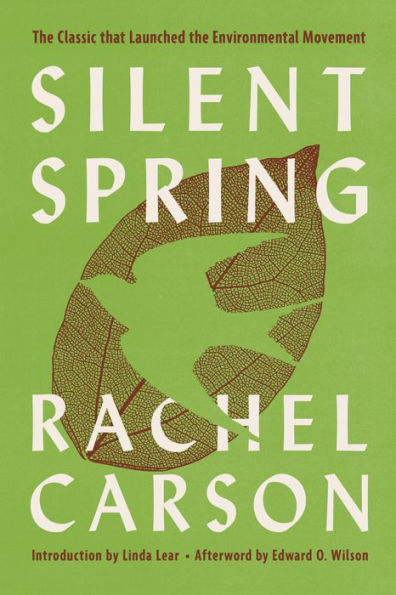
Headlines in the New York Times in July 1962 captured the national sentiment: “Silent Spring is now noisy summer.” In the few months between the New Yorker’s serialization of Silent Spring in June and its publication in book form that September, Rachel Carson’s alarm touched off a national debate on the use of chemical pesticides, the responsibility of science, and the limits of technological progress. When Carson died barely eighteen months later in the spring of 1964, at the age of fifty-six, she had set in motion a course of events that would result in a ban on the domestic production of DDT and the creation of a grass-roots movement demanding protection of the environment through state and federal regulation. Carson’s writing initiated a transformation in the relationship between humans and the natural world and stirred an awakening of public environmental consciousness.
It is hard to remember the cultural climate that greeted Silent Spring and to understand the fury that was launched against its quietly determined author. Carson’s thesis that we were subjecting ourselves to slow poisoning by the misuse of chemical pesticides that polluted the environment may seem like common currency now, but in 1962 Silent Spring contained the kernel of social revolution. Carson wrote at a time of new affluence and intense social conformity. The cold war, with its climate of suspicion and intolerance, was at its zenith. The chemical industry, one of the chief beneficiaries of postwar technology, was also one of the chief authors of the nation’s prosperity. DDT enabled the conquest of insect pests in agriculture and of ancient insect-borne disease just as surely as the atomic bomb destroyed America’s military enemies and dramatically altered the balance of power between humans and nature. The public endowed chemists, at work in their starched white coats in remote laboratories, with almost divine wisdom. The results of their labors were gilded with the presumption of beneficence. In postwar America, science was god, and science was male.
Carson was an outsider who had never been part of the scientific establishment, first because she was a woman but also because her chosen field, biology, was held in low esteem in the nuclear age. Her career path was nontraditional; she had no academic affiliation, no institutional voice. She deliberately wrote for the public rather than for a narrow scientific audience. For anyone else, such independence would have been an enormous detriment. But by the time Silent Spring was published, Carson’s outsider status had become a distinct advantage. As the science establishment would discover, it was impossible to dismiss her.
Rachel Carson first discovered nature in the company of her mother, a devotee of the nature study movement. She wandered the banks of the Allegheny River in the pristine village of Springdale, Pennsylvania, just north of Pittsburgh, observing the wildlife and plants around her and particularly curious about the habits of birds.
Her childhood, though isolated by poverty and family turmoil, was not lonely. She loved to read and displayed an obvious talent for writing, publishing her first story in a children’s literary magazine at the age of ten. By the time she entered Pennsylvania College for Women (now Chatham College), she had read widely in the English Romantic tradition and had articulated a personal sense of mission, her “vision splendid.” A dynamic female zoology professor expanded her intellectual horizons by urging her to take the daring step of majoring in biology rather than English. In doing so, Carson discovered that science not only engaged her mind but gave her “something to write about.” She decided to pursue a career in science, aware that in the 1930s there were few opportunities for women.
Scholarships allowed her to study at Woods Hole Biological Laboratory, where she fell in love with the sea, and at Johns Hopkins University, where she was isolated, one of a handful of women in marine biology. She had no mentors and no money to continue in graduate school after completing an M.A. in zoology in 1932. Along the way she worked as a laboratory assistant in the school of public health, where she was lucky enough to receive some training in experimental genetics. As employment opportunities in science dwindled, she began writing articles about the natural history of Chesapeake Bay for the Baltimore Sun. Although these were years of financial and emotional struggle, Carson realized that she did not have to choose between science and writing, that she had the talent to do both.
From childhood on, Carson was interested in the long history of the earthh, in its patterns and rhythms, its ancient seas, its evolving life forms. She was an ecologist—fascinated by intersections and connections buttttt always aware of the whole—before that perspective was accorded scholarly legitimacy. A fossil shell she found while digging in the hills above the Allegheny as a little girl prompted questions about the creatures of the oceans that had once covered the area. At Johns Hopkins, an experiment with changes in the salinity of water in an eel tank prompted her to study the life cycle of those ancient fish that migrate from continental rivers to the Sargasso Sea. The desire to understand the sea from a nonhuman perspective led to her first book, Under the Sea-Wind, which featured a common sea bird, the sanderling, whose life cycle, driven by ancestral instincts, the rhythms of the tides, and the search for food, involves an arduous journey from Patagonia to the Arctic Circle. From the outset Carson acknowledged her “kinship with other forms of life” and always wrote to impress that relationship on her readers.
Carson was confronted with the problem of environmental pollution at a formative period in her life. During her adolescence the second wave of the industrial revolution was turning the Pittsburgh area into the iron and steel capital of the Western world. The little town of Springdale, sandwiched between two huge coal-.red electric plants, was transformed into a grimy wasteland, its air fouled by chemical emissions, its river polluted by industrial waste. Carson could not wait to escape. She observed that the captains of industry took no notice of the defilement of her hometown and no responsibility for it. The experience made her forever suspicious of promises of “better living through chemistry” and of claims that technology would create a progressively brighter future.
In 1936 Carson landed a job as a part-time writer of radio scripts on ocean life for the federal Bureau of Fisheries in Baltimore. By night she wrote freelance articles for the Sun describing the pollution of the oyster beds of the Chesapeake by industrial runoff; she urged changes in oyster seeding and dredging practices and political regulation of the effluents pouring into the bay. She signed her articles “R. L. Carson,” hoping that readers would assume that the writer was male and thus take her science seriously.
A year later Carson became a junior aquatic biologist for the Bureau of Fisheries, one of only two professional women there, and began a slow but steady advance through the ranks of the agency, which became the U.S. Fish and Wildlife Service in 1939. Her literary talents were quickly recognized, and she was assigned to edit other scientists’ field reports, a task she turned into an opportunity to broaden her scientific knowledge, deepen her connection with nature, and observe the making of science policy. By 1949 Carson was editor in chief of all the agency’s publications, writing her own distinguished series on the new U.S wildlife refuge system and participating in interagency conferences on the latest developments in science and technology.
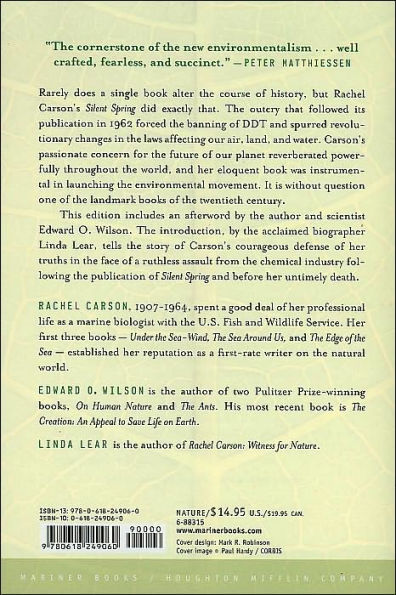
Her government responsibilities slowed the pace of her own writing. It took her ten years to synthesize the latest research on oceanography, but her perseverance paid off. She became an overnight literary celebrity when The Sea Around Us was first serialized in The New Yorker in 1951. The book won many awards, including the National Book Award for nonfiction, and Carson was elected to the American Academy of Arts and Letters. She was lauded not only for her scientific expertise and synthesis of wide-ranging material but also for her lyrical, poetic voice. The Sea Around Us and its best- selling successor, The Edge of the Sea, made Rachel Carson the foremost science writer in America. She understood that there was a deep need for writers who could report on and interpret the natural world. Readers around the world found comfort in her clear explanations of complex science, her description of the creation of the seas, and her obvious love of the wonders of nature. Hers was a trusted voice in a world riddled by uncertainty.
Whenever she spoke in public, however, she took notice of ominous new trends. “Intoxicated with a sense of his own power,” she wrote, “[mankind] seems to be going farther and farther into more experiments for the destruction of himself and his world.” Technology, she feared, was moving on a faster trajectory than mankind’s sense of moral responsibility. In 1945 she tried to interest Reader’s Digest in the alarming evidence of environmental damage from the widespread use of the new synthetic chemical DDT and other long-lasting agricultural pesticides. By 1957 Carson believed that these chemicals were potentially harmful to the long-term health of the whole biota. The pollution of the environment by the profligate use of toxic chemicals was the ultimate act of human hubris, a product of ignorance and greed that she felt compelled to bear witness against. She insisted that what science conceived and technology made possible must first be judged for its safety and benefit to the “whole stream of life.” “There would be no peace for me, she wrote to a friend, “if I kept silent.”
Silent Spring, the product of her unrest, deliberately challenged the wisdom of a government that allowed toxic chemicals to be put into the environment before knowing the long-term consequences of their use. Writing in language that everyone could understand and cleverly using the public’s knowledge of atomic fallout as a reference point, Carson described how chlorinated hydrocarbons and organic phosphorus insecticides altered the cellular processes of plants, animals, and, by implication, humans. Science and technology, she charged, had become the handmaidens of the chemical industry’s rush for profits and control of markets. Rather than protecting the public from potential harm, the government not only gave its approval to these new products but did so without establishing any mechanism of accountability. Carson questioned the moral right of government to leave its citizens unprotected from substances they could neither physically avoid nor publicly question. Such callous arrogance could end only in the destruction of the living world. “Can anyone believe it is possible to lay down such a barrage of poisons on the surface of the earth without making it unfit for all life?” she asked. “They should not be called ‘insecticides’ but ‘biocides.’” In Silent Spring, and later in testimony before a congressional committee, Carson asserted that one of the most basic human rights must surely be the “right of the citizen to be secure in his own home against the intrusion of poisons applied by other persons.” Through ignorance, greed, and negligence, government had allowed “poisonous and biologically potent chemicals” to fall “indiscriminately into the hands of persons largely or wholly ignorant of their potentials for harm.” When the public protested, it was “fed little tranquillizing pills of half-truth” by a government that refused to take responsibility for or acknowledge evidence of damage. Carson challenged such moral vacuity. “The obligation to endure,” she wrote, “gives us the right to know.” In Carson’s view, the postwar culture of science that arrogantly claimed dominion over nature was the philosophic root of the problem. Human beings, she insisted, were not in control of nature but simply one of its parts: the survival of one part depended upon the health of all. She protested the “contamination of man’s total environment” with substances that accumulate in the tissues of plants, animals, and humans and have the potential to alter the genetic structure of organisms.
Carson argued that the human body was permeable and, as such, vulnerable to toxic substances in the environment. Levels of exposure could not be controlled, and scientists could not accurately predict the long-term effects of bioaccumulation in the cells or the impact of such a mixture of chemicals on human health. She categorically rejected the notion proposed by industry that there were human “thresholds” for such poisons, as well as its corollary, that the human body had “assimilative capacities” that rendered the poisons harmless. In one of the most controversial parts of her book, Carson presented evidence that some human cancers were linked to pesticide exposure. That evidence and its subsequent elaboration by many other researchers continue to fuel one of the most challenging and acrimonious debates within the scientific and environmental communities.
Carson’s concept of the ecology of the human body was a major departure in our thinking about the relationship between humans and the natural environment. It had enormous consequences for our understanding of human health as well as our attitudes toward environmental risk. Silent Spring proved that our bodies are not boundaries. Chemical corruption of the globe affects us from conception to death. Like the rest of nature, we are vulnerable to pesticides; we too are permeable. All forms of life are more alike than different.
Carson believed that human health would ultimately reflect the environment’s ills. Inevitably this idea has changed our response to nature, to science, and to the technologies that devise and deliver contamination. Although the scientific community has been slow to acknowledge this aspect of Carson’s work, her concept of the ecology of the human body may well prove to be one of her most lasting contributions.
In 1962, however, the multimillion-dollar industrial chemical industry was not about to allow a former government editor, a female scientist without a Ph.D. or an institutional affiliation, known only for her lyrical books on the sea, to undermine public confidence in its products or to question its integrity. It was clear to the industry that Rachel Carson was a hysterical woman whose alarming view of the future could be ignored or, if necessary, suppressed. She was a “bird and bunny lover,” a woman who kept cats and was therefore clearly suspect. She was a romantic “spinster” who was simply overwrought about genetics. In short, Carson was a woman out of control. She had overstepped the bounds of her gender and her science. But just in case her claims did gain an audience, the industry spent a quarter of a million dollars to discredit her research and malign her character. In the end, the worst they could say was that she had told only one side of the story and had based her argument on unverifiable case studies.
There is another, private side to the controversy over Silent Spring. Unbeknown to her detractors in government and industry, Carson was fighting a far more powerful enemy than corporate outrage: a rapidly metastasizing breast cancer. The miracle is that she lived to complete the book at all, enduring a “catalogue of illnesses,” as she called it. She was immune to the chemical industry’s efforts to malign her; rather, her energies were focused on the challenge of survival in order to bear witness to the truth as she saw it. She intended to disturb and disrupt, and she did so with dignity and deliberation.
After Silent Spring caught the attention of President John F. Kennedy, federal and state investigations were launched into the validity of Carson’s claims. Communities that had been subjected to aerial spraying of pesticides against their wishes began to organize on a grass-roots level against the continuation of toxic pollution. Legislation was readied at all governmental levels to defend against a new kind of invisible fallout. The scientists who had claimed a “holy grail” of knowledge were forced to admit a vast ignorance. While Carson knew that one book could not alter the dynamic of the capitalist system, an environmental movement grew from her challenge, led by a public that demanded that science and government be held accountable. Carson remains an example of what one committed individual can do to change the direction of society. She was a revolutionary spokesperson for the rights of all life. She dared to speak out and confront the issue of the destruction of nature and to frame it as a debate over the quality of all life.
Rachel Carson knew before she died that her work had made a difference. She was honored by medals and awards, and posthumously received the Presidential Medal of Freedom in 1981. But she also knew that the issues she had raised would not be solved quickly or easily and that affluent societies are slow to sacrifice for the good of the whole. It was not until six years after Carson’s death that concerned Americans celebrated the first Earth Day and that Congress passed the National Environmental Policy Act establishing the Environmental Protection Agency as a buffer against our own handiwork. The domestic production of DDT was banned, but not its export, ensuring that the pollution of the earth’s atmosphere, oceans, streams, and wildlife would continue unabated. DDT is found in the livers of birds and fish on every oceanic island on the planet and in the breast milk of every mother. In spite of decades of environmental protest and awareness, and in spite of Rachel Carson’s apocalyptic call alerting Americans to the problem of toxic chemicals, reduction of the use of pesticides has been one of the major policy failures of the environmental era. Global contamination is a fact of modern life.
Silent Spring compels each generation to reevaluate its relationship to the natural world. We are a nation still debating the questions it raised, still unresolved as to how to act for the common good, how to achieve environmental justice. In arguing that public health and the environment, human and natural, are inseparable, Rachel Carson insisted that the role of the expert had to be limited by democratic access and must include public debate about the risks of hazardous technologies. She knew then, as we have learned since, that scientific evidence by its very nature is incomplete and scientists will inevitably disagree on what constitutes certain proof of harm. It is difficult to make public policy in such cases when government’s obligation to protect is mitigated by the nature of science itself.
Rachel Carson left us a legacy that not only embraces the future of life, in which she believed so fervently, but sustains the human spirit. She confronted us with the chemical corruption of the globe and called on us to regulate our appetites—a truly revolutionary stance—for our self- preservation. “It seems reasonable to believe,” she wrote, “that the more clearly we can focus our attention on the wonders and realities of the universe about us, the less taste we shall have for the destruction of our race. Wonder and humility are wholesome emotions, and they do not exist side by side with a lust for destruction.” Wonder and humility are just some of the gifts of Silent Spring. They remind us that we, like all other living creatures, are part of the vast ecosystems of the earth, part of the whole stream of life. This is a book to relish: not for the dark side of human nature, but for the promise of life’s possibility.
Copyright © 1962 by Rachel L. Carson Copyright © renewed 1990 by Roger Christie Introduction copyright © 2002 by Linda Lear Reprinted by permission of Houghton Mifflin Company.