Uh-oh, it looks like your Internet Explorer is out of date.
For a better shopping experience, please upgrade now.
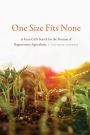
One Size Fits None: A Farm Girl's Search for the Promise of Regenerative Agriculture
“Sustainable” has long been the rallying cry of agricultural progressives; given that much of our nation’s farm and ranch land is already degraded, however, sustainable agriculture often means maintaining a less-than-ideal status quo. Industrial agriculture has also co-opted the term for marketing purposes without implementing better practices. Stephanie Anderson argues that in order to provide nutrient-rich food and fight climate change, we need to move beyond sustainable to regenerative agriculture, a practice that is highly tailored to local environments and renews resources. In One Size Fits None Anderson follows diverse farmers across the United States: a South Dakota bison rancher who provides an alternative to the industrial feedlot; an organic vegetable farmer in Florida who harvests microgreens; a New Mexico super-small farmer who revitalizes communities; and a North Dakota midsize farmer who combines livestock and grain farming to convert expensive farmland back to native prairie. The use of these nontraditional agricultural techniques show how varied operations can give back to the earth rather than degrade it. This book will resonate with anyone concerned about the future of food in America, providing guidance for creating a better, regenerative agricultural future.Download a discussion guide (PDF).
1128511346
One Size Fits None: A Farm Girl's Search for the Promise of Regenerative Agriculture
“Sustainable” has long been the rallying cry of agricultural progressives; given that much of our nation’s farm and ranch land is already degraded, however, sustainable agriculture often means maintaining a less-than-ideal status quo. Industrial agriculture has also co-opted the term for marketing purposes without implementing better practices. Stephanie Anderson argues that in order to provide nutrient-rich food and fight climate change, we need to move beyond sustainable to regenerative agriculture, a practice that is highly tailored to local environments and renews resources. In One Size Fits None Anderson follows diverse farmers across the United States: a South Dakota bison rancher who provides an alternative to the industrial feedlot; an organic vegetable farmer in Florida who harvests microgreens; a New Mexico super-small farmer who revitalizes communities; and a North Dakota midsize farmer who combines livestock and grain farming to convert expensive farmland back to native prairie. The use of these nontraditional agricultural techniques show how varied operations can give back to the earth rather than degrade it. This book will resonate with anyone concerned about the future of food in America, providing guidance for creating a better, regenerative agricultural future.Download a discussion guide (PDF).
21.95
In Stock
51
One Size Fits None: A Farm Girl's Search for the Promise of Regenerative Agriculture
“Sustainable” has long been the rallying cry of agricultural progressives; given that much of our nation’s farm and ranch land is already degraded, however, sustainable agriculture often means maintaining a less-than-ideal status quo. Industrial agriculture has also co-opted the term for marketing purposes without implementing better practices. Stephanie Anderson argues that in order to provide nutrient-rich food and fight climate change, we need to move beyond sustainable to regenerative agriculture, a practice that is highly tailored to local environments and renews resources. In One Size Fits None Anderson follows diverse farmers across the United States: a South Dakota bison rancher who provides an alternative to the industrial feedlot; an organic vegetable farmer in Florida who harvests microgreens; a New Mexico super-small farmer who revitalizes communities; and a North Dakota midsize farmer who combines livestock and grain farming to convert expensive farmland back to native prairie. The use of these nontraditional agricultural techniques show how varied operations can give back to the earth rather than degrade it. This book will resonate with anyone concerned about the future of food in America, providing guidance for creating a better, regenerative agricultural future.Download a discussion guide (PDF).
Stephanie Anderson is an instructor of English at Florida Atlantic University. She grew up on a ranch, has worked as a writer and photographer for the humanitarian aid organization Cross International, and served as an editor for the agricultural newspaper Tri-State Neighbor in South Dakota. Anderson’s work has appeared in Grist Journal, Sweet, the Chronicle Review, the Rumpus, and Kudzu House Quarterly.
Table of Contents
Introduction Part One: Conventional 1. The Vice President 2. The Farm We Grew 3. The Growth of Roth Farms 4. The Farm Town 5. The Muck Part Two: Holistic Regenerative 6. The Holistic Philosophy 7. The Grass 8. The Buffalo 9. The End of the CAFO 10. The Sun’s Wealth Part Three: Organic Regenerative 11. The Surfing Farmer 12. The Mission 13. The Plants 14. The Lifestyle 15. The Consumer 16. The Farmer Goes to the Table 17. The Urban Farmer 18. The Agriculturalized City Part Four: Diversified Regenerative 19. The Diversified Farm 20. The Soil 21. The Abundance of an Acre 22. The Livestock 23. The Alternative to Hay 24. The Restoration of the Native Prairie 25. The Farmers’ Market 26. The Message to Conventional Farmers Conclusion Acknowledgments Notes Bibliography