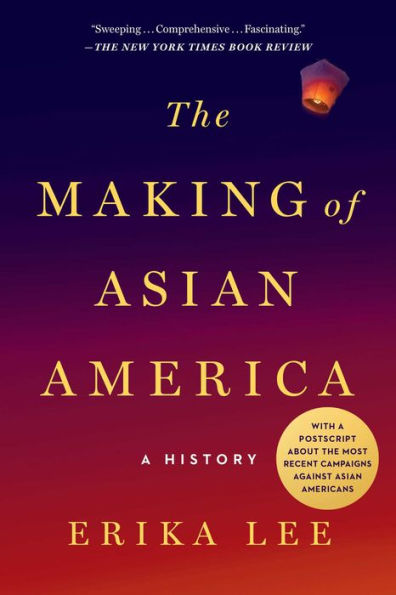
The Making of Asian America: A History
A “comprehensive…fascinating” (The New York Times Book Review) history of Asian Americans and their role in American life, by one of the nation’s preeminent scholars on the subject, with a new afterword about the recent hate crimes against Asian Americans.

In the past fifty years, Asian Americans have helped change the face of America and are now the fastest growing group in the United States. But much of their long history has been forgotten. “In her sweeping, powerful new book, Erika Lee considers the rich, complicated, and sometimes invisible histories of Asians in the United States” (Huffington Post).

The Making of Asian America shows how generations of Asian immigrants and their American-born descendants have made and remade Asian American life, from sailors who came on the first trans-Pacific ships in the 1500 to the Japanese Americans incarcerated during World War II. Over the past fifty years, a new Asian America has emerged out of community activism and the arrival of new immigrants and refugees. But as Lee shows, Asian Americans have continued to struggle as both “despised minorities” and “model minorities,” revealing all the ways that racism has persisted in their lives and in the life of the country.

Published fifty years after the passage of the United States’ Immigration and Nationality Act of 1965, these “powerful Asian American stories…are inspiring, and Lee herself does them justice in a book that is long overdue” (Los Angeles Times). But more than that, The Making of Asian America is an “epic and eye-opening” (Minneapolis Star-Tribune) new way of understanding America itself, its complicated histories of race and immigration, and its place in the world today.
1120678889
The Making of Asian America: A History
A “comprehensive…fascinating” (The New York Times Book Review) history of Asian Americans and their role in American life, by one of the nation’s preeminent scholars on the subject, with a new afterword about the recent hate crimes against Asian Americans.

In the past fifty years, Asian Americans have helped change the face of America and are now the fastest growing group in the United States. But much of their long history has been forgotten. “In her sweeping, powerful new book, Erika Lee considers the rich, complicated, and sometimes invisible histories of Asians in the United States” (Huffington Post).

The Making of Asian America shows how generations of Asian immigrants and their American-born descendants have made and remade Asian American life, from sailors who came on the first trans-Pacific ships in the 1500 to the Japanese Americans incarcerated during World War II. Over the past fifty years, a new Asian America has emerged out of community activism and the arrival of new immigrants and refugees. But as Lee shows, Asian Americans have continued to struggle as both “despised minorities” and “model minorities,” revealing all the ways that racism has persisted in their lives and in the life of the country.

Published fifty years after the passage of the United States’ Immigration and Nationality Act of 1965, these “powerful Asian American stories…are inspiring, and Lee herself does them justice in a book that is long overdue” (Los Angeles Times). But more than that, The Making of Asian America is an “epic and eye-opening” (Minneapolis Star-Tribune) new way of understanding America itself, its complicated histories of race and immigration, and its place in the world today.
23.0 In Stock
The Making of Asian America: A History

The Making of Asian America: A History

by Erika Lee
The Making of Asian America: A History

The Making of Asian America: A History

by Erika Lee

Paperback(Reprint)

$23.00 
  • SHIP THIS ITEM
    In stock. Ships in 1-2 days.
  • PICK UP IN STORE

    Your local store may have stock of this item.

Related collections and offers


Overview

A “comprehensive…fascinating” (The New York Times Book Review) history of Asian Americans and their role in American life, by one of the nation’s preeminent scholars on the subject, with a new afterword about the recent hate crimes against Asian Americans.

In the past fifty years, Asian Americans have helped change the face of America and are now the fastest growing group in the United States. But much of their long history has been forgotten. “In her sweeping, powerful new book, Erika Lee considers the rich, complicated, and sometimes invisible histories of Asians in the United States” (Huffington Post).

The Making of Asian America shows how generations of Asian immigrants and their American-born descendants have made and remade Asian American life, from sailors who came on the first trans-Pacific ships in the 1500 to the Japanese Americans incarcerated during World War II. Over the past fifty years, a new Asian America has emerged out of community activism and the arrival of new immigrants and refugees. But as Lee shows, Asian Americans have continued to struggle as both “despised minorities” and “model minorities,” revealing all the ways that racism has persisted in their lives and in the life of the country.

Published fifty years after the passage of the United States’ Immigration and Nationality Act of 1965, these “powerful Asian American stories…are inspiring, and Lee herself does them justice in a book that is long overdue” (Los Angeles Times). But more than that, The Making of Asian America is an “epic and eye-opening” (Minneapolis Star-Tribune) new way of understanding America itself, its complicated histories of race and immigration, and its place in the world today.

Product Details

ISBN-13: 9781476739410
Publisher: Simon & Schuster
Publication date: 08/16/2016
Edition description: Reprint
Pages: 560
Product dimensions: 6.10(w) x 9.00(h) x 1.30(d)
Lexile: 1330L (what's this?)

About the Author

Erika Lee is the granddaughter of Chinese immigrants who entered the United States through both Angel Island and Ellis Island. She grew up in the San Francisco Bay Area and received her PhD from the University of California at Berkeley. She teaches history at the University of Minnesota, where she is also the Rudolph J. Vecoli Chair in Immigration History and Director of the Immigration History Research Center. She is the author of The Making of Asian America, Angel Island (with Judy Yung), and At America’s Gates.

Read an Excerpt

Chapter 1: ‘Los Chinos’ in New Spain and Asians in Early America 1 Los Chinos in New Spain and Asians in Early America
Long before Asians came to the United States, they went to Latin America. The earliest came as part of Spain’s Pacific empire stretching from Manila in the Philippines to Acapulco in New Spain (present-day Mexico)—an empire that had been built on Christopher Columbus’ accidental “discovery” of America while searching for Asia.

Europeans, dating as far back as ancient Greece, had long been fascinated with Asia—including the Middle East and Far East—its people, its civilizations, and its fabled riches.1 In the European imagination, Asia was Europe’s polar opposite, its Other. Asia and Asians differed in “every respect” from Europe and Europeans, as the Greek physician and recognized father of medicine Hippocrates explained in the fourth or fifth century BCE.2 For centuries this difference between East and West was the subject of endless speculation, informing a Western-held understanding of a masculine, conquering Europe and a feminized Asia ripe for conquest.3 This worldview helped direct the West’s search for Asia and influenced its presence there. It was also a significant factor in propelling Asian peoples to the Americas.

During the Roman Empire, trading networks were established that eventually stretched from the British Isles to the Indian subcontinent. European pilgrims, merchants, and others shared their first impressions of Asia through sporadic travel writings. Crusaders rediscovered Asia when they set off for the Middle East on their quest to reclaim Jerusalem from the Muslims in 1095. Lasting almost 200 years, the Crusades gave generations of western Europeans firsthand knowledge of the Middle East and some idea of the vastness and richness of the rest of Asia. European travelers described the bizarre creatures, alien plants, and strange customs of the “East” and helped to define Asia as an “other world” that stood in opposition to Europe.4

Sustained long-distance travel and trade between Europe and Asia followed the establishment of the Mongol Empire that stretched across Asia to the eastern fringes of Europe in the early thirteenth century. The so-called Pax Mongolica of the thirteenth and fourteenth centuries brought Asia and Europe closer together as both Asians and Europeans ventured far from their homelands. Asian goods and Asia itself came within reach of more and more Europeans. During this period travelers could journey eastward and back in relative safety and those who returned found ready audiences for their tales of exotic lands and abundant riches.5

Among the most well known in western Europe was the story of Marco Polo, a young Italian merchant who journeyed 15,000 miles throughout the Middle East and Asia over a twenty-four-year period at the end of the thirteenth century. The Travels of Marco Polo contained accounts of fantastical unicorns, exotic sexual customs, and mountain streams flowing with diamonds. Marco described the court of the Mongol leader Kublai Khan as having “so many vessels of gold and silver that none without seeing could possibly believe it.”6

Published in 1356, The Travels of Sir John Mandeville also told incredible tales of the East, becoming a highly popular and influential book among a large audience of Europeans interested in understanding the larger world and the place of both Asia and Europe in it. Written under a pseudonym and allegedly the autobiography of an English knight, it described the Holy Land, Egypt, Arabia, and China as a region filled with cannibals and headless beasts as well as tantalizing spices, gems, and abundant quantities of gold and silver.7

By the dawn of the European age of exploration and conquest in the fifteenth century, wealthy Europeans had developed a growing taste for Asian imports such as spices, silks, and sugar, and they demanded more. Portuguese explorer Vasco da Gama relied upon an Indian navigator to become the first European to sail directly to Asia from Europe in 1497. His route took him around the Cape of Good Hope along the Atlantic coast of present-day South Africa to the legendary spice routes of India. When he returned to Portugal two years later, his spice-laden cargo yielded a 600 percent profit, paved the way for Portugal’s colonial empire in Asia, and spurred further European exploration of Asia that would last through the twentieth century. Profit was far from the only motivation. As England’s Sir Walter Raleigh predicted in 1615, “whosoever commands the sea commands the trade; whosoever commands the trade of the world commands the riches of the world, and consequently the world itself.”8

Technological advances in shipbuilding and navigation as well as breakthroughs in astronomy and geography made Europe’s oceangoing exploration possible. Spanish seafarers used the latest oceanic sailing ships to explore the Pacific and followed the Polynesian voyagers who preceded them. By the late fifteenth century, the ocean sea was no longer a barrier and soon became a passageway to the other side of the world.9

Inspired by Marco Polo, Christopher Columbus dreamed of Asia. His well-worn copy of Marco’s Travels contained numerous comments in the margins; it was through these adventures that Columbus formed his impressions of the Christian converts and fabulous riches that Asia promised. When he and his crew first spotted land in the Caribbean on October 12, 1492, Columbus imagined that he would soon be viewing Asia’s rich spice markets and gold-roofed houses. When he and his landing party rowed to the beach the next morning in the Santa María’s launch, however, nothing matched the men’s expectations.

Nevertheless, Columbus explored the surrounding islands over the next few months and returned to Spain in February of 1493 believing that he had accomplished his dream of reaching Asia. His accounts echoed the fantastical descriptions of exotic peoples and fabulous riches that numerous travelers to Asia had told before him. The new lands, he claimed, were full of boundless wealth and populations ripe for conversion to Christianity. Columbus would make three more voyages across the Atlantic to the New World before his death in 1506, forever convinced it was Asia.10

Columbus’s voyages and subsequent discoveries by other explorers such as Amerigo Vespucci helped Spain dispossess the indigenous peoples of Mesoamerica and establish its huge land-based American empire, Nueva España.11 Between 1520 and 1540, the Spanish added over three quarters of a million square miles to their empire in the Americas. In 1519, Spanish conquistador Hernán Cortés founded the town of Veracruz on the Mexican Atlantic Coast. The Aztec Empire was defeated by 1521, and Francisco Pizarro conquered the Incas of Peru a decade later. The wars of conquest and dispossession were violent affairs that cost many human lives among the indigenous peoples. But this death toll paled in comparison to the untold millions who perished as a result of the introduction of European diseases like smallpox.
1. “Americae Sive Novi Orbis, Nova Descriptio.” This map of the Americas, prominently featuring Manila galleons sailing across the Pacific from Manila to Acapulco, was included in what is considered to be the first world atlas, by Abraham Ortelius, initially printed in 1570. Description 1
Long after they realized that the lands Columbus had discovered were not in fact Asia, the Spanish continued to seek routes to Asia’s fabled empires. Asia and the Americas were linked in Spain’s imagination and became two parts of the New World, ambas Indias, both Indies, that could be conquered and converted to Christianity.12 Spain’s new American empire allowed explorers to continue the search for a transpacific trading route with Asia, but the vast size of the Pacific and the general lack of knowledge of winds and currents made this difficult. By 1522, Portuguese explorer Ferdinand Magellan’s crew had successfully circumnavigated the world, traveling from the Atlantic to the Pacific and back again. In doing so, they proved that Europeans could indeed sail westward to reach the riches of Asia. Of far greater consequence for Spain was navigator and friar Andrés de Urdaneta’s 1565 discovery of a route from Asia to New Spain by way of the Philippines, the new Spanish colony and seat of its Pacific empire. Urdaneta’s route set in motion a wave of Pacific exploration and conquest that was motivated by “God, gold, and glory.” Presidios (military bases), missions, and pueblos (settlements) rose up from Mexico to northern California.13 It also inaugurated a new era of transpacific migration and global trade.

Asia’s own history of maritime exploration and trade played an equally important role in connecting Asia and the Americas. Long before Europeans began their oceangoing missions, the Chinese navigator Zheng He commanded seven expeditions to explore the waters of Southeast Asia and the Indian Ocean in 1405. Zheng’s fleets ventured as far as the Persian Gulf, Aden, East Africa, and the south coast of Arabia.14 Following these successful expeditions, however, the Chinese emperor officially isolated China from the rest of the world and ended China’s maritime expansion. An imperial decree prohibiting private overseas trade was in place until 1567. Throughout the years of the ban, however, private Chinese traders from Fujian and Guangdong sailed their Chinese junks to ports throughout the Indian Ocean and South China Sea. As a result, Chinese junks came yearly to Manila, bringing a wealth of goods from throughout the Asian maritime world.15 At the crossroads of a flourishing trade established by both Chinese traders and the Portuguese in India, Manila became a vibrant global marketplace through which flowed the “riches of the Orient and the Occident,” as a Jesuit historian explained in 1663.16

With Urdaneta’s new route connecting Asia and the Americas in place by 1565, transpacific trade began. The first Spanish ship, known as a Manila galleon (nao de China or nao de Acapulco), left Manila and arrived in Acapulco in late 1565. The Manila galleon trade took off eight years later, when the Santiago and the San Juan carried 712 pieces of Chinese silk and 22,300 pieces of Chinese porcelainware to Acapulco. By 1576, the galleon trade was firmly established and controlled by a monopoly of merchants from Seville, Spain.17

From 1565 to 1815, 110 Manila galleons traveled across the Pacific between Manila and Acapulco. By imperial decree, all trade between Spain and Asia went through the Philippines, then by sea to Acapulco, overland to Veracruz via el camino de China (the China highway), and then across the Atlantic to Spain. Two ships were allowed to sail from each port annually, accompanied by several other vessels that protected the trading ships from British and Dutch pirates. These enormous teakwood “castles in the sea” ranged in size from 78 to 174 feet long and displaced from 300 to 2,000 tons.18 On the lengthy and arduous voyage to Acapulco, ships were at sea around six difficult months and had to sail northward to avoid westerly trade winds. A 1620 order required that the galleons leave Manila by the last day of June in order to guarantee their arrival in Acapulco by the end of the year. The return trip to Manila typically took seventy-five to ninety days and was mandated to begin by the end of March.19

The galleons brought to New Spain an enormous array of goods: porcelain, spices, furniture, and silk, cotton, satin, velvet, and linen fabric from China; emeralds, rubies, and diamonds from India; ivory from Cambodia; ebony from Siam; cinnamon from Ceylon; pepper from Sumatra; Persian carpets from the Middle East; and fans, umbrellas, and lacquered wood and silverware from Japan. Over the centuries, the Manila galleons also sent 2 million Mexican silver pesos to China, turning it into the world’s first currency. This unprecedented era of world trade would last for 250 years.20

Representing the first migrations of Asians to the Americas, some 40,000 to 100,000 Asians from China, Japan, the Philippines, and South and Southeast Asia crossed the Pacific from Manila and landed in Acapulco during the 250-year history of the galleon trade.21 Among the very first may have been Filipino crewmembers on Friar Urdaneta’s trailblazing voyage to New Spain in 1565. Also, a small number of Filipino crewmembers were likely on the Manila galleon that made a brief stop in Morro Bay, California, in 1587, where they battled with locals before heading back out to sea. According to some reports, Filipinos were also among the first settlers of Alta California after it became a province and territory in the Viceroyalty of New Spain in 1769.22 Others—mostly sailors, servants, and slaves—also came during the two and a half centuries of the Manila galleon era. Native Filipinos and mestizos (mixed race peoples) of Filipino/Chinese/Spanish descent were in the majority, but there was a sizable number of Chinese, Japanese, and South Asians as well.23

Filipino and Chinese sailors were among the most numerous, arriving as members of crews that ranged in size from 60 to 200. By the 1600s, they made up the majority of crewmembers sailing out of Manila to New Spain.24 Filipino sailors, called “Indians,” were highly valued. In a memorial to the Spanish king in 1765, Francisco Leandro de Viana, a Spanish official in Manila, praised the sailors, saying, “There is not an Indian in those [Philippine] islands who has not a remarkable inclination for the sea; nor is there at present in all the world a people more agile in manoeuvers on ship board, or who learn so quickly nautical terms and whatever a good mariner ought to know.”25

The ships they sailed, however, were filthy and often unseaworthy. Disease ran rampant and killed many crewmembers and passengers. During one voyage in the late seventeenth century, Pedro Cubero Sebastián’s ship barely survived a massive storm that lasted for eighty hours. Of 400 passengers and crew, 208 died before reaching Acapulco.26 In his book about his voyage around the world, Italian adventurer and traveler Giovanni Francesco Gemelli Careri titled the chapter describing his 1697 passage on a Manila galleon “the Author’s tedious and dreadful Voyage, to the port of Acapulco,” claiming that the transpacific voyage was “enough to Destroy a Man, or make him unfit for any thing as long as he Lives.” As he described it, the provisions brought on board the ship were full of maggots and the galleons swarmed with “little vermine”—bugs that “ran all over the cabin, in the food, and onto human passengers and crew.” With all available space devoted to cargo, he also noted, the ships often lacked proper crew quarters, and the sailors were required to sleep on deck.27

Despite their skill, Asian crewmembers received half the rations provided to Spanish crewmembers or were never paid the wages they were promised. And when provisions grew scarce near the end of the transpacific voyages, they were given even less.28 They were treated “like dogs,” according to Hernando de los Ríos Coronel, a Spaniard living in the Philippines who served as the Procurator General, the sole representative of the Philippines at the Spanish court. In his appeal for reform, Ríos Coronel explained that the crew arrived on board ship without adequate clothing for the cold weather, and because they slept in the open air many froze to death. “When each new dawn comes there are three or four dead men,” Ríos Coronel recounted. The Asian sailors suffered so much, Ríos continued, that to “tell in detail the evil that is done to them, would fill many pages.”29

The perilous and long journey, unfair wages, and harsh working conditions convinced many sailors that their fortunes lay in the New World. To prevent desertion, ship captains paid sailors only a portion of their wages when they sailed out of the Philippines toward America. Only on their return to the Philippines was the rest of their promised pay to be given. The outbound journey was so horrendous, however, that many sailors opted to forfeit their pay rather than suffer through another ship voyage. Many even came prepared with a few bundles of Asian fabrics to sell. On one ship alone in 1618, only five out of an original crew of seventy-five Asian sailors returned to their ship for the journey back to Manila. The remaining seventy easily blended into local society with their ability to speak Spanish. Some married and settled down.30

Some Asian servants also accompanied their Spanish masters across the Pacific to New Spain. The galleons carried a good number of Spanish passengers traveling across the Pacific as returning residents, new settlers, colonial and church officials, soldiers, and travelers. Their Asian servants catered to their needs on the sea voyage and in the new homes.31

After sailors, slaves made up the next largest group of Asians coming to the Americas. The importation of Asian slaves began in Manila with Portuguese slave traders traversing Portugal’s extensive Southeast Asian empire. European travelers in Asia and Spanish officials in Manila regularly recorded Portuguese ships arriving in Manila with both spices and slaves in their holds. These ships brought African slaves as well as slaves from Macao, the Malabar Coast of India, Pegu (Burma), Malacca, Java, and other areas where they conducted trade in the Indian Ocean. In 1625, for example, one Portuguese ship left the port of Bengal with rice, oil, textiles, and slaves in its hold on its way to Malacca and Manila. Japanese sources chronicle how Portuguese slavers bought “several hundred men and women” in the Goto islands, Hirado, and Nagasaki, and took them aboard their “black ships,” where they were chained hand and foot. Portuguese slavers were known to use deception and outright kidnapping in acquiring slaves. As a result, several hundred Asian slaves are estimated to have arrived in the Philippines each year from the Indian Ocean world.32

Licenses to transport slaves to the New World through the ports of southern Spain date back to the early sixteenth century, and African slaves had been brought to the Americas by the first conquistadors. When epidemics ravaged the indigenous populations during the first half of the seventeenth century in New Spain, slaves became a much sought-after commodity. By 1607, the Indian population of central Mexico had fallen to between 1.5 and 2 million, down from an estimated 20 million in 1520. Approximately 300,000 African slaves arrived in Spanish America and another 335,000 in Brazil from 1492 to 1650.33

In the sixteenth and early seventeenth centuries Manila became a center of transpacific slave trading. Facilitated by the Manila galleon trade, Asians constituted another pool of slave labor in New Spain, albeit much smaller than the African population. Colonial merchants, priests, and military and civil officials involved in the trade all profited handsomely. In 1604, Father Pedro Chirino observed that slaves from India, Malacca, and Maluco fetched the highest prices, because “the men are industrious and obliging, and many are good musicians; the women excellent seamstresses, cooks, and preparers of conserves, and are neat and clean in service.”34 An estimated 6,000 entered the colony each decade during the seventeenth century.35

Some of the Asian male slaves were skilled workers; others were not. A man named Francisco Corubi testified in 1616 that he had been captured by fishermen when he was a young boy and then sold to Portuguese masters, who took him from Goa to Malacca and then to Manila. He eventually ended up in Mexico.36 In 1642, a twenty-five-year-old slave named Gaspar sailed from Manila to Acapulco. Gaspar’s owner, who was a “citizen of the city of Manila” named Francisco de Araujo, put Gaspar into the custody of Manuel Joan de Alcántara, a sailor on the Nuestra Señora del Rosario, anchored in Manila Bay. Their contract stipulated that Alcántara would “give him [Gaspar] food and drink on the entire voyage” and “keep him comfortably in his quarters.” When the ship reached New Spain, Alcántara was instructed to “sell the said slave at the highest price offered.” Upon returning to Manila, Alcántara was to deliver the proceeds to Araujo. In return, the sailor could keep one third of the profits.37

Some women were captured for sale on the concubine market or as sex slaves. They faced particularly harrowing ordeals. Spanish officials and nobles were known to bring Filipina women on board as concubines and then abandon them once they reached Acapulco. One prominent official reportedly embarked with fifteen women. “Several were delivered of children by him, while others left the ship at Acapulco in a pregnant condition,” an observer noted with disgust. This abuse of women caused a “great scandal,” and a 1608 decree sought without much success to abolish the practice.38 Spain tried to restrict transpacific slavery, but the trade continued for many decades. In 1626, a tax of 4,000 reales was levied on every slave brought from the Philippines. In 1672, Asian slaves were emancipated in New Spain, and in 1700 a royal order prohibited the Asian slave trade. Only then did the number of Asians transported as part of the transpacific slave trade drop dramatically.39

Historians estimate that the first Asians—collectively known as los chinos—landed in Acapulco in the 1580s.40 Small but stable populations of chinos, the indigenous women they married, and their descendants formed communities along the Pacific coast in cities and pueblas like Acapulco, Coyuca, and San Miguel. The towns of Guerrero, Jalisco, and Michoacán were also popular settlements, as were the large settlements along el camino de China that connected Acapulco on the west coast to Mexico City, Puebla, and Veracruz on the east coast. According to historian Edward Slack Jr., Asians could be found in almost every corner of colonial Mexico during the late sixteenth to the early nineteenth centuries, from Loreto in Baja California to Mérida in Yucatán. 41

A small Japanese community traces its origins to the arrival of an official Japanese delegation in 1611, when Ieyasu, the powerful shogun of Japan, sent twenty-three tradesmen and an official to New Spain in the hopes of negotiating a trade agreement with Spanish American officials. They stayed for five months and returned to Japan with wine, cloth, and velvet, but no agreement. Three years later, Masamune Date, a lord of Sendai, sent a delegation via New Spain on the first leg of his journey to pay homage to the Spanish court in Madrid and then to the pope in Rome. One hundred eighty samurai and merchants led by Tsunenaga Hasekura arrived in Acapulco in January of 1614. While the majority traveled on to Spain and eventually returned to Japan, a small number settled in New Spain and started families.42

Other Asians ventured to different locales in the Americas. A 1613 census of the inhabitants of Lima, Peru, found “Indians of China and Manila.”43 Chinese shipbuilders worked in Spanish-controlled lower California, present-day Baja California in northwestern Mexico, during the late sixteenth and early seventeenth centuries. Chinese from the Philippines were employed in the textile mills of Peru in the seventeenth century, and reports of Chinese miners in the gold mines of Minas Gerais in Portuguese Brazil were recorded in the early 1700s.44

Along the Pacific coast of New Spain, Asians worked as fishermen or as farmers or farm laborers tending rice, corn, cotton, and tobacco fields. They transported goods and people along the coast and labored in the silver mines, textile workshops, or sugar mills. In Acapulco, Mexico City, and Puebla they took up a variety of occupations, including as laborers and craftsmen in the Acapulco royal shipyards, and as dancers, tailors, shoemakers, and butchers. Large numbers were peddlers, barbers, or merchants, selling Asian cotton and silk textiles or food in Mexico City’s Plaza Mayor. On a visit to Mexico City in the 1620s or 1630s, Dominican monk Thomas Gage marveled at the number of “people of China” who had converted to Christianity and excelled in goldsmithing. They had “perfected the Spaniards in that trade,” he observed.45 And Asians so dominated the field of barbering in the city that Spanish barbers filed a petition in 1635 complaining of unfair practices and competition.46

Filipinos were notably successful in making palm wine, or tuba, a liquor made from palm trees that was popular in the Philippines. In 1619, Philippine official Hernando de los Ríos Coronel reported that “Indian natives of the Filipinas Islands” who had arrived in Mexico as seamen had deserted their ships and were now turning a profit making the wine along the coast. Palm wine was so popular, Ríos observed, that the indigenous peoples in the colony were now drinking “none except what the Filipinos make,” which was as “strong as brandy.” This entrepreneurial success worried Ríos. Not only did the new palm wine threaten the import (and tax revenue) of Castilian wine, but Ríos predicted that its ready availability would cause harm to the natives of Nueva España, “a race inclined to drink and intoxication.”47

Some Asians in New Spain became well integrated into their local societies. They formed Catholic confraternities that provided charitable services and served in militias on the west coast of New Spain.48 They also rose to prominent and respected positions in their communities. Take, for example, the life histories of two Japanese merchants in seventeenth-century Guadalajara. Born in 1595 in northern Japan, a man who adopted the Spanish name of Luis de Encío had settled in the town of Ahuacatlán by 1620 and worked as a peddler. Fourteen years later, he and some business partners opened a shop in Guadalajara’s city center, and he married a local woman named Catalina de Silva. By the 1640s, Encío managed the monopoly of all coconut and mescal wine sales and became the major supplier of delicacies popular with local elites. He was also a leader in the Asian community in Guadalajara that developed as small numbers of new immigrants trickled into the city over the years. One of these newcomers was a Japanese-born man known as Juan de Páez.49

Born in 1608 in Osaka, Juan de Páez was just ten years old when he arrived in New Spain on a Manila galleon. He may have been an orphan in the care of Jesuits expelled from Japan during an anti-Christian purge. Despite his humble beginnings, Páez had become well established by the 1630s through his financial and legal services business and gained the approval of Luis de Encío to marry his daughter Margarita. One of the richest businessmen in town, Páez became part of the city’s elite, the mayor of Zapopan, as well as the steward of the Guadalajara cathedral. He drew his friends from among other social elites, clergy, and Spanish colonial authorities and was listed as the executor of a remarkable number of estates. When he died at the age of sixty-nine in 1675, Páez’s final resting place was at the foot of the Altar of the Santo Cristo in the Guadalajara cathedral.50

Perhaps the most well known and revered chino in New Spain was Mirrha-Catarina de San Juan, who in 1610 arrived in Puebla a sexually abused slave and died a holy woman respected by rich and poor alike. Mirrha’s exact birthplace and family origin are unknown. Seventeenth-century church biographies tell us that Mirrha was born in the “distant provinces” of China, Mogor, or India.51 She was just twelve years old when she was abducted from her home by Portuguese slave traders in 1618 or 1619 and confined and raped. She sailed with her captors to several port cities in the Indian Ocean. In Cochin, on the west coast of India, she was baptized before being sold in Manila to Spanish captain Miguel de Sosa.52

Mirrha crossed the Pacific Ocean on a Manila galleon with her new owner and then lived and worked in Captain de Sosa’s household in Puebla. When the captain died in 1624, Mirrha was granted her freedom. She continued to work as a domestic servant in the home of Padre Pedro Suarez, who ordered her to marry an Asian slave named Domingo Suarez. The two were married in 1627, but by that time, Mirrha had decided to dedicate her life to Christ. After both husband and master died by the 1640s, Mirrha began her life as a lay holy woman. In her later years, she became known as a healer and a Catholic visionary who worked among the poor and sick. When she died in 1688, devotees unofficially turned her former homes into shrines and Mirrha’s funeral was attended by crowds that included some of the most prominent members of colonial Mexican society. The Jesuit order also nominated her for sainthood.

The Church rejected the nomination in the 1690s during the Mexican Inquisition, an extension of the Spanish Inquisition that sought to reaffirm the practice of traditional Catholic tenets in the New World. Biographies of Mirrha were condemned as witchcraft and the Church ordered that all copies be destroyed along with any portraits of her. Despite this official condemnation, Mirrha-Catarina de San Juan remained a highly respected figure in Mexico, especially in her hometown of Puebla. Located on el camino de China that ran from Acapulco to Veracruz, Puebla had a large criollo population of American-born Spaniards who sought to promote the city’s importance in Spanish imperial and Christian history. Mirrha became a heroine to the emerging criollo class in Puebla, who revered her as a local saint even if she had arrived as a foreigner. Mirrha’s own holy visions connected Asia and the Americas together in complementary ways. She reportedly made numerous spiritual journeys in which she traveled to various nations in the Americas and Asia and witnessed the Christian conversions of the kings of Japan, India, and China. A chino from Asia who had become Christian and local, she represented two important historical linkages and aspirations at work in New Spain at the time: Europe’s search for Asia and Christian converts, and the successful spiritual conquest of the New World.53
2. “Poblanas,” a nineteenth-century painting of La China Poblana (the Chinese girl from Puebla), by Carl Nebel (1829).
In the nineteenth century, Mirrha-Catarina de San Juan became the inspiration for la china poblana, “the Chinese girl from Puebla,” an iconic symbol of Mexican womanhood that ironically glorified Mexico’s mestizaje (mixed race) and indigenous peoples rather than Mirrha’s own Asian origins. Representing the beauty and strength of local culture over imported European tastes, la china poblana is known for her indigenous country origins, distinctive behavior, hairstyle, and dress, typically a white blouse with silk and beaded embroidery, similarly decorated full skirt, and shawl resembling textiles from India, perhaps in honor of Mirrha. The red, green, and white colors of her clothes mirror the colors of the Mexican flag, and her skirt often has Mexico’s eagle and serpent on it.54 La China Poblana was captured in paintings, figurines, and other forms of popular culture throughout the nineteenth century. To this day, she remains one of Mexico’s most iconic symbols. Mirrha’s tomb lies inside the sacristy of Puebla’s eighteenth-century Jesuit church in the city’s historic center. And an enormous statue and fountain dedicated to her is a local landmark.

Spain’s Pacific empire had first connected Asia and the Americas together through colonization and trade. But as other European powers extended their reach into Asia and its markets, the Spanish monopoly on trade with Asia came to an end. By the 1760s, Britain was the world’s leading colonizer and its East India Company exported goods from the Indian subcontinent and China to the rest of the world. As a result, the American colonies, and later the new United States, became increasingly connected to Asia and Asian goods. Eventually, Asian immigrants followed.

Just as the peoples of New Spain had become enamored with Asian porcelain and fabrics through the Manila galleon trade, North American settlers also experienced a “China-mania” for Asian goods beginning in the eighteenth century. Everything from Chinese tea, teapots, and porcelain figurines to Japanese lacquerware and East Indies furniture, textiles, trinkets, and pictures made their way into the colonies and were viewed as symbols of civilization and refinement. George Washington, for example, was known for his love of exotic goods like Chinese tea sets and kept these items close at hand even as he battled the British. With tea drinking a popular pastime in the British colonies, millions of pieces of Chinese porcelain were imported for display and use in early American homes.55

Tea from China, of course, also helped fuel the opening acts of the American Revolution. It was both a coveted staple of American life and culture and a potent symbol of the “treachery of Britain’s mercantile establishment.” Americans were consuming more than a million pounds of tea each year (much of it smuggled in from non-British sources), and some suspected that American dependency on the “evil weed” was a British plot to make them weak and slavelike. When the British Parliament passed the Tea Act of 1773, which made it easier for the British-owned East India Company to import tea directly into the colonies and maintain taxes on tea, popular discontent turned into a protest movement. Americans believed that purchasing East Indies tea meant accepting the right of the British Parliament to levy direct taxes on them; one more example of “taxation without representation.” Boston patriots decided to act. On December 16, 1773, they famously boarded three East India Company ships and dumped 342 chests of Darjeeling tea into the Boston Harbor. The Boston Tea Party became one of the major turning points leading to the War of Independence.56

Asia remained important to Americans in the new United States. It continued to be imagined as a place of fabulous luxuries and advanced civilizations that America’s founding generation sought to emulate. But it was the lucrative trade with China (from which Europe’s great powers were already profiting) that Americans most immediately wanted to engage in. It symbolized, as historian Kariann Yokota explains, “both America’s independence and future promise.”57 Americans set sail for China only days after the British departed New York harbor in November 1783. The first vessel to embark on this journey was the Harriet from Boston. She sailed in December 1783 with a cargoful of North American ginseng, a native root the Chinese used as a health supplement. This was one month before the Continental Congress of the new United States of America ratified the Treaty of Paris on January 14, 1784, establishing its independent statehood.58

Then on February 22, 1784, the Empress of China set sail from New York as excited crowds gathered to witness the first U.S. vessel to travel to Canton under the United States flag. From the same harbor on the same day, another ship departed for London to deliver the congressional ratification of the Articles of Peace between the United States and Great Britain. The timing of the two launches had great significance. Finally free from King George III’s grasp, Americans were eager to voyage to the “golden regions” of the East Indies, where they had long been forbidden to go. Through China, Americans believed that the economic prosperity and the promise of the new nation itself would be secured.59

The Harriet and the Empress of China did not disappoint. The Harriet’s captain traded the ginseng for tea. When the Empress returned in 1785 after a fifteen-month voyage, it brought a cargo hold full of Chinese teas, silks, porcelains, and fans and made a handsome profit. China was now open to the United States. Within six years of American independence, fifty-two ships sailed from the United States into the Indian Ocean and beyond. By 1814, some 618 U.S. vessels had sailed to Macao or Canton. The China trade, which involved trading ginseng (from the mountainous backcountry regions of the northeastern United States) and pelts and furs from otters, seals, beavers, bears, and cattle (from the Pacific Northwest and California) to China in exchange for tea, porcelain, silk, furniture, and other goods, became a central part of the new U.S. economy. It helped build the fortunes of many East Coast families, turned New York into the U.S.’s commercial center, and connected European, Asian, American, and native communities on both sides of the Pacific Ocean together in a new era of global trade.60

The growing U.S. presence in Asia also led to new migration from Asia to the United States and Canada. Many U.S. ships recruited Filipinos to serve as deckhands, cooks, servants, and other members of the crew, and as a result Filipinos ended up in many of the Pacific islands and all the way to Alaska. Small numbers of Asian sailors and merchants also made their way to the East Coast of the United States by the late eighteenth century. In 1784 the Pallas arrived in Baltimore with “Chinese, Malays, Japanese and Moors” along with some European crewmembers. John Huston, a seaman and naturalized U.S. citizen, arrived as a young child in 1829 from China. When New York State census takers knocked on his door in lower Manhattan in 1855, he was married to an Irish woman. There were others as well, such as Lesing Newman and John Islee, Chinese-born naturalized U.S. citizens living in New York and serving on board transatlantic ships in the 1830s and 1840s.61

The first recorded Chinese woman to arrive in the United States was brought into New York harbor in November 1834 aboard the Washington, a trading vessel owned by two U.S.-China traders, brothers Nathaniel and Frederick Carne. The ship’s hold was full of new Chinese goods aimed at the American middle class (shawls, lacquered backgammon boards, snuffboxes, walking canes, fans, and baskets), as well as nineteen-year-old Afong Moy, advertised as a “beautiful Chinese Lady” with bound feet whom the Carnes hoped would attract buyers for their wares. Within three weeks of her arrival in New York, the brothers had secured an exhibit space and placed Moy in a re-created “Chinese Saloon” with paper lanterns, gold and red satin drapes, Chinese furniture, and paintings. Newspapers reported widely on Afong Moy’s arrival and upcoming appearances. Soon tickets were on sale to viewers eager to see the exotic traveler from the Far East.62
3. Afong Moy, the first recorded Chinese woman in the United States, 1834.
Wearing her “national costume,” or richly embroidered robes that fit a “lady of her rank,” Moy was on display for eight hours a day, from 10:00 a.m. to 2:00 p.m., and then again from 5:00 p.m. to 9:00 p.m. Viewers watched her use chopsticks and listened to her speak in Chinese. An interpreter helped viewers communicate with her, and Afong Moy was instructed to walk around the room to display her bound feet, which were the source of great fascination among men and women alike. The cost for viewing her was 50 cents. Afong Moy’s exhibit sent a clear message: China and the Chinese were exotic, different, and as Moy’s bound feet further illustrated, degraded and inferior. By relegating her to an exotic curiosity, the Carne brothers and all who came to gawk at her reaffirmed the West’s superiority as well as the great differences between the United States and China. Moy eventually departed New York and embarked on an East Coast tour that took her to New Haven, Philadelphia, Washington, Baltimore, Richmond, Norfolk, Charleston, New Orleans, and Boston. During her visit to the nation’s capital, she even met with members of Congress and paid a visit to President Andrew Jackson in the White House. By 1848, Afong Moy was sharing an exhibition space with Tom Thumb and working in a P. T. Barnum show. But two years later, she was cast aside when Barnum promoted a show featuring another “Chinese Belle” in New York. Afong Moy’s fate remains unknown.63

By the early nineteenth century, small pockets of Asians had settled in the southern United States as well. Some may have arrived through Mexico as early as the late eighteenth century.64 The earliest documented settlement dates back to the 1840s, when the Filipino fishing village of St. Malo, near the mouth of Lake Borgne in Louisiana, was founded. In 1883, Padre Carpio, one of the original inhabitants, told two journalists from the New Orleans–based Times-Democrat and Harper’s Weekly that he had been a sailor, but had deserted his ship to settle in St. Malo for its good harbor and excellent fishing and shrimping. Living in houses on stilts on the banks of the lake, the 100 male residents of St. Malo endured long, hot summers and cold winters with only mosquitoes, fleas, sand flies, alligators, and poisonous snakes for company. They worked long, hard hours to send alligators, fish, and shrimp to New Orleans for export to Asia, Canada, and South and Central America. Isolated enough to be ignored by the U.S. Postal Service and tax collectors, St. Malo residents still regularly sent money and letters to the Philippines and maintained relationships with the larger Filipino community based in New Orleans. Another Filipino named Jacinto Quintin de la Cruz founded a larger fishing village called Manila Village in Barataria Bay, and a number of Filipinos settled in New Orleans between 1850 and 1870. Long before the Philippines had become a U.S. colony in 1898 and U.S. imperialism launched a larger wave of mass migration from the Philippines during the early twentieth century, these Filipinos, or “Manila men,” had carved out a strong community for themselves.65 They represented both the continuation of a long line of Asians who had come as part of European colonization of the Americas as well as the forerunners in a new era of mass migration that would follow during the next centuries.

Table of Contents

Introduction 1

Part 1 Beginnings: Asians in the Americas

1 Los Chinos in New Spain and Asians in Early America 15

2 Coolies 34

Part 2 The Making of Asian America During the Age of Mass Migration and Asian Exclusion

3 Chinese Immigrants in Search of Gold Mountain 59

4 "The Chinese Must Go!": The Anti-Chinese Movement 89

5 Japanese Immigrants and the "Yellow Peril" 109

6 "We Must Struggle in Exile": Korean Immigrants 137

7 South Asian Immigrants and the "Hindu Invasion" 151

8 "We Have Heard Much of America": Filipinos in the US. Empire 174

9 Border Crossings and Border Enforcement: Undocumented Asian Immigration 191

Part 3 Asian America in a World at War

10 "Military Necessity": The Uprooting of Japanese Americans During World War II 211

11 "Grave Injustices": The Incarceration of Japanese Americans During World War II 229

12 Good War, Cold War 252

Part 4 Remaking Asian America in a Globalized World

13 Making a New Asian America Through Immigration and Activism 283

14 In Search of Refuge: Southeast Asians in the United States 314

15 Making a New Home: Hmong Refugees and Hmong Americans 334

16 Transnational Immigrants and Global Americans 357

Part 5 Twenty-first-Century Asian Americans

17 The "Rise of Asian Americans"? Myths and Realities 373

Epilogue: Redefining America in the Twenty-first Century 391

Bibliographic Essay 403

Image Credits 411

Acknowledgments 415

Notes 419

Index 503

From the B&N Reads Blog

Customer Reviews