The Great Gatsby

( 1183 )

Pick Up in Store

Reserve and pick up in 60 minutes at your local store

Paperback
$13.98
BN.com price
$15.00 List Price (Save 7%)
Marketplace (New and Used)
from
$3.99
$15.00 List Price (Save 73%)
All (112)  
Used (72)  
New (40)  
Close
Sort by
Page 1 of 12
Showing 1 – 10 of 112 (12 pages)
$3.99
(Save 73%)
Seller since 2006

Feedback rating:

(902)

Condition:

New — never opened or used in original packaging.

Like New — packaging may have been opened. A "Like New" item is suitable to give as a gift.

Very Good — may have minor signs of wear on packaging but item works perfectly and has no damage.

Good — item is in good condition but packaging may have signs of shelf wear/aging or torn packaging. All specific defects should be noted in the Comments section associated with each item.

Acceptable — item is in working order but may show signs of wear such as scratches or torn packaging. All specific defects should be noted in the Comments section associated with each item.

Used — An item that has been opened and may show signs of wear. All specific defects should be noted in the Comments section associated with each item.

Refurbished — A used item that has been renewed or updated and verified to be in proper working condition. Not necessarily completed by the original manufacturer.

Acceptable
PAPERBACK Fair 0743273567 Student Edition. Missing up to 10 pages. Heavy wrinkling from liquid damage. Does not affect the text. Heavy wear, wrinkling, creasing, Curling or ... tears on the cover and spine May be missing front or back cover. May have used stickers or residue. Poor binding causing loose and torn pages. Heavy writing, highlighting and marker. Read more Show Less

Ships from: Wentzville, MO

Usually ships in 1-2 business days

  • Canadian
  • International
  • Standard, 48 States
  • Standard (AK, HI)
  • Express, 48 States
  • Express (AK, HI)
$4.38
(Save 71%)
Seller since 2012

Feedback rating:

(18)

Condition: Good
100% Money Back Guarantee. Shows some signs of wear, and may have some markings on the inside. Shipped to over one million happy customers. Your purchase benefits world literacy!

Ships from: Mishawaka, IN

Usually ships in 1-2 business days

  • Standard, 48 States
$4.38
(Save 71%)
Seller since 2011

Feedback rating:

(270)

Condition: Good
Ships fast. Expedited shipping 2-4 business days; Standard shipping 7-14 business days. Ships from USA!

Ships from: Little Rock, AR

Usually ships in 1-2 business days

  • Standard, 48 States
  • Standard (AK, HI)
  • Express, 48 States
  • Express (AK, HI)
$4.50
(Save 70%)
Seller since 2012

Feedback rating:

(162)

Condition: Good
Minimal highlighting! 25th Edition. Ships fast. Expedited shipping 2-4 business days; Standard shipping 7-14 business days.

Ships from: Arlington, TX

Usually ships in 1-2 business days

  • Standard, 48 States
  • Standard (AK, HI)
  • Express, 48 States
  • Express (AK, HI)
$4.50
(Save 70%)
Seller since 2011

Feedback rating:

(407)

Condition: Good
Used books may not include access codes or one time use codes. Proven Seller with Excellent Customer Service. Choose expedited shipping and get it FAST.

Ships from: Conway, AR

Usually ships in 1-2 business days

  • Standard, 48 States
  • Standard (AK, HI)
  • Express, 48 States
  • Express (AK, HI)
$4.50
(Save 70%)
Seller since 2011

Feedback rating:

(407)

Condition: Acceptable
Used books may not include access codes or one time use codes. Proven Seller with Excellent Customer Service. Choose expedited shipping and get it FAST.

Ships from: Conway, AR

Usually ships in 1-2 business days

  • Standard, 48 States
  • Standard (AK, HI)
  • Express, 48 States
  • Express (AK, HI)
$4.50
(Save 70%)
Seller since 2012

Feedback rating:

(162)

Condition: Good
VOLUME 2 ONLY 25th Edition text. . Ships fast. Expedited shipping 2-4 business days; Standard shipping 7-14 business days. Ships from USA!

Ships from: Arlington, TX

Usually ships in 1-2 business days

  • Standard, 48 States
  • Standard (AK, HI)
  • Express, 48 States
  • Express (AK, HI)
$4.60
(Save 69%)
Seller since 2002

Feedback rating:

(10219)

Condition: Acceptable
All text is legible, may contain markings, cover wear, loose/torn pages or staining and much writing. SKU:9780743273565-5-0

Ships from: Salem, OR

Usually ships in 1-2 business days

  • Canadian
  • International
  • Standard, 48 States
  • Standard (AK, HI)
  • Express, 48 States
  • Express (AK, HI)
$4.63
(Save 69%)
Seller since 2008

Feedback rating:

(700)

Condition: Acceptable
0743273567 This is a used item.

Ships from: Cortland, NY

Usually ships in 1-2 business days

  • Standard, 48 States
  • Standard (AK, HI)
  • Express, 48 States
  • Express (AK, HI)
$4.71
(Save 69%)
Seller since 2005

Feedback rating:

(418)

Condition: Good
1999-09-30 Paperback Good Spine uncreased. Cover has light wear. Name on first page. Some text highlighted a few pages corner creased. *Ships Next Business day*

Ships from: Wilmington, IL

Usually ships in 1-2 business days

  • Canadian
  • International
  • Standard, 48 States
  • Standard (AK, HI)
  • Express, 48 States
  • Express (AK, HI)
Page 1 of 12
Showing 1 – 10 of 112 (12 pages)
Close
Sort by
NOOK Book (eBook)
$12.99
BN.com price

Available on NOOK devices and apps

  • Nook Devices
  • NOOK
  • NOOK Color
  • NOOK Tablet
  • Tablet/Phone
  • NOOK for iPad
  • NOOK for iPhone
  • NOOK for Android
  • NOOK for Android (Tablet)
  • NOOK Kids for iPad
  • PC/Mac
  • NOOK Study
  • NOOK for PC
  • NOOK for Mac

Want a NOOK? Explore Now

All Available Formats + Editions

Marketplace From
BN.com
 

Overview

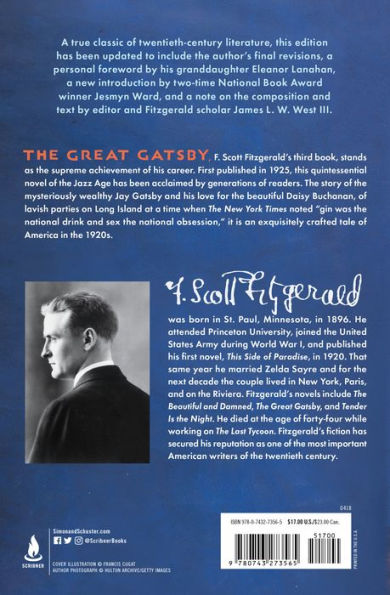
The mysterious Jay Gatsby embodies the American notion that it is possible to redefine oneself and persuade the world to accept that definition. Gatsby's youthful neighbor, Nick Carraway, fascinated with the display of enormous wealth in which Gatsby revels, finds himself swept up in the lavish lifestyle of Long Island society during the Jazz Age. Considered Fitzgerald's best work, The Great Gatsby is a mystical, timeless story of integrity and cruelty, vision and despair.

The timeless story of Jay Gatsby and his love for Daisy Buchanan is widely acknowledged to be the closest thing to the Great American Novel ever written.

Editorial Reviews

Edwin C. Clark
. . . It expresses one phase of the great grotesque spectacle of our American scene. It is humor, irony, ribaldry, pathos and loveliness. . . . A curious book, a mystical, glamorous story of today. It takes a deeper cut at life than hitherto has been essayed by Mr. Fitzgerald. He writes well -- he always has -- for he writes naturally, and his sense of form is becoming perfected. -- Books of the Century; New York Times review, April 1925
School Library Journal
Gr 8 UpAn initial biographical essay and closing chronology introduce Fitzgerald, his era, and his place in American literature. "For Further Research" includes Web site sources and provides helpful primary and secondary references. Spanning more than 50 years of criticism, the 19 pithy essays, one by Fitzgerald himself, are divided into three chapters that successively focus on Gatsby's character, American culture, and literary structure. Additional quotes, boxed and placed throughout the text, provide additional support for the authors' positions. There is little overlap of other Fitzgerald or Gatsby volumes in similar series, and although comparable titles written by one author exist, this volume's multi-authored critiques afford a highly varied, even conflicting, dialogue that's necessary for stimulating classroom discussion.Kate Foldy, Carnegie Library of Pittsburgh

Product Details

  • ISBN-13: 9780743273565
  • Publisher: Scribner
  • Publication date: 9/30/2004
  • Pages: 192
  • Sales rank: 136
  • Product dimensions: 8.08 (w) x 5.38 (h) x 0.42 (d)

Meet the Author

F. Scott Fitzgerald
F. Scott Fitzgerald

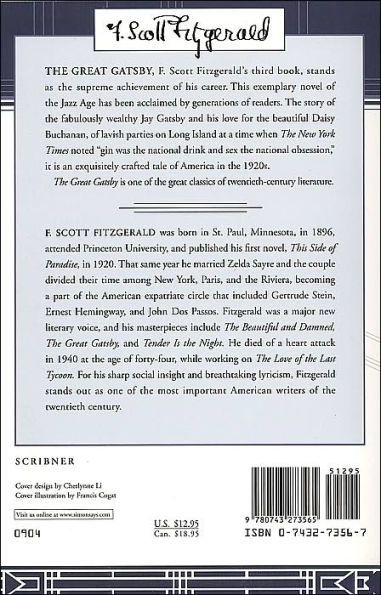
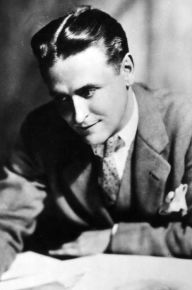
F. Scott Fitzgerald was born in St. Paul, Minnesota, in 1896, attended Princeton University, and published his first novel, This Side of Paradise, in 1920. That same year he married Zelda Sayre and the couple divided their time among New York, Paris, and the Riviera, becoming a part of the American expatriate circle that included Gertrude Stein, Ernest Hemingway, and John Dos Passos. Fitzgerald was a major new literary voice, and his masterpieces include The Beautiful and Damned, The Great Gatsby, and Tender Is the Night. He died of a heart attack in 1940 at the age of forty-four, while working on The Love of the Last Tycoon. For his sharp social insight and breathtaking lyricism, Fitzgerald is known as one of the most important American writers of the twentieth century.

Biography

The greatest writers often function in multifaceted ways, serving as both emblems of their age and crafters of timeless myth. F. Scott Fitzgerald surely fits this description. His work was an undeniable product of the so-called Jazz Age of the 1920s, yet it has a quality that spans time, reaching backward into gothic decadence and forward into the future of a rapidly decaying America. Through five novels, six short story collections, and one collection of autobiographical pieces, Fitzgerald chronicled a precise point in post-WWI America, yet his writing resonates just as boldly today as it did nearly a century ago.

Fitzgerald's work was chiefly driven by the disintegration of America following World War I. He believed the country to be sinking into a cynical, Godless, depraved morass. He was never reluctant to voice criticism of America's growing legions of idle rich. Recreating a heated confrontation with Ernest Hemingway in a short story called "The Rich Boy," Fitzgerald wrote, "Let me tell you about the very rich. They are different from you and me. They possess and enjoy early, and it does something to them, makes them soft where we are hard, and cynical where we are trustful, in a way that, unless you were born rich, it is very difficult to understand. They think, deep in their hearts, that they are better than we are because we had to discover the compensations and refuges of life for ourselves. Even when they enter deep into our world or sink below us, they still think that they are better than we are. They are different."

The preceding quote may sum Fitzgerald's philosophy more completely than any other, yet he also hypocritically embodied much of what he claimed to loathe. Fitzgerald spent money freely, threw lavish parties, drank beyond excess, and globe-trotted with his glamorous but deeply troubled wife Zelda. Still, in novel after novel, he sought to expose the great chasm that divided the haves from the have-nots and the hollowness of wealth. In This Side of Paradise (1920) he cynically follows opulent, handsome Amory Blaine as he bounces aimlessly from Princeton to the military to an uncertain, meaningless future. In The Beautiful and the Damned (1922) Fitzgerald paints a withering portrait of a seemingly idyllic marriage between a pair of socialites that crumbles in the face of Adam Patch's empty pursuit of profit and the fading beauty of his vane wife Gloria.

The richest example of Fitzgerald's disdain for the upper class arrived three years later. The Great Gatsby is an undoubted American classic, recounting naïve Nick Carraway's involvement with a coterie of affluent Long Islanders, and his ultimate rejection of them when their casual decadence leads only to internal back-stabbing and murder. Nick is fascinated by the mysterious Jay Gatsby, who had made the fatal mistake of stepping outside of his lower class status to pursue the lovely but self-centered Daisy Buchanan.

In The Great Gatsby, all elements of Fitzgerald's skills coalesced to create a narrative that is both highly readable and subtly complex. His prose is imbued with elegant lyricism and hard-hitting realism. "It is humor, irony, ribaldry, pathos and loveliness," Edwin C. Clark wrote of the book in the New York Times upon its 1925 publication. "A curious book, a mystical, glamorous story of today. It takes a deeper cut at life than hitherto has been essayed by Mr. Fitzgerald."

Gatsby is widely considered to be Fitzgerald's masterpiece and among the very greatest of all American literature. It is the ultimate summation of his contempt for the Jazz-Age with which he is so closely associated. Gatsby is also one of the clearest and saddest reflections of his own destructive relationship with Zelda, which would so greatly influence the mass of his work.

Fitzgerald only managed to complete one more novel -- Tender is the Night -- before his untimely death in 1940. An unfinished expose of the Hollywood studio system titled The Love of the Last Tycoon would be published a year later. Still The Great Gatsby remains his quintessential novel. It has been a fixture of essential reading lists for decades and continues to remain an influential work begging to be revisited. It has been produced for the big screen three times and was the subject of a movie for television starring Toby Stephens, Mira Sorvino, and Paul Rudd as recently as 2000. Never a mere product of a bygone age, F. Scott Fitzgerald's greatest work continues to evade time.

Good To Know

In 1937, Fitzgerald moved to Hollywood to pursue a screenwriting career. He only completed a single screenplay Three Comrades during this time before being fired for his excessive drinking.

He held a very romantic view of Princeton before attending the university in 1913. However, his failure to maintain adequate grades or become the football star he dreamed to be lead to an early end to his studies in 1917.

Fitzgerald owes a his name to another famous American writer. He was named after Francis Scott Key, the composer of "The Star Spangled Banner," who also happened to be a distant relative of Fitzgerald's.

    1. Also Known As:
      Francis Scott Key Fitzgerald (real name)
    1. Date of Birth:
      September 24, 1896
    2. Place of Birth:
      St. Paul, Minnesota
    1. Date of Death:
      December 21, 1940

Read an Excerpt

The Great Gatsby


By F. Scott Fitzgerald

Scribner

Copyright © 1925 Charles Scribner's Sons
All right reserved.

ISBN: 0-743-24639-X


Chapter One

In my younger and more vulnerable years my father gave me some advice that I've been turning over in my mind ever since.

"Whenever you feel like criticizing anyone," he told me, "just remember that all the people in this world haven't had the advantages that you've had."

He didn't say any more but we've always been unusually communicative in a reserved way and I understood that he meant a great deal more than that. In consequence I'm inclined to reserve all judgements, a habit that has opened up many curious natures to me and also made me the victim of not a few veteran bores. The abnormal mind is quick to detect and attach itself to this quality when it appears in a normal person, and so it came about that in college I was unjustly accused of being a politician, because I was privy to the secret griefs of wild, unknown men. Most of the confidences were unsought - frequently I have feigned sleep, preoccupation or a hostile levity when I realized by some unmistakable sign that an intimate revelation was quivering on the horizon - for the intimate revelations of young men or at least the terms in which they express them are usually plagiaristic and marred by obvious suppressions. Reserving judgements is a matter of infinite hope. I am still a little afraid of missing something if I forget that, as my father snobbishly suggested and I snobbishly repeat, a sense of the fundamental decencies is parcelled out unequally at birth.

And, after boasting this way of my tolerance, I come to the admission that it has a limit. Conduct may be founded on the hard rock or the wet marshes but after a certain point I don't care what it's founded on. When I came back from the East last autumn I felt that I wanted the world to be in uniform and at a sort of moral attention forever; I wanted no more riotous excursions with privileged glimpses into the human heart. Only Gatsby, the man who gives his name to this book, was exempt from my reaction - Gatsby who represented everything for which I have an unaffected scorn. If personality is an unbroken series of successful gestures, then there was something gorgeous about him, some heightened sensitivity to the promises of life, as if he were related to one of those intricate machines that register earthquakes ten thousand miles away. This responsiveness had nothing to do with that flabby impressionability which is dignified under the name of the "creative temperament" - it was an extraordinary gift for hope, a romantic readiness such as I have never found in any other person and which it is not likely I shall ever find again. No - Gatsby turned out all right at the end; it is what preyed on Gatsby, what foul dust floated in the wake of his dreams that temporarily closed out my interest in the abortive sorrows and short-winded elations of men.

My family have been prominent, well-to-do people in this middle-western city for three generations. The Carraways are something of a clan and we have a tradition that we're descended from the Dukes of Buccleuch, but the actual founder of my line was my grandfather's brother who came here in fifty-one, sent a substitute to the Civil War and started the wholesale hardware business that my father carries on today.

I never saw this great-uncle but I'm supposed to look like him - with special reference to the rather hard-boiled painting that hangs in Father's office. I graduated from New Haven in 1915, just a quarter of a century after my father, and a little later I participated in that delayed Teutonic migration known as the Great War. I enjoyed the counter-raid so thoroughly that I came back restless. Instead of being the warm center of the world the middle-west now seemed like the ragged edge of the universe - so I decided to go east and learn the bond business. Everybody I knew was in the bond business so I supposed it could support one more single man. All my aunts and uncles talked it over as if they were choosing a prep-school for me and finally said "Why - ye-es" with very grave, hesitant faces. Father agreed to finance me for a year and after various delays I came east, permanently, I thought, in the spring of twenty-two.

The practical thing was to find rooms in the city but it was a warm season and I had just left a country of wide lawns and friendly trees, so when a young man at the office suggested that we take a house together in a commuting town it sounded like a great idea. He found the house, a weather beaten cardboard bungalow at eighty a month, but at the last minute the firm ordered him to Washington and I went out to the country alone. I had a dog, at least I had him for a few days until he ran away, and an old Dodge and a Finnish woman who made my bed and cooked breakfast and muttered Finnish wisdom to herself over the electric stove.

It was lonely for a day or so until one morning some man, more recently arrived than I, stopped me on the road.

"How do you get to West Egg Village?" he asked helplessly.

I told him. And as I walked on I was lonely no longer. I was a guide, a pathfinder, an original settler. He had casually conferred on me the freedom of the neighborhood.

And so with the sunshine and the great bursts of leaves growing on the trees - just as things grow in fast movies - I had that familiar conviction that life was beginning over again with the summer.

There was so much to read for one thing and so much fine health to be pulled down out of the young breath-giving air. I bought a dozen volumes on banking and credit and investment securities and they stood on my shelf in red and gold like new money from the mint, promising to unfold the shining secrets that only Midas and Morgan and Maecenas knew. And I had the high intention of reading many other books besides. I was rather literary in college - one year I wrote a series of very solemn and obvious editorials for the "Yale News" - and now I was going to bring back all such things into my life and become again that most limited of all specialists, the "well-rounded" man. This isn't just an epigram - life is much more successfully looked at from a single window, after all.

It was a matter of chance that I should have rented a house in one of the strangest communities in North America. It was on that slender riotous island which extends itself due east of New York and where there are, among other natural curiosities, two unusual formations of land. Twenty miles from the city a pair of enormous eggs, identical in contour and separated only by a courtesy bay, jut out into the most domesticated body of salt water in the Western Hemisphere, the great wet barnyard of Long Island Sound. They are not perfect ovals - like the egg in the Columbus story they are both crushed fiat at the contact end - but their physical resemblance must be a source of perpetual confusion to the gulls that fly over-head. To the wingless a more arresting phenomenon is their dissimilarity in every particular except shape and size.

I lived at West Egg, the - well, the less fashionable of the two, though this is a most superficial tag to express the bizarre and not a little sinister contrast between them. My house was at the very tip of the egg, only fifty yards from the Sound, and squeezed between two huge places that rented for twelve or fifteen thousand a season. The one on my right was a colossal affair by any standard - it was a factual imitation of some Hôtel de Ville in Normandy, with a tower on one side, spanking new under a thin beard of raw ivy, and a marble swimming pool and more than forty acres of lawn and garden. It was Gatsby's mansion. Or rather, as I didn't know Mr. Gatsby it was a mansion inhabited by a gentleman of that name. My own house was an eye-sore, but it was a small eye-sore and it had been overlooked, so I had a view of the water, a partial view of my neighbor's lawn and the consoling proximity of millionaires - all for eighty dollars a month.

Across the courtesy bay the white places of fashionable East Egg glittered along the water and the history of the summer really begins on the evening I drove over there to have dinner with the Tom Buchanans. Daisy was my second cousin once removed and I'd known Tom in college. And just after the war I spent two days with them in Chicago.

Her husband, among various physical accomplishments, had been one of the most powerful ends that ever played football at New Haven - a national figure in a way, one of those men who reach such an acute limited excellence at twenty-one that everything afterwards savours of anti-climax. His family were enormously wealthy - even in college his freedom with money was a matter for reproach - but now he'd left Chicago and come east in a fashion that rather took your breath away: for instance he'd brought down a string of polo ponies from Lake Forest. It was hard to realize that a man in my own generation was wealthy enough to do that.

Why they came east I don't know. They had spent a year in France, for no particular reason, and then drifted here and there unrestfully wherever people played polo and were rich together. This was a permanent move, said Daisy over the telephone, but I didn't believe it - I had no sight into Daisy's heart but I felt that Tom would drift on forever seeking a little wistfully for the dramatic turbulence of some irrecoverable football game.

And so it happened that on a warm windy evening I drove over to East Egg to see two old friends whom I scarcely knew at all. Their house was even more elaborate than I expected, a cheerful red and white Georgian Colonial mansion overlooking the bay. The lawn started at the beach and ran toward the front door for a quarter of a mile, jumping over sun-dials and brick walks and burning gardens - finally when it reached the house drifting up the side in bright vines as though from the momentum of its run. The front was broken by a line of French windows, glowing now with reflected gold, and wide open to the warm windy afternoon, and Tom Buchanan in riding clothes was standing with his legs apart on the front porch.

He had changed since his New Haven years. Now he was a sturdy, straw haired man of thirty with a rather hard mouth and a supercilious manner. Two shining, arrogant eyes had established dominance over his face and gave him the appearance of always leaning aggressively forward. Not even the effeminate swank of his riding clothes could hide the enormous power of that body - he seemed to fill those glistening boots until he strained the top lacing and you could see a great pack of muscle shifting when his shoulder moved under his thin coat. It was a body capable of enormous leverage - a cruel body.

His speaking voice, a gruff husky tenor, added to the impression of fractiousness he conveyed. There was a touch of paternal contempt in it, even toward people he liked - and there were men at New Haven who had hated his guts.

"Now, don't think my opinion on these matters is final," he seemed to say, "just because I'm stronger and more of a man than you are." We were in the same Senior Society and while we were never intimate I always had the impression that he approved of me and wanted me to like him with some harsh, defiant wistfulness of his own.

We talked for a few minutes on the sunny porch.

"I've got a nice place here," he said, his eyes flashing about restlessly.

Turning me around by one arm he moved a broad flat hand along the front vista, including in its sweep a sunken Italian garden, a half acre of deep pungent roses and a snub-nosed motor boat that bumped the tide off shore.

"It belonged to Demaine the oil man." He turned me around again, politely and abruptly. "We'll go inside."

We walked through a high hallway into a bright rosy-colored space, fragilely bound into the house by French windows at either end. The windows were ajar and gleaming white against the fresh grass outside that seemed to grow a little way into the house. A breeze blew through the room, blew curtains in at one end and out the other like pale flags, twisting them up toward the frosted wedding cake of the ceiling - and then rippled over the wine-colored rug, making a shadow on it as wind does on the sea.

The only completely stationary object in the room was an enormous couch on which two young women were buoyed up as though upon an anchored balloon. They were both in white and their dresses were rippling and fluttering as if they had just been blown back in after a short flight around the house. I must have stood for a few moments listening to the whip and snap of the curtains and the groan of a picture on the wall. Then there was a boom as Tom Buchanan shut the rear windows and the caught wind died out about the room and the curtains and the rugs and the two young women ballooned slowly to the floor.

The younger of the two was a stranger to me. She was extended full length at her end of the divan, completely motionless and with her chin raised a little as if she were balancing something on it which was quite likely to fall. If she saw me out of the corner of her eyes she gave no hint of it - indeed I was almost surprised into murmuring an apology for having disturbed her by coming in.

The other girl, Daisy, made an attempt to rise - she leaned slightly forward with a conscientious expression - then she laughed, an absurd, charming little laugh, and I laughed too and came forward into the room.

"I'm p-paralyzed with happiness."

She laughed again, as if she said something very witty, and held my hand for a moment, looking up into my face, promising that there was no one in the world she so much wanted to see. That was a way she had. She hinted in a murmur that the surname of the balancing girl was Baker. (I've heard it said that Daisy's murmur was only to make people lean toward her; an irrelevant criticism that made it no less charming.)

At any rate Miss Baker's lips fluttered, she nodded at me almost imperceptibly and then quickly tipped her head back again - the object she was balancing had obviously tottered a little and given her something of a fright. Again a sort of apology arose to my lips. Almost any exhibition of complete self sufficiency draws a stunned tribute from me.

I looked back at my cousin who began to ask me questions in her low, thrilling voice. It was the kind of voice that the ear follows up and down as if each speech is an arrangement of notes that will never be played again.

Continues...


Excerpted from The Great Gatsby by F. Scott Fitzgerald Copyright © 1925 by Charles Scribner's Sons. Excerpted by permission.
All rights reserved. No part of this excerpt may be reproduced or reprinted without permission in writing from the publisher.
Excerpts are provided by Dial-A-Book Inc. solely for the personal use of visitors to this web site.

Customer Reviews

Average Rating 4
( 1183 )

Rating Distribution

5 Star

(581)

4 Star

(315)

3 Star

(166)

2 Star

(64)

1 Star

(57)

Your Rating:

Your Name: Create a Pen Name or Leave Anonymously

Barnes & Noble.com Review Rules

Our reader reviews allow you to share your comments on titles you liked, or didn't, with others. By submitting an online review, you are representing to Barnes & Noble.com that all information contained in your review is original and accurate in all respects, and that the submission of such content by you and the posting of such content by Barnes & Noble.com does not and will not violate the rights of any third party. Please follow the rules below to help ensure that your review can be posted.

Reviews by Our Customers Under the Age of 13

We highly value and respect everyone's opinion concerning the titles we offer. However, we cannot allow persons under the age of 13 to have accounts at BN.com or to post customer reviews. Please see our Terms of Use for more details.

What to exclude from your review:

Please do not write about reviews, commentary, or information posted on the product page. If you see any errors in the information on the product page, please send us an email.

Reviews should not contain any of the following:

  • - HTML tags, profanity, obscenities, vulgarities, or comments that defame anyone
  • - Time-sensitive information such as tour dates, signings, lectures, etc.
  • - Single-word reviews. Other people will read your review to discover why you liked or didn't like the title. Be descriptive.
  • - Comments focusing on the author or that may ruin the ending for others
  • - Phone numbers, addresses, URLs
  • - Pricing and availability information or alternative ordering information
  • - Advertisements or commercial solicitation

Reminder:

  • - By submitting a review, you grant to Barnes & Noble.com and its sublicensees the royalty-free, perpetual, irrevocable right and license to use the review in accordance with the Barnes & Noble.com Terms of Use.
  • - Barnes & Noble.com reserves the right not to post any review -- particularly those that do not follow the terms and conditions of these Rules. Barnes & Noble.com also reserves the right to remove any review at any time without notice.
  • - See Terms of Use for other conditions and disclaimers.
Search for Products You'd Like to Recommend

Recommend other products that relate to your review. Just search for them below and share!

Create a Pen Name

Your Pen Name is your unique identiy on BN.com. It will appear on the reviews you write and other website activities. Your Pen Name cannot be edited, changed or deleted once submitted.

Your Pen Name can be any combination of alphanumeric characters (plus - and _), and must be at least two characters long.

Continue Anonymously

We're sorry, but penname is already taken.

Please select one of the following:
Your Pen Name can be any combination of alphanumeric characters (plus - and _), and must be at least two characters long.

Continue Anonymously

penname is available!

By visiting the BN.com website or marking a purchase on BN.com, a User is deemed to have accepted the Terms of Use.

Continue Anonymously

Welcome, penname

You have successfully created your Pen Name. Start enjoying the benefits of the BN.com Community today.

See All Sort by: Showing 1 – 20 of 1188 Customer Reviews
  • Posted February 10, 2010

    I Also Recommend:

    The Great Gatsby

    Though the ending isn't Disney-worthy (my usual preference), Fitzgerald did a marvelous job. The book centers around the mysterious character of Gatsby, and, as you turn the pages, his history unravels before your eyes, as well as the narrator's--Nick. Nick is an "average" guy whom we feel we can trust--because he follows his father's advice and does not immediately judge (or so he says). The book will make you yearn for a love you know is impossible, cringe with embarrassment at a shameful past, blush at the awkwardness encountered on nearly every page, laugh and cry at the dramatic irony, and have you researching the Charleston (the dance, not the city--this is set in the 1920s, after all!). It may not be considered a typical love story, but the electricity between Daisy and Gatsby is too strong to deny and it always has me wondering what will happen (though I know). Read for irony, read for lessons, read to be taken back to another time--no, another dimension in which the music never dies and the party is perpetual.

    13 out of 17 people found this review helpful.

    Was this review helpful? Yes  No   Report this review
  • Posted June 29, 2011

    I Also Recommend:

    Excellent Read

    This is a wonderful book. It will keep you entertained for hours

    8 out of 9 people found this review helpful.

    Was this review helpful? Yes  No   Report this review
  • Anonymous

    Posted August 12, 2009

    A good quick read but...

    I read "The Great Gatsby" two times, one for leisure and the other for school. I still can't entirely understand why it's considered a classic. The themes are hard to pick up and realize and some parts such as the whole switching cars fiasco were confusing and I had to go back and read the part again. Some parts don't make sense but I guess that's just because it's from a different time period such as Tom talking to his lover on the phone and Daisy knows. Why doesn't she do anything about it??? Gatsby gets somewhat annoying and you feel like, "Just talk to her already!!!!" Fitzgerald sets the scene and setting perfectly and the reader gets a real sense of the 1920s vibe. Let's just say it has highs and lows. Worth reading? Yeah, but you'll probably find that there are better books out there. The whole thing is not long so it's good if you have a few hours to spare.

    8 out of 12 people found this review helpful.

    Was this review helpful? Yes  No   Report this review
  • Posted June 16, 2009

    more from this reviewer

    An American Classic

    As soon as a reader opens up their copy of The Great Gatsby they will find themselves thrust into the world of 1920's America. This "Jazz Age" featured the prodigious house parties that the prohibition era was known for. But none of the parties thrown could match the lavishness of the festivities at the Gatsby residence on West Egg, Long Island, especially if you were viewing them from the house of his neighbor Nick Carraway. Nick, being a 29 year old bondsman from Minnesota, would have not expected to be around such a lively atmosphere in the first place and could not be prepared in the very least for the summer that was ahead of him while living next to the Gatsby estate. His summer that year nudged him in the directions of such themes as materialism, adultery, murder and life. Through this time, Nick finds himself telling the story of his events on Long Island that summer and how he progressed through a rite of passage which can also connect to the timeless self-discoveries gone through by all readers throughout their lives. But F. Scott Fitzgerald developed his story further from the narrator's rite of passage and developed a tragic figure that is the focus of the story's title, Jay Gatsby. Jay is the charismatic next door neighbor of Nick, who has more mystery surrounding him than he does house guests. Jay's story revolves around Nick's cousin, Daisy, whom Jay has continued to be devoted to even though their relationship had ended years ago. Those who have felt the hurt of a broken heart can relate to the emotions expressed by both Daisy and Jay while they find themselves immersed in the complications of this love during the book. The immersion in which readers can find themselves experiencing is the reason why this book has not stopped birthing positive review after positive review. F. Scott Fitzgerald has truly created a time portal to the 1920's through this literary masterpiece for all to experience and escape from their own worlds and venture into a life much different than their own.

    7 out of 7 people found this review helpful.

    Was this review helpful? Yes  No   Report this review
  • Posted June 8, 2010

    I Also Recommend:

    Definitely a Classic

    This book has been named a classic and I would have to completely agree with that. The book is an amazing novel that captures the early 1900s with amazing accuracy. If you enjoy American literature and history this book is a must read. The writing is exquisite and the higher class of America is excellently portrayed. Fitzgerald's characters will make you question yourself and ethics as they become enthralled in the drama that surrounds them. The book is amazing for discussions and will have to become a permanent fixture in your life after reading it once. This realsitic novel will make you think more than most other classics!

    4 out of 4 people found this review helpful.

    Was this review helpful? Yes  No   Report this review
  • Posted March 18, 2009

    more from this reviewer

    Fitzgerald's masterpiece

    I've read this novella over and over again and love it more each time I read it. There is one part that drags on a bit, and that is when it rattles off names of guests at one of Gatsby's elaborate parties, but other than that, it is perfection.

    Jay Gatsby is probably F. Scott Fitzgerald's best characters. I can really empathize with him. This work also shows Fitzgerald's improvement in his use of dialogue, which is a bit weak in his previous novels.

    At only 188 pages, it is a quick read, but a read that will stick with you forever.

    4 out of 5 people found this review helpful.

    Was this review helpful? Yes  No   Report this review
  • Posted January 31, 2012

    Interesting Read

    "The Great Gatsby" is about a man named Nick. When he moved he constantly heard about a man named Jay Gatsby. Little did he know he lived next door. Jay is a person who is wealthy and intelligent. This caused Nick to wonder, who is he? He seemed very secretive to Nick. He wanted to get to know him. He yearned to know how and why he was so wealthy, and who, truthfully, is Jay Gatsby? He finds his way to Jay, in a coincidence. This starts Nick’s "investigation" to find the real Jay Gatsby. Characters such as: Mr. & Mrs. Buchanan add a twist. The characters slowly reveal and define Gatsby. I enjoyed the book. The different concepts, the different characters and their personalities kept you wondering what is going to happen next. Is there something they're hiding? It keeps you on your feet. The language they use was a challenge at first; but once you got adjusted to the way they used their words it was fairly easy and pleasant to read.

    3 out of 3 people found this review helpful.

    Was this review helpful? Yes  No   Report this review
  • Anonymous

    Posted May 18, 2011

    Boo!

    Would like to read it except it didn't download the whole book! Guess that's what you get for .99 cents!

    3 out of 6 people found this review helpful.

    Was this review helpful? Yes  No   Report this review
  • Posted April 1, 2011

    Great Gatsby

    The Great Gatsby does symbolize much more than what the anonymous man said. It symbolizes not only one of the major flaws of human beings, but the greatest test for us as well; honesty. Jay gatsby lived a lie and in the end died a lie as well. The book tells a lot about society and is very educational. It is overall a great book if you analyze it the wat Fitzgerald would want u to.

    3 out of 4 people found this review helpful.

    Was this review helpful? Yes  No   Report this review
  • Posted March 31, 2011

    never ever...

    ...listen to anonymous comments like that one, obviously the writings of a pathetic nobody who desperately knows nothing of fine literature. great read.

    3 out of 4 people found this review helpful.

    Was this review helpful? Yes  No   Report this review
  • Posted December 13, 2008

    more from this reviewer

    I Also Recommend:

    The Great Fitzgerald

    Truly a classic; Fitzgerald beautifully paints the 20's era with the new sensations of money and bootlegging and partying in his fantastic novel. His superb writing details the life of Nick Carraway with his friend, a new wealth, Jay Gatsby, who longs for the married Daisy Buchanan. The trials of trying to get her shows how flawed Gatsby is, and therefore, fulfilling the title of the book, how truly great he is. Fitzgerald's writing intoxicates the reader into this forgotten world. His sentences really do stand up and take a little bow.

    3 out of 3 people found this review helpful.

    Was this review helpful? Yes  No   Report this review
  • Anonymous

    Posted July 16, 2008

    Overly Glorified Door Stop

    I was forced to read this book for high school and I absolutely hate it. It doesn't live up to the name so many people give it. I understand that the basic idea behind the story is the struggle to fulfill unattainable desires but despite the moral being very strong this book disappoints me to no end. It's overly simplistic and is told in such a way that it leaves a student feeling numb from boredom. Thanks a lot California educational system for making me waste my precious youth on this over glorified door stop.

    3 out of 14 people found this review helpful.

    Was this review helpful? Yes  No   Report this review
  • Anonymous

    Posted March 5, 2008

    The Great Gatsby

    The Great Gatsby... When I was first assigned to read this book the title did not sound appealing to me. If I was assigned this book in the past, I would have figured it would have been a typical book I had to read for school boring. Even though the title does not sound to appealing to me, I trusted my teacher enough to give the book a a chance. As I begin reading the book I did not understand why it was called ¿The Great Gatsby¿ because the character Gatsby never talked to anyone nor did anyone get to visualize him. As I read through the book , I eventually noticed why it was called the `Great Gatsby¿ and understood why the author picked the title of this book. The Great Gatsby showed the time during the 1920¿s and how it was. Things such as the parties, the poor life, the rich life, cars, and fashion to name a few. The book consisted of two young people [Daisy and Gatsby] in love, but broken apart because Gatsby [who was poor] had to go to war. Daisy ended up not waiting for Gatsby and married a rich fellow named Tom. Tom and Daisy had a child together, but lived a marriage of lies. He had cheated on her with many women due to the unstable choice of marriage. Gatsby came back from war and made something of himself. He became very wealthy and successful. He did this to try to win his old love Daisy back. Years later the both had houses near each other, and Gatsby tried his hardest to get back with Daisy. He thought he could relive the past with her and rekindle there love. Although I enjoyed the book the ending was not how I planned it to turn out in my head. One thing I liked about the ending was how it showed money does not give you everything and you cannot always buy love and happiness, nor a perfect life. The book showed two sides, the life of the poor and the life of the rich. Both ways you can be happy, you just have to find your happiness in yourself and life. You understand in this book that money can buy you nice things, but cannot always buy you love.

    3 out of 3 people found this review helpful.

    Was this review helpful? Yes  No   Report this review
  • Anonymous

    Posted January 31, 2012

    UNDERSTANDABLE OR NOT?! The Great Gatsby

    In the Great Gatsby, by F. Scott Fitzgerald, Jay Gatsby who is the main character, struggles to keep honesty in a relationship. The main idea of this story is about Jay Gatsby,who meets Nick Carraway, his new neighbor, and develops a relationship with him; in addition, he has troubles keeping his love for Daisy Buchanan at bay. The main characters of this story are obviously Jay Gatsby, Nick Carraway, and Daisy Buchanan; in addition, the secondary characters are Tom Buchanan, Jordan Baker, Myrtle Wilson, George Wilson, Owl Eyes, Klipspringer, and Meyer Wolfsheim. The main character Jay Gatsby is a man who is elegant and very eloquent; nevertheless, he does throw a lot of parties, especially in the long summer nights. He is a very charismatic man who happened to accumulate a lot of wealth. Nick Carraway is the narrator, and is a kind gentle type of guy, who develops a friendship with Jay Gatsby. Daisy Buchanan, Tom Buchanan’s wife, is a woman who is materialistic and once was deeply in love with Jay Gatsby, but keeps the fact she still loves him a mystery. The main conflict is internal because Jay is fighting against himself to keep his feelings for Daisy at bay. The internal conflict is man versus self because of his own mental struggle with facing Daisy’s love on a daily basis. One of the main plot events that make up the rising action is where Tom begins to suspect something is going on between Gatsby and Daisy at a luncheon they were having. He witnesses Gatsby staring at Daisy with a deep loving passionate look. Another one of the major events is when Nick, Jordan, and Tom are driving through the valley of the ashes and find that Gatsby’s car has hit Myrtle Wilson, who happens to be Tom’s lover. I overall enjoyed this book, but I did find it hard to understand what was going on. I dislike the fact there was a lot of imagery and literary elements used, it made it really confusing to know what was going on. I also didn’t enjoy it much because I felt the story was a little choppy and it jumped from one event in one chapter to a totally different one in the other. The final reason I didn’t fully enjoy it was that it used a lot of deep meaning and symbolism, so it made me go back and reread pages even to the point of three times just to grasp what had occurred. In spite of these setbacks I enjoyed the story’s idea and surprisingly at some points did not want to set down the book called, The Great Gastby.

    2 out of 2 people found this review helpful.

    Was this review helpful? Yes  No   Report this review
  • Posted May 15, 2011

    My FAVORITE Fitzgerald book!

    if you like books from this era then the great gatsby is a no brainer. While i have all the works of F Scott Fitzgerald this is by far my favorite. And when i saw the NookBook for only 99 cents it was undeniable!!

    2 out of 2 people found this review helpful.

    Was this review helpful? Yes  No   Report this review
  • Anonymous

    Posted March 12, 2011

    Never Ever read this book.

    Worst book ever written. Ever. People say it is full of symbolism and mystery but really it's just the desperate pathetic writing of a desperate pathetic man.

    2 out of 26 people found this review helpful.

    Was this review helpful? Yes  No   Report this review
  • Posted March 15, 2009

    more from this reviewer

    What's the big deal?

    So, everyone at school was saying, "I loved The Great Gatsby," so when my class started reading it, I was excited. But, after a couple chapters, my first reaction was, "This is boring." Sure, it's a love story and sure, it has its moments, but it wasn't the greatest read, and to be honest, Gatsby was the most pathetic character I've seen in awhile. I wouldn't recommend this book to many people.

    2 out of 13 people found this review helpful.

    Was this review helpful? Yes  No   Report this review
  • Anonymous

    Posted June 4, 2005

    The Great Bore

    While The Great Gatsby may have been a classic for other readers, it was hard for me to believe that it was one of the greatest novels of all time. This fictional book touches several different themes including envy between the rich, interracial issues, and clashes between ¿old money¿ and ¿new money.¿ It also provides a good overview of what life was like in the 1920s as the economy soared and people lived without worries in the ¿Jazz Age.¿ In a way, author F. Scott Fitzgerald places himself into the story through the characters of Nick Carrawy and Jake Gatsby. Fitzgerald¿s personality along with his own personal experiences and feelings are all portrayed through these two characters. The book starts off with Nick introducing himself and all the riches that surround him. He describes his new life in the east and his goals to make money in the bond business. As I was reading, numerous other characters were also introduced, all except Gatsby. With all the questions and assumptions of the mysterious Gatsby, it wasn¿t until later in the book that I was able to realize who this title character really was. The book then goes on to tell the background of each of the characters and how they got to be so rich. The novel mainly focuses on how Daisy, Tom and Gatsby struggle with love and how they try to keep their scandalous secrets from each other. The trouble with love soon turns tragic, causing the novel to finally end with a shocking finish. Overall, this book was just one big bore. I constantly found myself drifting away from what was going on in the story. Though the novel did have some entertaining elements, most of it was extremely uninteresting. I was so fed up with it that I even wanted to skip some paragraphs and pages as I was wondering when the chapter and book was going to end. With all the affairs that were going on, and all the secrets that were being kept from each other, this book was like watching a soap opera. Eventually, I was able to predict that something catastrophic was bound to happen, much like any other reader who had read this book. I could understand how other people may have enjoyed this novel but it just wasn¿t the book for me. However, if you¿re fascinated by how the rich lived in the 1920s and you take pleasure in reading about love and affairs, this may be the story you have been waiting for. While The Great Gatsby is one of the most finest literary pieces ever written to most people, it is one of the dullest and most tedious books I have ever opened.

    2 out of 6 people found this review helpful.

    Was this review helpful? Yes  No   Report this review
  • Anonymous

    Posted May 15, 2012

    Cheaper isnt better

    Bought this for school couldnt even get through the first chapter. Bad capitalization and horrible spacing between words.

    1 out of 2 people found this review helpful.

    Was this review helpful? Yes  No   Report this review
  • Anonymous

    Posted February 20, 2012

    Skye Lass and Anna

    I just finished this book. I loved it. There is always something watching over them like that eye doctor sign with the glasses. Also when Gatsby had his parties there was that guy with the owl eyed glasses. I liked how he tied it together with the same owl eyed guy at the end. The end was very sudden and a bit confusing. It really made me think. I noticed it doesn't have much of a moral if any which makes it different because most books have a moral. I think he did a nice job. I am excited to see the movie. Our class couldn't agree which side Nick's house was on...right or left...I pictured it on the right.

    1 out of 1 people found this review helpful.

    Was this review helpful? Yes  No   Report this review
See All Sort by: Showing 1 – 20 of 1188 Customer Reviews

If you find inappropriate content, please report it to Barnes & Noble
Why is this product inappropriate?
Comments (optional)
500 character limit