9 Revelations from Elizabeth Gilbert’s Big Magic
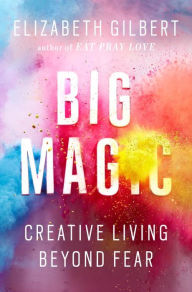
Big Magic: Creative Living Beyond Fear
Hardcover $29.00
Big Magic: Creative Living Beyond Fear
In Stock Online
Hardcover $29.00
Before she was Elizabeth Gilbert: International Bestseller, Guru of Self-discovery, and Julia Roberts’s Real-life Inspiration, Elizabeth Gilbert was just another writer toiling away at her craft. (She’ll tell you that even after Eat, Pray, Love, she is still just another writer toiling away at her craft.) In her latest work of non-fiction, Big Magic, Gilbert throws wide open a window on her writing process and creative philosophy. As the ancient Greeks called forth the Muse, Gilbert invokes “Big Magic.” Her world is animated with benevolent creative spirits—ideas—begging to be made manifest. To do so takes courage, enchantment, permission, persistence, trust, even a touch of the divine.
Gilbert is best when she’s at her most personal, and what the author reveals of herself in Big Magic is as enlightening as the advice she gives. Here are 9 of our favorite discoveries.
1. Ann Patchett wrote Elizabeth Gilbert’s book—and Gilbert is okay with that
Of course Patchett didn’t literally write a book published under Gilbert’s name; there was no stealing, no plagiarizing, no ghostwriting. As Gilbert’s story goes, the idea for a novel set in the Amazon jungle came to her. It occupied her, it inflamed her, it energized her…and then it didn’t. She set aside her inspiration, and so it left her, like a lover too long taken for granted. It migrated to the mind of her friend and fellow writer, Patchett, where it grew into that author’s bestselling novel set in the Amazon jungle, State of Wonder. If we don’t engage with our creative ideas, Gilbert learned, they’ll go looking for other willing collaborators. (And may we be as gracious as Gilbert if they do.)
2. Gilbert doesn’t believe in MFA programs
This critical darling does not have a masters in creative writing and does not recommend spending tens of thousands of dollars to earn one. The Class of 2015 might respectfully disagree, but Gilbert has a point. Creativity is about self-cultivation. Dig deep within yourself; don’t dig yourself into a financial hole. If you want to study under the masters, you can find them at a greatly reduced rate in the library, at the museum, or on the screen.
Before she was Elizabeth Gilbert: International Bestseller, Guru of Self-discovery, and Julia Roberts’s Real-life Inspiration, Elizabeth Gilbert was just another writer toiling away at her craft. (She’ll tell you that even after Eat, Pray, Love, she is still just another writer toiling away at her craft.) In her latest work of non-fiction, Big Magic, Gilbert throws wide open a window on her writing process and creative philosophy. As the ancient Greeks called forth the Muse, Gilbert invokes “Big Magic.” Her world is animated with benevolent creative spirits—ideas—begging to be made manifest. To do so takes courage, enchantment, permission, persistence, trust, even a touch of the divine.
Gilbert is best when she’s at her most personal, and what the author reveals of herself in Big Magic is as enlightening as the advice she gives. Here are 9 of our favorite discoveries.
1. Ann Patchett wrote Elizabeth Gilbert’s book—and Gilbert is okay with that
Of course Patchett didn’t literally write a book published under Gilbert’s name; there was no stealing, no plagiarizing, no ghostwriting. As Gilbert’s story goes, the idea for a novel set in the Amazon jungle came to her. It occupied her, it inflamed her, it energized her…and then it didn’t. She set aside her inspiration, and so it left her, like a lover too long taken for granted. It migrated to the mind of her friend and fellow writer, Patchett, where it grew into that author’s bestselling novel set in the Amazon jungle, State of Wonder. If we don’t engage with our creative ideas, Gilbert learned, they’ll go looking for other willing collaborators. (And may we be as gracious as Gilbert if they do.)
2. Gilbert doesn’t believe in MFA programs
This critical darling does not have a masters in creative writing and does not recommend spending tens of thousands of dollars to earn one. The Class of 2015 might respectfully disagree, but Gilbert has a point. Creativity is about self-cultivation. Dig deep within yourself; don’t dig yourself into a financial hole. If you want to study under the masters, you can find them at a greatly reduced rate in the library, at the museum, or on the screen.
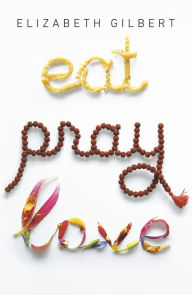
Eat, Pray, Love: One Woman's Search for Everything Across Italy, India and Indonesia
Paperback $18.00
Eat, Pray, Love: One Woman's Search for Everything Across Italy, India and Indonesia
In Stock Online
Paperback $18.00
3. She told her husband that no one would read the book she was writing about him
Wrong. Eat, Pray, Love stayed on the New York Times Best Seller list for more than 200 weeks. The point is that Gilbert was not writing in order to be read or even understood. She was writing to understand and—hold onto your hats—because she liked doing it. That was the only motivation and permission she needed.
4. At age 16, she took a vow to be a writer
Gilbert did not vow to be rich or famous or even terribly good at writing. But by golly, she lit a candle, got down on her knees in her childhood bedroom, and committed herself to her creative process. Fear, procrastination, and need for recognition: speak now or forever hold your peace. Amen.
5. She had a short-lived Southern Gothic period
(She is from Connecticut.) She also had a Hemingway stage and a Cormac McCarthy stage. She stank at imitating, but at least she was writing. Finally she reached her Elizabeth Gilbert stage.
6. Sometimes she puts on lipstick to write
Elizabeth Gilbert dates her creativity. She dresses up for it. She takes a shower for it. She shows up, and she seduces it.
7. She is a self-described “deeply disciplined half-ass.”
Gilbert has published books that were, in her own esteem, good enough. Many writers have. The truth is that good enough is the only way creative endeavors ever exist. Perfection is an illusion and a trap. That doesn’t mean you should not create. It means embracing the paradox that what you create both matters and doesn’t matter one stinking whit. Work your tail off, and then let it go.
8. She threw out an entire book
It was called Go Set a Watchman. Just kidding. But just like the time Gilbert had to hack away 30% of the first short story she ever published, or the time an editor who once rejected her story enthusiastically accepted it in the very same form several years later, she realized that her ego would not serve her in that moment. Demanding that her story remain intact, asking why her writing was suddenly deemed brilliant when it had not been earlier, howling in frustration at failure—all these would have turned her away from what she really needed most: more wonder, less ego.
3. She told her husband that no one would read the book she was writing about him
Wrong. Eat, Pray, Love stayed on the New York Times Best Seller list for more than 200 weeks. The point is that Gilbert was not writing in order to be read or even understood. She was writing to understand and—hold onto your hats—because she liked doing it. That was the only motivation and permission she needed.
4. At age 16, she took a vow to be a writer
Gilbert did not vow to be rich or famous or even terribly good at writing. But by golly, she lit a candle, got down on her knees in her childhood bedroom, and committed herself to her creative process. Fear, procrastination, and need for recognition: speak now or forever hold your peace. Amen.
5. She had a short-lived Southern Gothic period
(She is from Connecticut.) She also had a Hemingway stage and a Cormac McCarthy stage. She stank at imitating, but at least she was writing. Finally she reached her Elizabeth Gilbert stage.
6. Sometimes she puts on lipstick to write
Elizabeth Gilbert dates her creativity. She dresses up for it. She takes a shower for it. She shows up, and she seduces it.
7. She is a self-described “deeply disciplined half-ass.”
Gilbert has published books that were, in her own esteem, good enough. Many writers have. The truth is that good enough is the only way creative endeavors ever exist. Perfection is an illusion and a trap. That doesn’t mean you should not create. It means embracing the paradox that what you create both matters and doesn’t matter one stinking whit. Work your tail off, and then let it go.
8. She threw out an entire book
It was called Go Set a Watchman. Just kidding. But just like the time Gilbert had to hack away 30% of the first short story she ever published, or the time an editor who once rejected her story enthusiastically accepted it in the very same form several years later, she realized that her ego would not serve her in that moment. Demanding that her story remain intact, asking why her writing was suddenly deemed brilliant when it had not been earlier, howling in frustration at failure—all these would have turned her away from what she really needed most: more wonder, less ego.
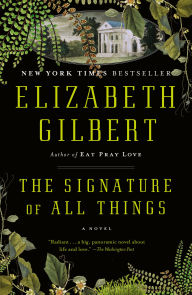
The Signature of All Things
Paperback $18.00
The Signature of All Things
In Stock Online
Paperback $18.00
9. When she started her last novel, The Signature of All Things, about a 19th-century botanist, she was not a gardener
Gilbert needed an idea. Something. Anything. She did not have an innate passion for gardening—in fact she’d once seriously disliked the activity—but that’s okay because what she did have was curiosity. It was a tepid curiosity, perhaps, but it had perched on her shoulder, and so she paid attention. She followed her curiosity on what would become a deep and wide and long scavenger hunt, ending in a novel and, lo and behold, a garden.
9. When she started her last novel, The Signature of All Things, about a 19th-century botanist, she was not a gardener
Gilbert needed an idea. Something. Anything. She did not have an innate passion for gardening—in fact she’d once seriously disliked the activity—but that’s okay because what she did have was curiosity. It was a tepid curiosity, perhaps, but it had perched on her shoulder, and so she paid attention. She followed her curiosity on what would become a deep and wide and long scavenger hunt, ending in a novel and, lo and behold, a garden.