Happiness Drives Success: A Guest Post by Ali Abdaal
Being productive can be hard, and Dr. Ali Abdaal shares simple but effective ways to help inspire productivity and become the person you want to be. Read on for an exclusive essay from Dr. Ali Abdaal on writing Feel-Good Productivity.
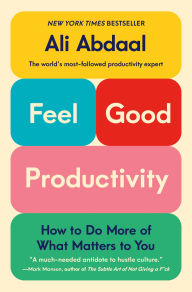
Paperback
$14.24
$18.99
Feel-Good Productivity: How to Do More of What Matters to You
Feel-Good Productivity: How to Do More of What Matters to You
By Ali Abdaal
In Stock Online
Paperback
$14.24
$18.99
The secret to productivity isn’t discipline. It’s joy.
The secret to productivity isn’t discipline. It’s joy.
I ended up writing Feel-Good Productivity to solve my own problem: that I wanted to be productive, but I wasn’t enjoying it. I was working full-time as a doctor in the UK, fresh out of Cambridge medical school, where my strategy of discipline and grinding harder had always paid off. It got me through exams, secured publications, and even let me launch a side business.
But in the real world of hospital shifts, everything shifted. I was on the path to burnout. I’d get home drained every day, I was anxious about potential mistakes, I was barely sleeping, I was letting friendships fade into the background. My mood tanked, and the job I’d trained for felt depressing rather than fulfilling.
At first, I thought the problem was me. I’d built an online audience teaching productivity tips on YouTube, so surely I just needed to apply my own advice and work harder, right? But pushing more only made things worse. Tasks piled up, paperwork never ended, my interactions with patients and colleagues were strained, and no amount of late nights seemed to make a dent in my to-do list.
That’s when I started questioning the “hustle harder” mantra I’d internalized over the years. Remembering my old tutor’s wisdom — “If the treatment isn’t working, question the diagnosis” — I experimented with alternatives, diving back into studies from my psychology degree. What I discovered in the field of Positive Psychology flipped my perspective.
I came across Dr. Alice Isen’s “Candle Problem” experiment from the 1990s, which shows how a simple mood boost, like a bag of candy, can enhance our creativity and problem-solving by broadening our thinking. Professor Barbara Fredrickson’s Broaden-and-Build theory built on this: her work found that positive emotions expand our awareness, improve our resilience, and create an “upward spiral” of growth and success. Her Undoing Hypothesis also showed that feeling good can reverse stress’s physiological effects, like elevated heart rate from anxiety. And a meta-analysis of over 275,000 people confirmed it: happiness drives success, not the other way around.
These insights highlighted that feel-good energy, fueled by hormones like dopamine, serotonin, endorphins, and oxytocin, boosts motivation, reduces stress, and improves life overall.
I tested it on myself: tweaking the way I approached work, using the energizing effects of Play, Power, and People (Chapters 1–3), helped make my shifts more manageable, improved my focus, and even lifted the mood of my interactions with patients. As my energy returned, so did joy in my work.
I shared these ideas on social media, and they resonated — viewers reported acing exams, growing businesses, and balancing life better — which inspired me to expand them into a book.
Feel-Good Productivity isn’t just a system; it’s a philosophy. Part I explores energizing your work through power, play, and people. Part II tackles procrastination blockers like uncertainty and fear. And Part III helps us sustain our productivity over the longer-term with tools to conserve, recharge, and align energy. Each chapter includes practical strategies and experiments you can try out immediately.
I’m thrilled the book now lives in paperback at Barnes & Noble, making these insights more accessible. As we head into the new year, I hope it inspires a “New Year, Feel-Good You” mindset — where rather than fueling your goals with the “dirty” fuel of obligation and grind, you’re able to work towards what matters to you while actually enjoying the journey along the way.