Seduced by Spirits: A Guest Post by Sarah Penner
Sarah Penner’s latest began as all great ideas do: a complete fascination. Intrigued by the time of famous mediums and spiritualism in the Victorian era, Penner began researching for her novel, The London Séance Society. By attending a séance of her own and poring over information on Victorian funeral traditions, this novel came to life bit by bit. Here’s an exclusive essay from Sarah on the research and inspiration that brought us this magical whodunit.
Paperback $18.99
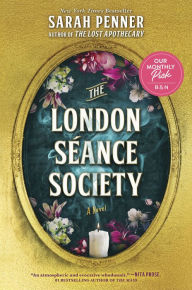
The London Séance Society
The London Séance Society
By Sarah Penner
In Stock Online
Paperback $18.99
If you loved The Lost Apothecary as much as we did, you’ll devour Sarah Penner’s newest novel, where mystery and the supernatural collide under a layer of swirling London fog.
If you loved The Lost Apothecary as much as we did, you’ll devour Sarah Penner’s newest novel, where mystery and the supernatural collide under a layer of swirling London fog.
I’ve always been fascinated by the Victorians and their obsession with the dead. Spiritualism was in its heydey in the late 1800s, and Victorians were mesmerized by anything supernatural, otherworldly or occult. Parlor-room séances were a frequent occurrence, as were public theatrical displays of mediumship.
As a writer of historical mysteries with a feminist bent, I was especially delighted to learn that in the Victorian era, women who practiced as mediums were far more respected than men in the same profession. Men weren’t considered particularly amenable to spirits taking control of their psyches, whereas women often drew enormous audiences to their public displays.
The Victorians were highly superstitious, and during my research for this book, I devoured anything I could find about this era’s obsession with ghosts. Chris Woodyard’s The Victorian Book of the Dead was particularly insightful, as it included newspaper articles and other ephemera excerpts from the late nineteenth century.
During my research, I learned that immediately upon death in a household, window coverings were drawn closed and remained this way until after the funeral. Mirrors were covered with black cloth so the deceased’s soul would not be trapped inside. Clocks were stopped at the time of death, and photographs of the dead were turned facedown to prevent others from being possessed.
Of course, I couldn’t write a book about séances without actually attending one myself. In the summer of 2021, while drafting The London Séance Society, my mother and I traveled to Cassadaga, Florida, a nineteenth-century spiritualist village. I was—and am—a skeptic, much like Lenna, the protagonist in my story. As we settled in for our evening séance led by a medium, I kept my notebook close, anxious to see how the whole affair would unfold.
We didn’t experience anything paranormal that evening, but it was surprising nonetheless: two of the other participants informed me that they’d been attending regular séances after losing a beloved member of the family. They found these séances cathartic and a great help in their grieving process. As a skeptic, it was a reminder to me that my book-in-progress wasn’t just about the possible existence of ghosts, but also about the universal experience of grief. As Lenna states at the end of The London Séance Society, “the palpable could coexist with the invisible.”
So much can coexist, after all: differing beliefs, varying experiences. If only we could apply this same lesson to politics, religion, sexuality. If only we could honor and respect another’s right to believe what they want. If only we could seek our commonalities and not focus so much on our differences.
This book began with my interest in the Victorians, but ultimately it taught me a much greater lesson. Whether skeptics or believers, I hope that readers find themselves open to the various themes explored in the story.
The London Séance Society is now available in paperback. Enjoy!
