Space Opera: The Intergalactic Life and Times of Earth’s Glam Rock Savior
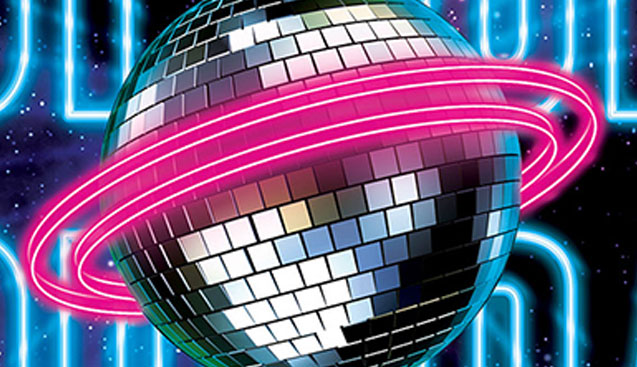 Catherynne M. Valente never fails to surprise—from timeless children’s stories to an incendiary examination of comic book tropes, her works span a Grand Canyon of tones and styles, but share a clear vision and a bracing fearlessness. They are also, sometimes, weird as hell. Her latest, Space Opera, brings us the story of the Metagalactic Grand Prix, a galactic song contest with the highest possible stakes, and of Decibel Jones, Earth’s glam-rock savior. It’s preposterous, frenetic, word-drunk, and has no business working at all, let alone quite so brilliantly. Channeling the giants of sci-fi satire and glam rock into a brilliantly over-the-top burlesque, it’s a novel only Catherynne Valente could write.
Space Opera

Hardcover $19.99
Space Opera
Hardcover $19.99
Earth’s first contact with alien life occurs via a simultaneous, shared hallucination experienced by every living human. It should be a glorious moment. Unfortunately, the galactic community isn’t overly impressed with us: we’re greedy, rapacious, polluting, judgmental, and will happily drive a species to extinction if it means a chance to stave off erectile dysfunction. To the aliens of the greater Milky Way, our culture’s highest cultural achievement—the one thing that might single us out as exceptional—is “MacArthur Park.” And maybe the collected works of Yoko Ono.
Earth’s first contact with alien life occurs via a simultaneous, shared hallucination experienced by every living human. It should be a glorious moment. Unfortunately, the galactic community isn’t overly impressed with us: we’re greedy, rapacious, polluting, judgmental, and will happily drive a species to extinction if it means a chance to stave off erectile dysfunction. To the aliens of the greater Milky Way, our culture’s highest cultural achievement—the one thing that might single us out as exceptional—is “MacArthur Park.” And maybe the collected works of Yoko Ono.
The aliens aren’t entirely sure we even qualify as sentient, but they’re reasonably certain that we’re capable of a degree of unpleasantness (and have reached a level of technology) that renders us a threat to galactic harmony. We’re a borderline case, in line for extermination—but there’s a way to sort these things: the Metagalactic Grand Prix. Quite simply, it’s the biggest entertainment event in the galaxy, and our one and only chance to prove we’re capable of creating something beautiful, and thus, are worthy of survival. All we have to do is enter a song and not come in dead last.
Again, though, it turns out that, on a galactic scale, we’re as terrible at music as we are at everything else.
Helpfully, the aliens sent to guide us through the process of entering the Grand Prix have provide a list of acceptable candidates who might have half a shot at not failing. Unfortunately, several of them are dead. But one of them is Danesh Jalo, aka Decibel Jones, a Pakistani-Nigerian-Welsh-Swedish Brit who describes his gender identity as gendersplat, and the former lead singer of Decibel Jones and the Absolute Zeros, a defunct glam rock outfit whose entire raison d’être was to bring a little glitter and shine into a world gone to grit. It has been years since Decibel has done anything of note, musical or otherwise, but he’s humanity’s only hope—if he can demonstrate that we have souls that can jam in tune with the universe, then we might get to survive for a bit. If not, well, at least we’ll all die together.
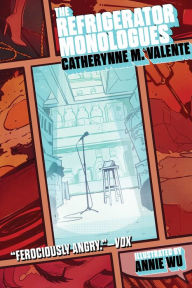
The Refrigerator Monologues
Paperback $17.99
The Refrigerator Monologues
By
Catherynne M. Valente
Illustrator
Annie Wu
Paperback $17.99
The Metagalactic Grand Prix, by the way, is Valente’s outer-space, all-glam take on the Eurovision Song Contest. If you’re not familiar with the mega-popular, too-weird-to-exist competition, you might just be American. Every year, countries served by the European Broadcasting Union hold internal contests to determine which song and artist to send to a broader competition hosted by the previous year’s winning nation. Given the variety of languages and music styles represented, the contest tends to favor splendor and showmanship: anything to get the attention of voters. Regional politics also come into play, putting a further twist on the proceedings. In short: it’s amazing. That context probably isn’t critical to enjoying Space Opera, but it provides the framework around which the weird, wild story develops.
The Metagalactic Grand Prix, by the way, is Valente’s outer-space, all-glam take on the Eurovision Song Contest. If you’re not familiar with the mega-popular, too-weird-to-exist competition, you might just be American. Every year, countries served by the European Broadcasting Union hold internal contests to determine which song and artist to send to a broader competition hosted by the previous year’s winning nation. Given the variety of languages and music styles represented, the contest tends to favor splendor and showmanship: anything to get the attention of voters. Regional politics also come into play, putting a further twist on the proceedings. In short: it’s amazing. That context probably isn’t critical to enjoying Space Opera, but it provides the framework around which the weird, wild story develops.
It’s much more than just a space oddity, though: Valente never fails to cut with a fierce and wickedly satirical edge, and this book is certainly no different. If it’s not her most pointed, it’s only because her targets are so many and so varied. The alien visitors offer up a catalog of human frailties, from trophy hunting to our obsession with determining someone’s value before offering them help. The book feels like an heir to, and glam evolution of, the Douglas Adams/Hitchhiker’s Guide style of sci-fi satire: biting but never cruel, and admiring of those who just want to sing their hearts out amid the chaos and nonsense. And as with Douglas Adams, even the throwaway bits are memorable—turns out those things we call “wormholes” are the seedy, underfunded, garbage-strewn galactic transport hubs of the galaxy.
This book is thrilling for its sheer audacity. It’s almost too much to take in, and there’s definitely a learning curve—it takes a few chapters for the brain adjust to the feverish prose, yet we’re tossed into the deep end of the intergalactic rock concert from the opening paragraphs; if you’ve gotten this far into this review without clicking away to place your preorder, there’s a chance you’ll bounce off of it, and hard. But while there are lots of books about music (if fewer about music in space), rarely has a work with pop at its heart so accurately captured the experience of attending a brilliant concert. It’s a bit loud, and it leaves you shaky and shaken, but once the hangover fades, you realize there’s no other experience that quite compares.