


 Order History
 Premium Membership & Rewards
 Help Center / FAQ


Thanks for the Trouble’s Tommy Wallach on Life at the End of the Alphabet

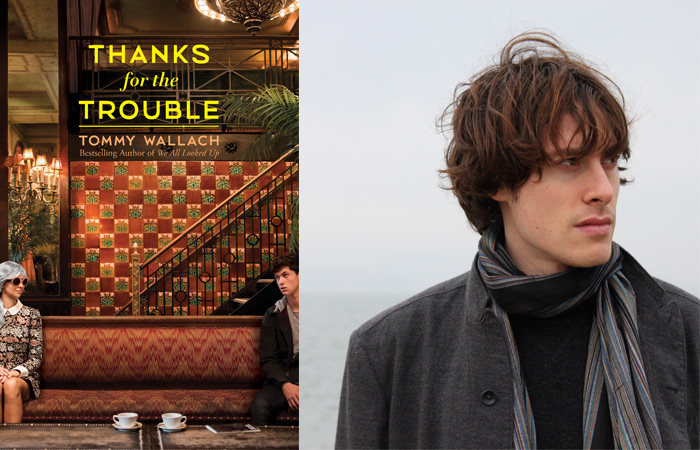
Next week Tommy Wallach’s sophomore novel, Thanks for the Trouble, hits bookshelves everywhere. Where his bestselling debut, We All Looked Up, followed four teens in what might be the last days of the world, as humankind waits for an asteroid to hit earth, Thanks for the Trouble‘s Parker Sante has already met the asteroid that blows up life as he knows it. Her name is Zelda Toth, a silver-haired beauty he meets in the lobby of a fancy hotel. Their meet-cute story involves more larceny than these things usually do, as he lifts a wad of thousands from her purse…then is forced to return it when retrieving the notebook he left behind. The two embark on a bucket list adventure to spend all the money, before Zelda fulfills an old promise to herself: that she’ll finally die, by jumping off the Golden Gate Bridge. See, Zelda claims to be a near-immortal, a more than 200-year-old girl who will never look a day older than 17. As the money dwindles, the hours tick by, and Parker falls more and more in love with her, he grows determined to find a way to make her stay—and to finally, after years of muteness and disconnect following a traumatic accident, start living a life worth staying for. Here’s Wallach on his name, and his life on the bottom shelf.

Ships in 1-2 days.
Wallach. Wallach. Wall lick. Ick. Icky. Ichor. Igor.
I’ve never liked my last name very much, and not just because it sounds like the noise you might make to dislodge a fish bone that got caught in your throat (try saying it out loud right now…see what I mean?) or because it happens to rhyme perfectly with “bollock.” No, growing up, my biggest problem with my last name was the lastness of it. “W” is really the last plausible letter of the alphabet for a name (no offense to the X-, Y-, and Z-ers, but we all know you aren’t seeing a lot of action), which means I spent my childhood being the last or second-to-last name called during any alphabetically organized activity: attendance, lining up for fire drills, separating out for study groups. And though you may think it doesn’t matter, there’s always something galling about going last. It reeks of failure: last place, last rites, last call.
My late-blooming last name stopped mattering much after middle school, thankfully, so I mostly managed to forget about it for years. Then I sold my first novel, and I had a terrible realization: books, it turns out, are just like kickball games in fourth grade P.E. Both are organized alphabetically (and, in my case, both were equally likely to end with me crying on the floor).
Though there are disadvantages to having a last name at either edge of the alphabet, as usual, the folks at the end get the crappier deal. Sure, you might have to go up on tippy toes for that boxed set of Judy Blume novels, or even ask for a stepladder to reach the new Margaret Atwood (and you should get both of those, by the way), but if you want to pick up Rick Yancey’s latest Wave, or browse through Markus Zusak’s back catalog, you better be ready to get down in the dirt and crawl like a baby.
While “Wallach” may not require the full hands-and-knees experience, nobody’s getting my books without giving their glutes and calves a good workout. And isn’t the whole point of reading to avoid exercise? Oh, why couldn’t I just have been born “Suzanne Collins”? Three letters into the alphabet places you perfectly at eye level! If my name were “Suzanne Collins,” I would almost certainly be friends with Jennifer Lawrence by now.
Then again, I’ve learned I do have some things to be grateful for. The alphabet doesn’t just determine which shelf your books will be placed on; it also determines your shelfmates. I care about my books, and I would hate to think of them spending their lives next to some jerk. Just think—there’s probably some nonfiction author out there named Sandy Palinowski, or Donald Trumpert.
When I was younger, I’d planned to be a writer for adults, and that meant my books would be right next to those of David Foster Wallace. I had mixed feelings about that. On the one hand, David Foster Wallace’s books are really popular, so maybe some people would end up accidentally mistaking my book for one by Wallace, buying it, then being too lazy to bother returning it. On the other hand, David Foster Wallace’s books are really good, so maybe some people would come in intending to buy my book, then notice David Foster Wallace’s books right next to mine and think, “Hey, I’ve heard such good things about this other guy, why should I bother with a hack like Tommy Wallach? I mean, look at that stupid last name he has. It sounds like the kind of noise you’d make to scare a raccoon out of your garbage can!”
When I discovered (much to my surprise!) that I was going to be a YA author, my famous shelfmate changed from David Foster Wallace to Scott Westerfeld. Westerfeld presents all the same drawbacks as Wallace—Scott’s books are wildly successful and universally loved—but with none of the advantages (i.e., nobody’s going to mistake the mellifluous lullaby of “Westerfeld”for the aggressive sucker punch to the eardrum that is “Wallach”).
But just in case anyone’s confused, allow me to clarify. Yes, I wrote the bestselling Uglies series. That was me. Not Scott. Me. Pay no attention to the covers or titles. Just buy the one that says “Wallach” on it.
Anyway, there is a very important lesson to be gleaned from the Westerfelds, Yanceys, and Zusaks of the world: we end-of-the-alphabet folks can thrive, in spite of our less-than-ideal shelf placement. So remember us, please, the next time you’re in the bookstore. We’re down there, hiding in the shadows, far below your line of sight, waiting to be discovered. Don’t be afraid to crawl.
Thanks for the Trouble is on sale February 23, and available for pre-order now.