


 Order History
 Premium Membership & Rewards
 Help Center / FAQ


10 Science Fiction Books for the Video Game Obsessed

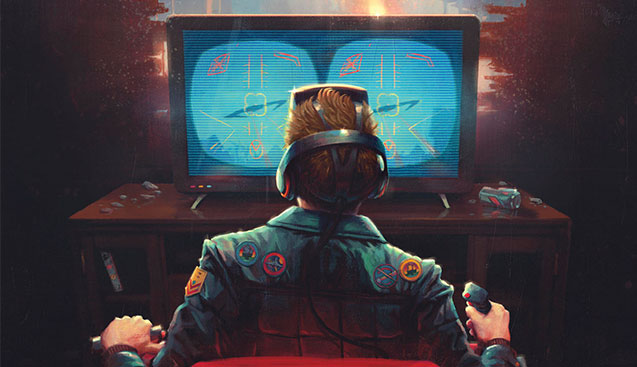 Over the past few decades, video games have moved from fad, to kids’ stuff, to a new pillar of mainstream entertainment, but in some ways we’re still figuring out how they slot into the landscape of our everyday lives. Who is a gamer and who isn’t? If you play games on your phone during your commute, are you a gamer in the same way as someone who owns three consoles and spends weekends immersed in a MMORPG?An obsession with gaming can have consequences both good and bad—games can offer skills and experiences that useful in real life, and help players make social connections they might not otherwise have been able to. But games, like anything else, can also be used as a shield from the outside world, a way to avoid IRL complications that don’t go away when the controller’s batteries die.
Science fiction has been dealing with virtual worlds since long before such things were real considerations, but the last couple of decades have seen games and virtual spaces begin to conquer the physical world. These 10 books have complex and interesting protagonists, and explore the real advantages and alarming downsides of living in a world in which video games have become a way of life.
Bash Bash Revolution, by Douglas Lain
Lain’s latest begins with an outdated Nintendo game and ends with the technological singularity that we may or may not deserve. Matthew Munson is an unambitious kid from a broken home—mom’s barely getting by, and dad is flighty and frequently absent. He’s also working on a highly secretive government project looking to create a sentient artificial intelligence. The two try to reconnect over a game called Bash Bash Revolution, before Matthew learns that dad is more interested in his AI, named Bucky, than his son. The numbed new world that Bucky offers is as believably enticing as it is disturbing.

Ships in 1-2 days.
Only You Can Save Mankind, Terry Pratchett
Quirky, outlandish fantasy writer Pratchett took some time off for quirky, outlandish sci-fi with this, the first of his “Johnny Maxwell” trilogy. Much like the protagonist of Bash, Johnny has a difficult home life and becomes addicted to video games, with the Gulf War seeming no more real to the 12-year-old than the ScreeWee aliens of his favorite computer game. And then, one day, the aliens surrender. Which isn’t supposed to happen. Soon, Johnny finds himself inside the game, negotiating with the ScreeWee and helping them to find a way home. A little retro, sure, but graphics don’t matter much in a novel. This one inspired its own video game, a cheeky and un-winnable one called Journey to Alpha Centauri (in Real Time).

Ships in 1-2 days.
United States of Japan, by Peter Tieryas
The first of a series of novels set in an alternate past/future in which America lost World War II and has been colonized by Japan, Peter Tieryas’ sophomore effort owes a clear debt to Philip K. Dick’s The Man in the High Castle, but where the lives of characters in that 1960s masterwork are thrown into disarray by a subversive novel that depicts life in a world in which the Allies defeated the Axis, the macguffin of United States of Japan is a subversive video game. Government censors are desperate to suppress the spread of the seditious game. Beniko Ishimura, the son of two American citizens imprisoned in internment camps during the war, is tasked with finding the source of the video game, and ends up partnering with Akiko, a member of the secret police, who is guarding secrets of her own. They tumble around the USJ, running into all manner of gangsters, spies, cyborgs, and who knows what else, and reckon with their pasts—their alternate pasts, which feel like history. The giant robots that adorn the cover don’t figure much in the “real world” until the sequel; they feature in the game and function in the novel as a shout-out to the mecha and kaiju who battle it out in Japanese pulp fiction. The game itself is a nod to the ascendency of the Japanese video games played so fervently by so many Americans in our version of the ’80s (and beyond), and a recognition of their immersive power. (For what it’s worth, Tieryas is a huge gaming geek.)

Ships in 1-2 days.
Warcross, by Marie Lu
Marie Lu (Legend) introduces 18-year-old Emika Chen and the immersive combat game of Warcross in her recent cyber-thriller. Emika, having been on her own for years, has a juvenile record and massive debts which she tries to mitigate by taking work as a bounty hunter. The game is massively popular—to the tune of millions of players who’ve made the game a way of life for a decade. Illegal betting on the game is a major industry, and people like Emika can find work in bringing gamblers to justice. Even that isn’t enough to keep Emi in ramen noodles, so she exploits a bug and hacks the opening game of the international Warcross Championship, accidentally becoming a part of the action and an overnight celebrity. Rather than arrest her, the game’s young creator gives her a job: hunt down a saboteur hiding on one of the world’s top Warcross teams. (Available as a Nook eBook, Diane Duane’s 2011 Omnitopia Dawn similarly involves a conspiracy to bring down an MMORPG—for noobs, that’s a massively multiplayer online role-playing game—with global reach and millions of players.)
Ack-Ack Macaque, by Gareth L. Powell
Come for the delightfully weird title, stay because Powell (Embers of War) has crafted a unique and engaging bit of sci-fi alt-history with impressive world-building. Lead by a foul-mouthed, cigar-smoking monkey fighter-pilot. Ack-Ack Macaque was the main character of a hugely popular Word War II-themed online game but, as the novel’s character soon realize, he wasn’t just a digital creation. The game’s masters fiddled with the mind of a real macaque and plugged him into the game to give their lead character a little something extra. It made for a huge hit, but Ack-Ack has escaped, and quickly becomes involved in a plot against the heir to the British throne in a steampunk near-future. Rather than being about the game, Powell’s novel is about a the world shaped by it. But we had to mention it, because monkey with a revolver.

Ships in 1-2 days.
Insignia, by S.J. Kincaid
Sometimes, it ain’t about the game. It’a about the player. Kincaid’s Insignia trilogy stars teenage gamer Tom Raines, a 14-year-old who’s not much of a physical specimen in reality—but in virtual reality, he’s a champ. For the Intrasolar Forces, that’s enough. In this future, the resources of the planet are gone, so war rages in the solar system for control for the riches of the broader solar system. His skills make him a hero, but the computer newly implanted in his brain makes him a virtual puppet to the military leadership. There’s a bit of Ender’s Game in this one’s DNA.
Otherworld, by Jason Segel and Kirsten Miller
Most of these books are ambivalent about games and gamer culture—presumably because “Games are cool!” is a bit limited as a thesis. Otherworld goes full-on Black Mirror, though, with the story of a limitless virtual world that lets you do all of the things you’d like to do IRL but don’t have the guts to. Otherworld has no laws, no rules, and no limits. So why would you ever leave? What happens when the lure of imaginary worlds becomes more than we’re able to reists? That’s the question at the heart of the book, and it’s one that touches upon some very current and growing concerns about our relationship technology.

Ships in 1-2 days.
Armada, by Ernest Cline
Ready Player One is a given on this list, so instead we went with Cline’s follow-up, which has a great deal in common with The Last Starfighter, a classic (if cheesy) ’80s movies that brought video game-sensibilities to the big screen. Like Ready Player One, Armada is also likely to become a film in the near future. It’s about angry teenager Zack Lightman, who has lived his life pining after his dad, a video game champ who went missing shortly after Zack’s birth. Zack’s life changes when he looks out of his classroom window one day and sees a UFO that very closely resembles the one from the game with which he’s obsessed. Soon, he’s contacted by the Earth Defense Alliance, who are recruiting soldiers to defend against an anticipated invasion by alien forces. Zack finds, however, that the motivations of the “invaders” might not be quite what he’s been told.

Ships in 1-2 days.
In Real Life, by Cory Doctorow and Jen Wang
This graphic novel is about Anda, a huge fan of Coarsegold Online, a popular MMORPG. It’s her entire social sphere, and a place in which she can be her ideal self. A hero and a leader with friends from all over the world. Inspired to join an all-female guild, she’s soon approached with a business proposal: in exchange for IRL cash, she’ll use her skills to hunt and kill gold farmers, being players from developing countries who collect game currency and items to sell to players who are looking to get ahead quickly. It sounds great until she befriends Raymond, a Chinese teenager already crippled from years of factory work. The story brings up a variety of complex issues, not the least of which are the ways in which our virtual lives impact the real world, whether we realize it or not.

Ships in 1-2 days.
For the Win, by Cory Doctorow
Another Cory Doctorow book about gold farming, though this one is a prose novel with a dystopian bent. In a dark near-future, teenagers in the world’s poorest countries are made slaves to their computers, working tirelessly as gold farmers in electronic sweatshops, kept docile by exploitative contracts and threats of violence as they collect virtual treasure for wealthy players who don’t want to put in the work of building up their characters in a massively popular online game. Everything changes when a mystery woman with connections within and outside of the gaming world organizers some of the best teen gold farmers and sparks a revolution that will change the world, online and off. It’s a book that forces you to think about the who is paying the true costs of the gadgets and luxuries we take for granted in our everyday lives.

Otherland, by Tad Williams
Williams’ prognosticating ’90s sci-fi quartet is sprawling (four volumes, each flirting with 1,000 pages), but it earns the expansive page count with a story that both predicted the rise of immersive gaming and our always-connected world, and built a fascinating fantasy setting that works even without all the techno-trappings. In an undefined but not-too-distant future, immersive online gaming—closer to Second Life or the OASIS of Ready Player One than World of Warcraft—is omnipresent, and the real and virtual worlds have become irrevocably interwoven; people link up to the digital world via technology implants. But then children around the world begin falling into comas, a condition known as Tandagore Syndrome, that seems to be tied to events within the digital world that goes beyond simple failures of technology. A group of scientists begin investigating, and uncover a vast conspiracy that involves manipulation of the shared virtual world by the elite powers of the world—and soon, they find themselves trapped within the game, unable to log off. And as in The Matrix (which came out years after the first Otherland book), if you die in the game, you die in real life.
What books would you add to our list?