


 Order History
 Premium Membership & Rewards
 Help Center / FAQ


An Introduction to the Neon Genesis Evangelion Manga

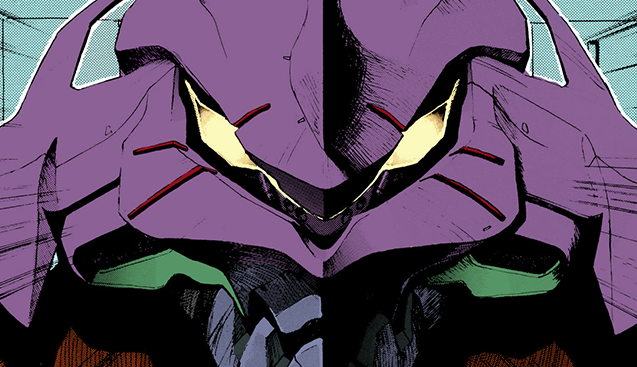 Neon Genesis Evangelion is back—and for a lot of people, it’s here for the first time. The show begins streaming on Netflix on June 21, making it widely available to North American viewers for the first time in years. For those who’ve already seen it—or if you’re reading this on June 22 and you’ve already binged all 26 episodes—and just can’t get enough NGE, the manga makes a great companion read. If you’re not into anime but don’t want to be left out of the Evangelion party, it also stands really well on its own.
The anime was first broadcast in Japan in 1995, but the manga started earlier and lasted much longer: it wasn’t completed until 20 years later. Although it started out as a fairly straightforward adaptation of the anime, it later veered off and became its own thing, so the manga actually has unique elements of its own—making it worthwhile even if you’ve seen the entire run of the TV series. (Of course, reinvention is part and parcel with this franchise: the anime was swiftly followed by a several movies that tweaked the ending, then decades later by a still-ongoing four-film reboot that changes a lot more than that.)
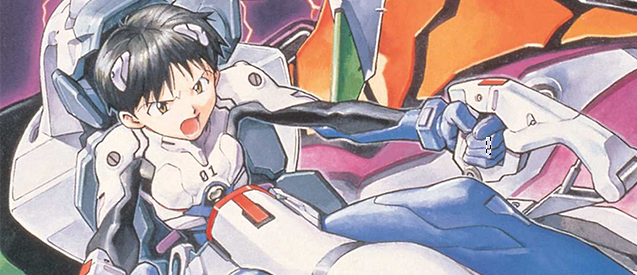

Neon Genesis Evangelion 3-in-1 Edition, Vol. 1: Includes vols. 1, 2 & 3
Yoshiyuki Sadamoto
4
Paperback
$24.99
Ships in 1-2 days.
Neon Genesis Evangelion starts out as a familiar sort of sci-fi action manga. It takes place in Japan in 2015, some time after an event called the Second Impact caused the polar ice caps to melt and much of the world to be submerged. The setting is Tokyo-3, a futuristic city built after the original Tokyo was destroyed, and the nudge that gets the story rolling is an attack by a giant being called an Angel.
The lead character, Shinji Ikari, initially seems like your typical shonen hero, a nebbishy guy who will turn out to have one really important talent that allows him to excel in some sort of competition. In this case, the talent is piloting a giant mecha, and the competition is fighting the apparently cybernetic monsters called Angels. The Angels keep popping up and attacking things, and as is so often the case, only teenagers operating incredibly complicated equipment can save the world.
Right from the start, though, it’s obvious that there’s something strange about these machines, the Evangelion Units. There’s more to piloting them than just good motor skills:the pilot syncs with the machine in a sort of mind meld. At first that makes sense: Shinji wills his arm to move, and the suit’s arm moves. Things get weirder, though, when he loses consciousness during a fight and drifts off into a bizarre nightmare while the suit goes berserk and defeats the Angel on its own.
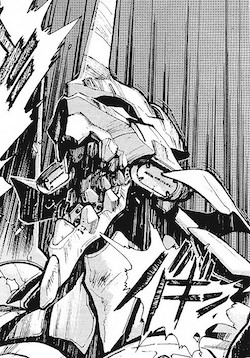
All this takes place under the auspices of NERV, the organization responsible for developing the mecha and matching them with pilots. Shinji’s father Gendo is the head of NERV, but he seems to be answering to some sort of higher power. Shinji’s mother disappeared during the test of the first Evangelion suit, 10 years previously, and Gendo subsequently abandoned his son, leaving Shinji to be raised, apparently without much tenderness, by relatives. Shinji resents his father’s disappearance, and although they are reunited at the beginning of the manga, Gendo is cold as dry ice and Shinji can’t get over his anguish at his father’s apparent rejection.
This all sounds pretty serious, but there’s also a lot of light-hearted byplay in the manga (and even more in the spinoffs—see below). Shinji goes to school, where he quickly makes two friends, a tough guy and a nerd. His sort-of guardian, Misato Katsuragi, is the sexy/smart chief operations officer of NERV, and when she’s not doing Important Science Stuff, she likes to drink and flirt and care for her super-adorable pet penguin. Rei, the other pilot at NERV when Shinji arrives, is pale, quiet, and apparently emotionless. She takes a beating in the first fight Shinji sees but is willing to go back out again without complaint. Asuka, the other pilot, is a duplicitous, angry redhead who changes her entire bearing depending on who is around her.
Fans of the anime like to make fun of Shinji for being so neurotic, but he comes across as pretty likable in the manga: he doesn’t want to be tossed into an Eva with no training, but he does it to keep Rei from having to go out again. He’s earnest and heartfelt, if a bit clueless, and he’s easy to empathize with.
No spoilers here, but as the story goes on, many secrets are revealed, some of them horrifying and some of them pretty deep. There’s a lot more to the story than teens in mechs, and the narrative eventually draws in a lot of different strands of religion, history, and philosophy to create its own unique mythology. The religious references, only a few of which I’ve mentioned here, are a giant clue, but they all take on new meanings of their own in this story.
Although the anime was largely the work of director Hideaki Anno and was shaped by his struggles with depression, the manga was created by Yoshiyuki Sadamoto. Sadamoto was the character designer for the anime, so the visuals are consistent, but he has made the story his own. The first three volumes were released before the anime aired, partly to promote it, but the fourth volume did not come out until well after the television version had ended. Progress was even slower after that; although the manga was supposed to run as a monthly series, Sadamoto was busy with other projects and there were long delays between chapters. The final volume was not released until 2014, 20 years after the first chapter came out. Over time, the manga wandered off from the anime, becoming an alternate version of the story.
Speaking of alternate versions…
Neon Genesis Evangelion was such a phenomenon in its time that it generated numerous spinoffs, some only tangentially related to the original. Here’s a quick look at what’s available in English.

Neon Genesis Evangelion: The Shinji Ikari Raising Project Omnibus Volume 1
Khara, Osamu Takahashi
Paperback
$24.99
Ships in 1-2 days.
Neon Genesis Evangelion: The Shinji Ikari Raising Project, by Osamu Takahashi
Battles take a back seat to relationships in this spinoff that focuses on the triangle of Shinji, Rei, and Asuka. In this world, Asuka and Shinji are childhood friends, and Rei is the new kid who messes things up. This story is 18 volumes long—four volumes longer than the original series—and Dark Horse has published it as both single volumes and beefy three-in-one omnibuses.
Neon Genesis Evangelion: The Shinji Ikari Detective Diary, by Takumi Yoshimura
Shinji, still in high school, plays detective when his friend Toji gets into trouble with some gangsters. All the characters in this two-volume series appeared in the original manga, but here they are cast in a very different story.
Neon Genesis Evangelion: Campus Apocalypse, by Gainax
We’re back to action stories in this three-volume series (collected by Dark Horse into a single omnibus). Shinji is a student at the elite NERV Academy, and his fellow students, Rei, Asuka, and Kaworu (another NGE character) are out every night fighting humanoid Angels on the streets.
Tony Takezaki’s Neon Evangelion, by Tony Takezaki
There’s an unwritten rule of manga (or maybe it is written down somewhere, who knows?) that anything really popular must eventually be turned into a gag manga. Takezaki does the honors in this book, a collection of spoofs and imaginative new takes on the familiar story and characters.

Ships in 1-2 days.
Thanks to the continued fan interest in the original anime and the subsequent revisions and reboots, there’s also been a steady supply of art books, most of them drawing from material created for the various filmed iterations. Viz Media recently released Evangelion Illustrations: 2007-2017, collecting character sketches, key art, posters, chibi character designs, and even a spread featuring Evangelion Unit-01 fighting Godzilla—concept art for a theme park ride you’ll need to go to Japan to experience.
In August, Udon Entertainment is releasing another must-have for fans: the Neon Genesis Evangelion: TV Animation Production Art Collection is a massive hardcover volume collecting 432 pages worth of draft artwork created for the original anime. As we said above, Evangelion manga-ka Yoshiyuki Sadamoto creaated all the character designs for the series, so this is fascinating stuff no matter your preferred medium to experience giant teen-piloted robots battling invading massive monsters.
If you love Evangelion as an anime, have you gone on to read the manga? Let us know which version you prefer!