


 Order History
 Premium Membership & Rewards
 Help Center / FAQ


Charles Soule on the Peter Parker Problem at the Heart of The Oracle Year

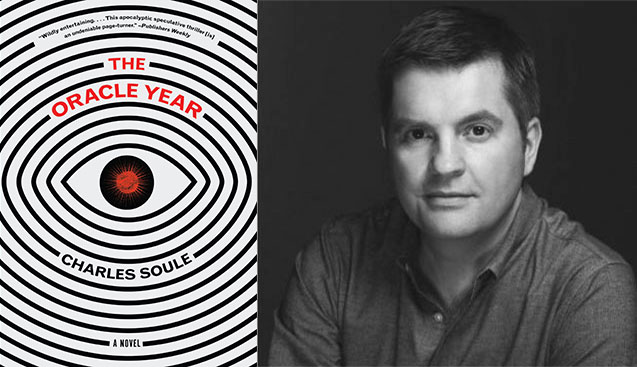 Charles Soule’s debut novel, The Oracle Year, came out this week. He’s a first-time prose author, but his name is very familiar to comic and graphic novel fans for his work on books like Daredevil, Poe Dameron, She-Hulk, Letter 44, and Curse Words.
He’s also an attorney and a musician, and may or may not sleep.
The Oracle Year follows Will Dando, a luckless New Yorker who recently saw his fortunes change when he was gifted with exactly 108 flawless predictions about upcoming world events, both big and small. Figuring out what to do with the=at information is the hard part, and Will’s choices capture the imagination of the globe as they draw the attention of big business, evangelists, assassins, and the President of the United States. It is a remarkably accomplished book—an entertaining, globe-spanning page-turner and a mediation on ideas of destiny and personal responsibility.
Charles Soule was kind enough to chat with us about the book’s origins, the differences between writing comics and novels, and about finding time to create.
I don’t want to spend too much time on your comics work, but you write, literally, a billion comics.
It’s crazy. I’ve passed something like 6,000 pages of published comics. I think that happened early this year and it’s amazing. Amazing that I’ve written so many, and that I’m still writing so many considering everything else that’s going on.
This sounds like a frivolous question, but I’m serious about it: when did you find the time to write a book? I’m very curious about that.
You know, it’s something that I did around the sides of the responsibilities that I have in the comics…and the legal work. Because I started writing this when I was still practicing law. And it’s just like anything else: if you want to do it, you find time. And it’s not like you spend eight hours every day doing it. You spend two hours here. Maybe you get three hours one week to work on it, but that’s enough to get a draft of the chapter. Then find another two hours someplace else to revise that chapter. There were several more concentrated periods where I worked on it in more of a sprint, to the exclusion of other things, especially as it was getting to the point where it was going out to be purchased. But, but by enlarge it just was something that I did alongside everything else.

Ships in 1-2 days.
Is that frustrating to do? This is being your first novel, I have to assume at some point it became an important priority. Is it frustrating to have to find the bits and pieces of time to do the various different things?
I wouldn’t lie about that, but the truth is I’m working on my next novel right now and I was able to spend the morning today working on it. But it was hard to carve out that time. I think of it in terms of being extremely lucky, which I am. I’m fortunate that my comics career is going pretty darn well right now. There have been some very high profile and busy projects there.
You know, I sort of see this as a moment that I need to really capitalize on, so I’m just working as much as I can and it’s not drudgery by any means. It’s all work and stories that I love telling. So it’s easier to get motivated to do it.
Good problems?
Yeah, exactly.
I said I wanted to talk mostly about the book rather than your other work, but what did you learn writing a novel as opposed to writing comics? They’re maybe not entirely different…but they’re pretty different. What were the challenges?
I think they’re hugely different types of writing. The truth is, when you’re writing a comic you’re part of a band; you’re one instrument among several, between the art and the colors and the letters and everything else. When you were working on a book, you’re responsible for the entire experience that the reader has, and so it becomes a series of choices at small and large levels sometimes that you don’t have to make when you’re working on a comic strip. Like if I say “this scene is set in a casino,” I don’t have to make every single decision about how the reader experiences that. Some of those things are on the other members of the team.
But if I’m writing it in a novel, every detail is a decision that I have to make. In some ways that’s good, because I’m in complete control of the experience. So I can use tricks and I can mold the emotional and technical writing content to whatever level I want. That also can be kind of a trap, right? Because then you’re never done. In comics there’s a deadline, you have to hand it off, it’s got to go and so you write it and then you get chances to fiddle with it again down the road at the lettering pass or whatever it might be.
Generally speaking, when it’s done, it’s done. With a novel, there really is no point when it can’t be fiddled with or improved or changed or altered. You have to keep a totality of it in your mind, as well as from the individual sentence level all the way up to the novel level. Every decision you’re making. And it can be really hard and grueling. You’re building a cathedral as opposed to just building one part of a cathedral, which is sort of what you’re doing when you make a comics issue. But it’s a discipline that I like. I’m a kind of a focused guy. I like that kind of exercise and it’s really satisfying when you type “The End” at the end of the novel.
I don’t know that I expect you to answer this, but do you feel like you prefer one format over the other?
They both have challenges. The fact is a novel could take two years or more from the day you start typing it to the day it sees shelves. And so it’s this big, slow, slow, slow, slow glacial buildup to this incredible moment. Which, for me, is going to be April third when The Oracle Year actually hits. Whereas if I write a comic, I mean the comic I write tomorrow is going to be an X-Men issue and that issue is going to be on the shelf in three months, if that. That’s very, it’s very cool. It’s very satisfying. It’s very immediate. It’s very punk, and I love comics for that. I don’t think I’ll ever leave them. But at the same time, you know, there’s something beautiful about crafting a longer, more detailed experience for readers. And that will hopefully live with them for a longer time.
There’s a lot going on in the book (in a good way). You’ve got presidential politics, you’ve got televangelists, you’ve got like assassins. They’re going all over the world. I’m curious about the inception of the story. Did the story start out with scope, or is that something that built over the process of writing? Was it always that big?
It was always that big. The genesis behind the novel was really…it was partly that when I started writing it, I was still working as the lawyer and comics hadn’t blown up the way they subsequently have for me. It hadn’t become apparent that I could make a career, but I was working on it and trying really hard and, and fitting it around the edges like I do, like we spoke about earlier. And, so, I would have given a lot to be able to ask the question. Will this work out? Will this turn into something? Will I have the life that I want to have? And I figured that while that was my question at the time, everybody in the world has a question like. Whether it’s: Will I ever see her again? Will I ever achieve this goal that I’ve been working for? Will he get better? Whatever the question is, everybody has one.
And so I thought the appearance of a prophet in the world, Somebody who could hypothetically answer those questions would have massive ramifications all over the world in all kinds of societal structures: from politics, economics, to pop culture, to everything. And I wanted to write a book that explored that in as much detail and on as many levels as I could. I wrote about a lot in this book as you as you noted, and I tried to make all of it as fun and engaging and cool and fact-based as possible. But I could have written seven more books just set in this one year about how people react to the idea that there’s a prophet out there. There’re so many stories you could tell. It was always going to be big. As big as I was capable of making within the time. But I think it could have even been bigger.
So there was a sort of meta-level where you were wondering and wanting someone to tell you if this book was going to work out, while you were writing the book. That’s interesting.
Oh, yes. There’s no guarantee with any novel. There’s no guarantee even now. It’s not like comics where the pre-orders numbers come in and the comics are sold, and so that’s what the book has done. With a novel, people have to go into stores and buy it. They have to walk in and put the money down or get it online. However they want to read it. Except pirating it. Those are the purchases that count. So even though I have gotten this far, I still have not made it as far as I’m concerned on the novel. But fingers crossed.
Was there a lot of research that went into this? Or was this stuff that you were able to pull out of your head?
Oh, yeah. Lots and lots. I’ve been lucky that I’ve gotten to travel a fair amount in my life and we lived different places growing up. The legal background helps with some of the political stuff and so on. But yeah, I read lots of stuff. Researched about the way to the dark and deep webs work. Coding and viruses. There’s so much that went into it. Everything from a random quick google search to reading books on various subjects. I mean I live in New York and I’ve been a musician for a long, long time. So a lot of the elements about the main characters working in the music scene in New York are from my own experience. Then things about hedge funds and, and how they work: it was talking to friends who are in that world. You have to do your best to make it feel like people are getting a glimpse into a world they don’t know. Otherwise what’s the point of reading a book, if you’re just going to see things and experience things you’ve already experienced in your own life.
You talked about this a little bit, but were there big changes between the initial concept and the book that I have sitting in front of me?
I would say the general thrust of the story, which is that you track a prophet. The main character Will Dando, has this information, but always a limited amount of information. The 108 predictions. That number fluctuated a little bit here and there, but he got his information, didn’t know where it came from, and decided to start using it. Putting it out into the world and then looking at how the world freaked out, and how his life changed as a result. That was always the spine of the book. As for specifics, I could show you early drafts that focus on different characters in different ways that changed completely from beginning to end. There’s probably not a single page or sentence from draft 1 that is the same in the final draft. That said, I think if you read draft 1 you would recognize the book as it became. One of my creative tenets is that you never have all your good ideas at the same time. You have them over a period of time, and they’re often exposed to you by having worse ideas first.
Until you write the bad draft, you can’t get to the good draft.
So Will Dando has these abilities, and I was fascinated with some of the discussion in the book about how far our responsibilities go when we’re given a gift. Do we have a responsibility to use it for the greater good, or do we just accept it graciously and use it however we feel? Is that something that you have a strong feeling about yourself?
I would say that yes, I do have a strong feeling about that. It’s the Peter Parker thing. But it’s a very, very complicated question as to whether or not you have responsibility for the luck that comes your way in your life; or the luck that comes to you generationally through the parents or the family you were raised in; or the country you were born in; or your skin color. All that stuff. All of those things that fall into or don’t fall into your lap as a human being. Just the same way these powers fell in Will Dando’s lap. And my feeling is that basically we are all part of an ecosystem, and the idea that that you should pretend you’re not and that your actions are not influencing the other parts of that ecosystem would be a terrible thing.
Let me rephrase that: I think it is possible, if you are in a certain place in society, whether it’s in America or someplace around the world, there are certain segments of society that are able to essentially live their entire lives by taking things. They don’t ever have to really give anything back because of the way things are for them. I think that is horrible and bad, and it disgusts me, actually. And so, if you’re lucky enough to have gifts and options, I think using them to try to help society to the degree that you can is important.
I don’t know if that’s the answer to your question…
You hit it on the head. So, just to wrap up, is there anything coming up that you want to talk about?
I always like to end these by thanking people who read my books. That’s the only reason I get to keep doing it and it’s something I really, really love. Thank you for that, anyone who’s reading this. It gives me a lot of joy. What am I excited about? Anything I’m doing with Marvel is work I’m proud of and excited to get into people’s hands. I’m also doing an Image Comics series called Curse Words with my good friend Ryan Browne. It’s one of my favorite things I’m writing these days. But especially check out The Oracle Year.