The Moon and the Other Offers a Bold Vision of the Future, and the Present
 Even for science fiction writers, predicting the future is never a safe bet. But whether it works out that way or not, I’d like to make a bid for future classic status for John Kessel’s The Moon and the Other. It’s the first novel in 20 years from the multi-award-winning author, and it is a masterclass in language and worldbuilding.
It is the mid-22nd century. Humans have colonized the moon and Mars. With a population exceeding three million, the moon is home to 20 independent nations and a general governing body called the Organization of Lunar States (OLS), each with its own organizing principles. One, the Society of Cousins, follows a matriarchal model where men are free to follow personal pursuits and sexual relations, but forfeit their rights to vote and wield political power. If a man wishes to cast a vote, he must sacrifice his carefree lifestyle and enter into the menial workforce, tending fish farms or collecting bird droppings.
The Moon and the Other
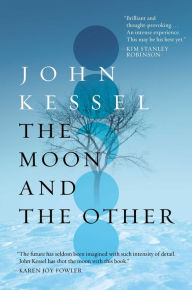
Hardcover $27.99
The Moon and the Other
By John Kessel
Hardcover $27.99
There is growing unrest between the Society of Cousins and other members of the OLS. Some that a patriarchal governing model seize on the opportunity to undermine and infiltrate the Society of Cousins on the premise of investigating the poor treatment of men. Following multiple characters, we glimpse day-to-day life in a few of the lunar colonies, and discover how far some are willing to go for power and money, even if it means going to war.
The Moon and the Other is so in tune with contemporary issues it feels almost prescient, tackling topics from gender politics, to the validity of social constructs, to the true price of freedom. Political intrigue at the highest levels of government make for an intensely paced and thought-provoking potboiler plot. The tightly packed, perfectly paced narrative never wavers as it shifts between disparate characters. It is a story you can sink into like a hot tub set to simmer, and enjoy. You get to know the characters, appreciate the care that went into the worldbuilding—the lunar colonies operate with the fiendish logic required of outposts in an untenable atmosphere—and revel in the subtle shifts of understanding as the characters discover hard truths about themselves and their loved ones.
Kessel’s gift for language forces you to slow down and savor his prose; many passages border on the poetic. But more than the beauty of his writing, Kessel astounds with his ideas, creating a world that is a funhouse mirror the political reality we inhabit today, despite the vast differences of time and setting. Colony founders aimed to create utopia, but at what cost can they achieve such a goal? How many people must sacrifice their rights, their happiness, their ambitions, so that others more powerful can live in perfect harmony? And is it really a utopia if it is only a utopia for some?
There is growing unrest between the Society of Cousins and other members of the OLS. Some that a patriarchal governing model seize on the opportunity to undermine and infiltrate the Society of Cousins on the premise of investigating the poor treatment of men. Following multiple characters, we glimpse day-to-day life in a few of the lunar colonies, and discover how far some are willing to go for power and money, even if it means going to war.
The Moon and the Other is so in tune with contemporary issues it feels almost prescient, tackling topics from gender politics, to the validity of social constructs, to the true price of freedom. Political intrigue at the highest levels of government make for an intensely paced and thought-provoking potboiler plot. The tightly packed, perfectly paced narrative never wavers as it shifts between disparate characters. It is a story you can sink into like a hot tub set to simmer, and enjoy. You get to know the characters, appreciate the care that went into the worldbuilding—the lunar colonies operate with the fiendish logic required of outposts in an untenable atmosphere—and revel in the subtle shifts of understanding as the characters discover hard truths about themselves and their loved ones.
Kessel’s gift for language forces you to slow down and savor his prose; many passages border on the poetic. But more than the beauty of his writing, Kessel astounds with his ideas, creating a world that is a funhouse mirror the political reality we inhabit today, despite the vast differences of time and setting. Colony founders aimed to create utopia, but at what cost can they achieve such a goal? How many people must sacrifice their rights, their happiness, their ambitions, so that others more powerful can live in perfect harmony? And is it really a utopia if it is only a utopia for some?
Corrupting Dr. Nice
Paperback $23.99
Corrupting Dr. Nice
By John Kessel
In Stock Online
Paperback $23.99
Characters rise off the page, joining readers as friends and compatriot. Even minor players are layered, flawed, real. It has the feel not offiction, but of future history, a work of narrative non-fiction that slipped through a wormhole and traveled back in time. These are characters I can see in the here and now, people I count as friends and greet as neighbors. Through them, a complex network of colonial life emerges.
Such a pointedly provocative and ambitious book risks getting bogged down in over-explanations: how did science allow for us to emigrate from Earth? Please, explain to me your personal philosophical pedagogy in a lengthy soliloquy. Not here. With the acumen of Ursula K. LeGuin, Kessel deftly conveys a lunar world where, despite nearly a 150 years of “progress,” many of the same social issues and prejudices exist, as they always have. It is never weighed down by its ambitions; instead it soars. It is a bold vision of our future, exploring more than the creation of colonies or the particulars of a society. It digs deep into human nature—our interactions, our prejudices, our flaws. Some things we carry with us, no matter how far we travel.
The Moon and the Other is available April 4.
Characters rise off the page, joining readers as friends and compatriot. Even minor players are layered, flawed, real. It has the feel not offiction, but of future history, a work of narrative non-fiction that slipped through a wormhole and traveled back in time. These are characters I can see in the here and now, people I count as friends and greet as neighbors. Through them, a complex network of colonial life emerges.
Such a pointedly provocative and ambitious book risks getting bogged down in over-explanations: how did science allow for us to emigrate from Earth? Please, explain to me your personal philosophical pedagogy in a lengthy soliloquy. Not here. With the acumen of Ursula K. LeGuin, Kessel deftly conveys a lunar world where, despite nearly a 150 years of “progress,” many of the same social issues and prejudices exist, as they always have. It is never weighed down by its ambitions; instead it soars. It is a bold vision of our future, exploring more than the creation of colonies or the particulars of a society. It digs deep into human nature—our interactions, our prejudices, our flaws. Some things we carry with us, no matter how far we travel.
The Moon and the Other is available April 4.