


 Order History
 Premium Membership & Rewards
 Help Center / FAQ


Tales of Two Drowned Cities: New York 2140 and Blackfish City

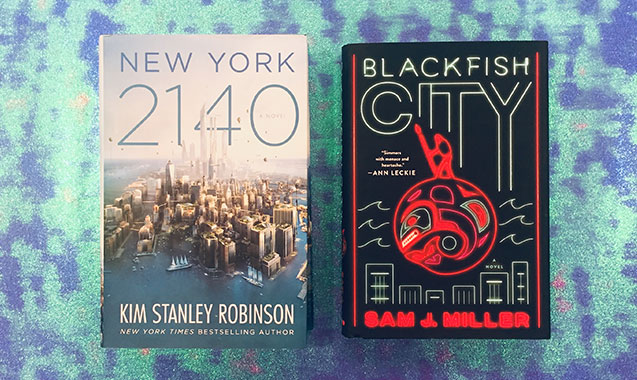 In his science fantasy novel Blackfish City , Sam J. Miller posits that “all cities are science experiments.” As experiments go, the climate change-afflicted floating city at the center of Miller’s novel—the arctic burg of Qaanaaq—looks quite a bit different than the drowned Manhattan of Kim Stanley Robinson’s New York 2140. Though released within a year of one another, and sharing a general focus—how will cities cope and change as sea levels continue to rise?—these two novels show us vastly different visions of metropolitan life in the waterlogged future.
Although the cities themselves are quite different, there are some striking similarities between the two novels. Structurally, they both shift between different viewpoint characters with each chapter. Robinson jumps back and forth between seven perspectives (two of which feature pairs of characters who are always together); Miller uses six. Each book has one viewpoint character who does the heavy lifting when it comes to doling out expository backstory, explaining how the cities arrived at the point where their respective stories begin.
Class divisions persists in both Qaanaaq and NYC: In New York 2140, the elite own space in soaring graphite towers on the dry bedrock of Upper Manhattan, while the middle class live in partially submerged buildings with waterproofed lower levels, and the lower class squat in buildings sinking into the sea; in Blackfish City, each of the eight arms of the asterisk-shaped city houses a different socioeconomic group in varying levels of luxury or squalor. In both tales, the elites are in control, but the common folk are rising up in revolt.

Ships in 1-2 days.
Robinson imagines a plausible future in which sea levels have risen 50 feet by 2140. With support from his characteristically robust worldbuilding, the novel details how New York City has survived and thrived in the wake of this cataclysmic climate shift. Some areas of Upper Manhattan sit on bedrock and remain safely above the high tide level; here is where new, high-tech skyscrapers are being constructed. Buildings located below Central Park—in standing water—use diamond coatings and other technology to waterproof the floors now underwater (provided they have the resources to do so), and build boat docks accessible from the floors at water level. (Lower Manhattan has become a “super Venice,” with boats replacing cars, buses, trains, and subways.) The have-nots live in crumbling buildings perched precariously on now-submerged landfill, surviving (or not) at the mercy of the tides.
All but one of Robinson’s viewpoint characters are connected to a single residential building, and their relationships develop from that association. The exception is the unnamed narrator who provides the history of the great climate shift, referred to simply as “A Citizen” (we never learn if they have any direct connection to the events of the novel). Said Citizen speaks directly to the reader, telling the story of how New York City got from present day to 2140, but also loading us with trivia about the earlier history of the metropolis, going all the way back to the days of Henry Hudson. For among other things, this novel is a paean to New York City. The Citizen’s chapters are purely what sci-fi readers like to call an “info dump” (albeit an interesting one), and Robinson knows it—at one point the Citizen advises impatient readers to skip to the next chapter if they tire of the “expository rants.” Speaking of: several of the characters also talk a lot about economics. (Robinson has said in interviews that he wanted to write a book about economics, and this is it.)
I am sure there are a lot of NYC references that went over my head, but there are two sly ones I did catch: a Dutch floating city brings a load of refuges to New York City. Its name? New Amsterdam. Logical, in the context of the year 2140, since the Amsterdam we know today is probably underwater in the novel, but that’s also what the Dutch called Manhattan, back when they owned it. The Citizen at one point wonders if their words are being read in the year 2144, 2312, 3333, or 6666. The second of those, of course, being the title of one of Robinson’s other novels, and another book with scenes set in a drowned New York City.
New York 2140 offers a lot of things (certainly enough to earn it that Hugo nomination), but none that I’d consider in the category of big SFnal ideas (climate change novels being rather less speculative these days than I’d prefer). Blackfish City, on the other hand, certainly does. Its setting, the floating city of Qaanaaq, is anchored over a deep sea geothermal vent that supplies the heat and energy needed to survive the harsh conditions of life in the Arctic Circle. The mechanics and much of the city policy are run by software, an advanced AI system only somewhat diminished after the cyberattacks of the Sys War.
But Miller introduces an even more dramatic SF concept—nanotechnology that allows humans to bond to animals and, we eventually discover, much more than that, pushing the book into the realm of fantasy.
Miller doesn’t dwell on specifics: we’re not sure when the novel is set, or how much the sea level has risen by that point. But there are references to “Events” that suggest the history between now and then. There was a Sys War, a Water War, and a Cancer War. The Real Estate Riots turned into the Real Estate War. The denizens of Qaanaaq refer to the “Sunken World,” which seems to mean the entire old world order reshaped by climate change. Much of the background of Qaanaaq is revealed by the program City without Maps, a broadcast followed by many of the characters. In contrast to the contributions of Robinson’s Citizen, these sequences as essential; as the book progresses, we learn more about the purpose of the broadcast and the author behind it. All the main characters share deep, significant connections, some of which they themselves only learn about as the story progresses. The end of the novel connects beautifully to its beginning.
So to connect this end back to my own beginning: we don’t know by how many feet the sea will rise. Or how we will adapt. But Robinson and Miller give us fascinating, very different visions of what might be in our future, one more plausible, the other more fantastical, and both, certainly, a whole lot wetter.
New York 2140 is available now in paperback. The paperback edition of Blackfish City arrives October 2.