


 Order History
 Premium Membership & Rewards
 Help Center / FAQ


The World’s Descent


Harold Bloom celebrates his eighty-fifth birthday on July 11. Two months ago Bloom published his forty-first book (The Daemon Knows: Literary Greatness and the American Sublime), and in two months’ time he will begin his sixty-first year of teaching literature at Yale (though now, due to poor health, his lectures are delivered in his living room). But Bloom’s reputation as “a singular breed of scholar-teacher-critic-prose poet-pamphleteer” (Sam Tanenhaus, New York Times Book Review) is built on more than longevity and productivity. The following passage is from The Anxiety of Influence, in which Bloom argues that literary criticism should engage us with the world by being “personal and passionate . . . a kind of wisdom literature, and so a meditation upon life”:
Twenty-first-century America is in a state of decline. It is scary to reread the final volume of Gibbon these days. . . . We have approached bankruptcy, fought wars we cannot pay for, and defrauded our urban and rural poor. . . . If we are a democracy, what are we to make of the palpable elements of plutocracy, oligarchy and mounting theocracy that rule our state?
Bloom is equally pessimistic about the current state of reading: “I know of no larger indictment of the world’s descent into subliteracy,” he famously said of the appetite for Harry Potter books. In How to Read and Why, Bloom exhorts us to spend more time on the traditional Western canon and to read for a variety of deeper reasons:
[T]hat we cannot know enough people profoundly enough; that we need to know ourselves better; that we require knowledge, not just of self and others, but of the way things are. Yet the strongest, most authentic motive for deep reading of the now much-abused traditional canon is the search for a difficult pleasure.
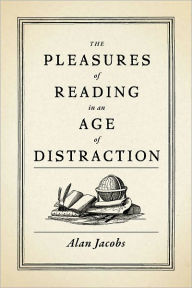 Alan Jacobs, also a professor of English literature, begins The Pleasures of Reading in an Age of Distraction with a critique of the reading guide genre — mostly misguided, says Jacobs, full of Charles Atlas plans and promises that lead away from the genuine enjoyments. After giving Bloom and his proscriptive insistence on the Western canon an especially long toss out the window, Jacobs offers his one and only rule: “Read at whim.”
In his interviews, Bloom returns often to his conviction that, having lost the war, his side is now fighting “only a rear guard action” against the digital age and the cultural climate responsible for having “devalued the very difficult act of solitary deep reading.” In his recent Book Was There: Reading in Electronic Times, Andrew Piper says that the war metaphors are unhelpful and the binary opposites misleading:
Books will always be there. That is what they are by definition: there. Whether in the classroom, the library, the archive, the bookstore, the warehouse, or online, it is our choice, however, where books will be. It is time to stop worrying and start thinking. It is time to put an end to the digital utopias and print eulogies, bookish venerations and network gothic, and tired binaries like deep versus shallow, distributed versus linear, or slow versus fast. Now is the time to understand the rich history of what we have thought books have done for us and what we think digital texts might do differently… The question is not one of “versus,” of two single antagonists squaring off in a ring; rather, the question is far more ecological in nature. How will these two very different species and their many varieties coexist within the greater ecosystem known as reading?
Like Bloom and Jacobs, Piper is also a literary scholar, but one heavily involved in the new crossover discipline of Digital Humanities — where some recent titles (Hacking the Academy and Breaking the Book, for example) suggest more of the squaring off than the species toleration.