


 Order History
 Premium Membership & Rewards
 Help Center / FAQ


Two New Books Shine a Light on the Strong Women of Star Wars

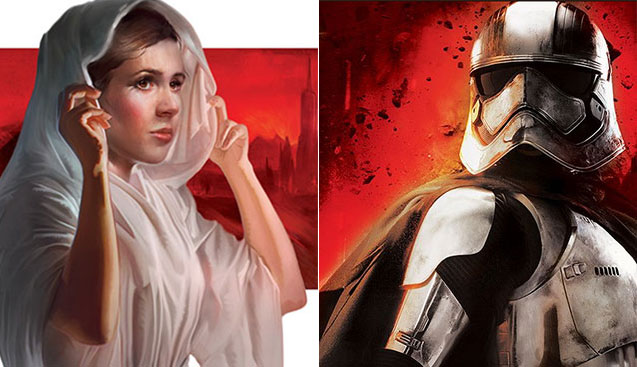 As we wait on pins and needles for Star Wars: The Last Jedi, there are two new books out that explore the fascinating women of the galaxy far, far away. Both are origin stories, but told in very different styles, focusing on two very different women. But in exploring the past, both give hints about the future of the Star Wars saga.
Phasma
When last we left the First Order’s Captain Phasma, she was about to be tossed down a garbage chute—a comic-relief callback to the original Star Wars and hardly a fitting end for the Boba Fett of The Force Awakens (or maybe a perfectly fitting end, come to think of it). It’s possible the character was never intended to survive the film, and her current status has more to do with a cool costume and the imposing physical and vocal presence of Gwendoline Christie inside of it. No matter: Fett got his start in much the same way, and the Force allows for happy accidents. Phasma, the new book from Delilah S. Dawson (Servants of the Storm) strongly suggests the Captain is far too resourceful to stay in that garbage chute for long.
(Point of order: this book is an origin story, but Marvel’s Captain Phasma series, to be collected in November, will tell the story of her escape from Starkiller Base, setting up her appearance in the next movie.)
The book begins with a framing device, set shortly before The Force Awakens. Vi Moradi is an agent of General Leia’s Resistance who finds herself captured by a man in blood-red armor, calling himself “Cardinal.” He trains young recruits to serve the First Order, but recently lost favor with his bosses when the mysterious Phasma appeared as a protege of Brendol Hux, initiator of the First Order’s Stormtrooper program (he’s also the father of Armitage Hux, the surly general who sassed Kylo Ren in The Force Awakens).

Ships in 1-2 days.
Cardinal’s not interested in acquiring typical intelligence from Vi: he knows she’s familiar with Parnassos, Phasma’s Mad Max-esque homeworld, and he wants the dirt—anything that he can use to knock his chrome-plated nemesis down a peg. Vi has what he needs, but she plans to take her sweet time giving out the information, buying herself the opportunity to work out an escape plan. We learn of two opposing factions on Parnassos: the Scyre and the Claws, scrabbling for minuscule resources on the blasted world. Phasma rules the close-knit tribe with her brother, though she’s largely the muscle. The crash of Brendol Hux’s shuttle delivers the promise of escape to a more civilized existence, and opportunities that go beyond survival. If she and her warriors help Hux contact his people, he’ll take them into the fold of the First Order.
Mad Max meets Game of Thrones
What follows is a trek across a post-apocalyptic wasteland in a story that grows increasingly grim. It’s brutal, especially for a Star Wars book, with grueling challenges and compromises greeting each of the major characters, leaving even the noblest of them with blood on their hands. Knowing Gwendoline Christie plays Phasma onscreen, it’s hard not to think of the character as an analogue to Brienne of Tarth from Game of Thrones. But where her GoT character is honorable to a fault, Phasma is altogether more opportunistic. Her loyalty, which at first seems unimpeachable, quickly gives way when she realizes ruling in the hell of Parnassos isn’t necessarily preferable to serving the First Order. The speed with which she joins up with Hux against the wishes of her brother and traditions of her people might not bode well for Snoke’s organization in the long-term.
Given her enigmatic persona in the film, Dawson smartly avoids telling the story from Phasma’s point of view. We almost always see her from at least a secondhand remove, her actions described, but never her motivations. Even given such a detailed background, she loses little of her mystery, nor is she softened in the least. She’s actually a far more intimidating (and ruthless) presence then we’ve yet seen onscreen, and hopefully that will carry over to The Last Jedi. By the end of Dawson’s book, she’s gone beyond the one-note villain in cool armor, transformed into something approaching legend.
Also—she will cut you. And stomp on your corpse. And erase the evidence that you ever existed.
Speaking of legends:
Leia, Princess of Alderaan
When last we left Leia Organa of Alderaan, also at the end of The Force Awakens, she was in an altogether more bittersweet place than Phasm. The Resistance scored a major victory with the destruction of Starkiller base, and her long-lost brother had been located, but she’d lost Han Solo at the hands of their son. That sadness was well eclipsed by the still impossibly sad death of Carrie Fisher a year after the film’s release. Claudia Gray’s Leia: Princess of Alderaan takes us away from all that, rewinding the clock to a foundational time in Leia’s development into the greatest of all Star Wars heroes.
Having just turned 16, Leia is due to undergo the most grueling challenge of her life thus far: the Day of Demand encompasses a series of trials she must undergo in order to prove that she’s worthy to inherit the crown of Alderaan from her mother. The challenges are designed to tax her physical ability, mental prowess, and empathy, and Leia is eager to do well, but there’s more than the trials on her mind. Her parents, once doting, have withdrawn over the past year, leaving her feeling at sea with her growing responsibilities as an apprentice senator and future ruler. Setting out to prove herself in her own right, her very first mission puts her at odds with her parents when her enthusiasm for helping out a group of civilians oppressed by the Empire undermines a long-in-the-works political solution.
Resourceful, and almost too smart for her own good, she soon discovers the truth about the budding galactic rebellion her parents had been working to hide. Their desire to protect her from the work that they’re doing to undermine the Emperor shapes the book’s major conflict, as the willful princess is steadfastly opposed to sitting on the sidelines. Seeing Leia grow into the proud, noble warrior we know is a joy, even as she comes to face the moral ambiguities of a rebellion that will inevitably turn violent. The shadow of Saw Gerrera’s Partisans (seen in Rogue One) hangs over the peaceful, possibly naive, goals of the Organas.
Always in motion the future is
Though its distance from the “current” Star Wars universe makes it a bit more of a standalone, Gray narrative is peppered with unobtrusive connections to the broader universe. We take a trip back to Naboo to meet with a character from the prequels (it’s not Jar Jar). We visit the planet Crait, land of freaky red sand, which will have some role to play in The Last Jedi. More significantly, we meet Leia’s flighty but gentle friend Amilyn Holdo from the planet Gatalenta. She’ll be a grown-up Resistance leader played by Laura Dern in the next movie.
The best connection is a conceptual one, however: Gray’s earlier book, Bloodline, told a story of budding General Leia in the years between Return of the Jedi and The Force Awakens. Together, the two novels serve as bookends to a remarkable fictional career, as well as fitting tributes to the enduring pop culture hero Carrie Fisher brought to life.
It’s worth noting that the two books that start the run-up to The Last Jedi, a movie with a woman in the lead, star women—something that’d would have been unthinkable just a few years ago. Phasma’s own place in the canon is very much a work in progress, but she’s part of a legacy that began forty years ago, when a young princess first stood up to a Dark Lord to save a galaxy.
Phasma and Leia: Princess of Alderaan are available now.