


 Order History
 Premium Membership & Rewards
 Help Center / FAQ


Weird. Queer. Disabled. Ugly: A Brief History of Doom Patrol


Ships in 1-2 days.
Superhero comics are weird. That’s not meant as an insult—far from it. It’s just to say that there’s nothing prosaic about people who dress up in tights and spoil for fights with enemies who are generally even more bizarre than the heroes.
So when we talk about the Doom Patrol, understand that being known largely as the biggest weirdos in the DC stable, that’s really saying something.
Since the team’s creation in 1963 by writers Arnold Drake and Bob Haney and artist Bruno Premiani, they’ve been standard-bearers for the outré. Shaped by tragedy, their line-up has featured rejects of all types: some shunned for their comic book origins, others because they fall outside of real-world expectations of what’s “normal.” The team has always provided a home and family for the disabled, the queer, the ugly. That might help explain why they’ve never been popular with the mainstream, but it definitely explains why Doom Patrol engenders so much love.
Gerard Way (of My Chemical Romance, and more recently the comics mastermind behind Umbrella Academy) recently brought the team back with artist Nick Derington as part of DC’s experimental Young Animal imprint. That, in turn, seems to have generated enough interest to launch the team’s own TV series on DC’s subscription streaming service (oddly enough, the first episode of Doom Patrol dropped the same day the first season of Umbrella Academy hit Netflix). It’s heavy exposure for a series that has always thrived on the fringes. Will success spoil the Doom Patrol?

Ships in 1-2 days.
The similarities to Marvel’s X-Men, who also first appeared in 1963, just a few months after the Doom Patrol, might be entirely coincidental. Then again, maybe not: it has been debated for decades whether or not Stan Lee and co. came across the Doom Patrol concept via a bit of corporate skullduggery. Reed Tucker’s Slugfest: Inside the Epic, 50-year Battle between Marvel and DC, deals some pretty good dirt on the ways in which the rivalry between the venerable DC and the plucky upstart Marvel got ugly. So Marvel might have nabbed the idea. Then again, Doom Patrol might have been a twist on Marvel’s Fantastic Four—each company spent most of the ’60s chasing the other around.
Regardless, comparing the books opens a window on the state of superhero comics of the era. These were both teams of misfits and rejects who came together into slightly dysfunctional surrogate families led by disabled, cerebral, somewhat distant father figures. One of these wheelchair-using daddies had lots of hair, and the other had no hair whatsoever, so it’s not like they were entirely similar. In spite of their innovations, both books were initially successful but eventually fizzled (X-Men’s more mainstream success came only in the wake of a nothing-to-lose post-cancellation revival). While the mutants at Marvel eventually birthed some of the most successful books on the stands, the Doom Patrolers have remained outsiders, developing a cult following in part from the spectacular (and then-unprecedented) way the creative team ended their initial run.

Ships in 1-2 days.
The original Patrol consisted of four members: Chief Niles Caulder, the genius and mastermind who brought the team together; Cliff Steele, whose brain had been transplanted into a robot body following a racing accident; Rita Farr, an athlete and actress who developed stretching powers after huffing on a volcano during a location shoot; and Larry Trainor, a test pilot exposed to weird radioactivity in the upper atmosphere.
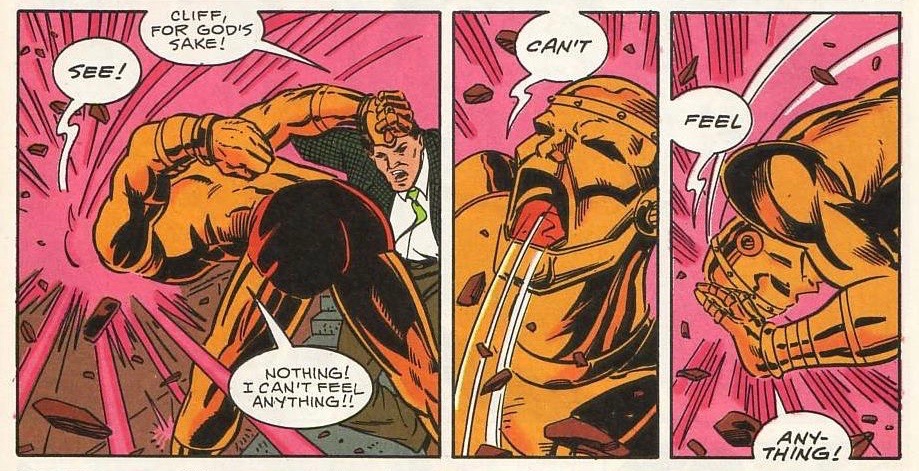
The horror-movie implications of Robotman’s status are pretty obvious—his brain is the last remaining bit of his human existence, stuffed into a metal skull atop a mechanical body incapable of any real sensation. Trainor, who takes the name Negative Man, can’t remove the full-body bandages that keep his radioactivity from harming others; luckily, he can control a shadow-like energy being independent of his body, but only for about a minute at a time, after which his helpless physical body will die. Like Cliff, he’s isolated from any real human contact. Rita Farr seems, at first glance, like the least freaky of the team of freaks. She can pass as totally normal, and her literal movie-star good looks remain intact. But she makes the choice everyday to forego the dream of 1960s womanhood: marriage would inevitably involve settling down and surrendering to normalcy—all things that she wants, but not as much as she wants to be a hero. In a sense, her willingness to give up the the perfect ’60s life and family in favor of living in a mansion with a bossy megalomaniac, a surly robot, and the radioactive guy with a crush, makes her just as much of a freak as the boys. She chooses a career.
At the series’ outset, the Chief assembles these sullen, reclusive individuals and offers them purpose. The resulting squabbling, dysfunctional family vibe was unique at DC, hewing much closer to Marvel’s house style, and the villains were as wild as anything in the comics, then or now: Animal-Vegetable-Mineral Man; a brain in a jar called “The Brain”; and uplifted gorilla Monsieur Mallah, to name just a few. It’s fun stuff, with enough angst and weirdness to make the stories distinct, especially among the DC comics of the era. What really gave the team legs, though, was the way the creative team handled the book’s eventual cancellation: the heroes didn’t just fade away or walk off into the sunset. The October 1968 issue saw the entire team sacrifice itself to save a small fishing village from the machinations of the Nazi General Zahl and the Chief’s sometimes-love interest Madame Rouge. A memorable ending can be more effective than a successful run, which is perhaps why the Doom Patrol eventually came back.
Prolific writer Paul Kupperberg spent years keeping the flame alive, first in a series of one-off stories, and then with a full revival in 1987. Cliff, we learned, survived, as did the negative energy spirit that once inhabited Larry Trainor. The Chief’s estranged wife Arani Desai takes it upon herself to put together a new team. The book that followed isn’t bad, amping up the soap opera aspects of the storylines while otherwise leaning into the more superheroic aspects of the team. (I tend to think of some of the lesser-appreciated Doom Patrol runs the same way I think of the Doom Patrol-ers themselves: plucky outsiders that don’t get enough love.) The Kupperberg era simply has the misfortune of being overshadowed by what came next. After 18 issues of declining sales, Kupperberg was replaced by a hip young Glaswegian named Grant Morrison and artist Richard Case.

Ships in 1-2 days.
If the original run of Doom Patrol in the 1960s was groundbreaking, Morrison and Case’s book was utterly subversive. Weird, goofy, and meta at a time when that wasn’t yet a default mode for superhero comics, it brought together a new team after several members of the old met a tragic end (a Doom Patrol running theme). Here, Cliff Steele isn’t just a man with a robot body; he describes himself as a total amputee, complete with phantom bowel movements. Each of newcomer Kay Challis’ 64 personalities manifests a different superpower. As a portrait of dissociative identity disorder, symptoms like Kay’s probably don’t show up in the DSM-IV. But Morrison grounds her DID in real, and genuinely heartbreaking, childhood abuse of the kind that can trigger symptoms very similar to those experienced by “Crazy Jane.” Dorothy Spinner is a pre-teen with a facial deformity. Tellingly, she’s never drawn as Hollywood ugly (with, like, glasses and a mole). She’s drawn with the face of an ape, and it’s very believable that a sweet but very damaged young girl approaching puberty would have a rough time of it. The queer and biracial Rebis is an amalgam of Larry Trainor, the Negative spirit, and an African-American doctor named Eleanor Poole. Josh Clay is the most “normal” member of the team, but that normalcy is leavened by the the relative scarcity of black superheroes.

Ships in 1-2 days.
They’re occasionally joined by Flex Mentallo, Man of Muscle Mystery, and Danny the Street: a literal suburban street who also identifies as a cross-dresser and communicates in Polari, an old slang code used in Britain’s gay communities (he’s inspired by the British drag performer Danny LaRue). There are memorable adversaries (the Scissormen who cut people out of reality, the nihilistic Brotherhood of Dada, and Men from N.O.W.H.E.R.E. But the lines are always shifting, with classic-era arch-villain Mr. Nobody becoming a kinda/sorta ally and eventually runs for President with the Doom Patrol not standing in the way. And their final and most devastating adversary during this period isn’t a “bad guy” at all, but one of the team’s most important figures. It’s all much less about good vs. evil than it is about how damaged people engage with a world full of other damaged people who may have very different ideas.
It could all be a whole lotta weird-for-the-sake-of-weird, but these are all real people with problems that aren’t just metaphors for real problems—they’re real problems. Cliff and the Chief’s disabilities, Dorothy’s lack of friends her own age, and the childhood sexual trauma that leads Kay to the mental hospital where the story begins. It’s not always easy to relate to super heroic angst, but these people’s problems and challenges bleed over into our world. Where this incarnation soars is not just in its wild story ideas and completely bonkers villains, but in its absolute commitment to the emotional reality of team members. As out there as things got during this era, they never stopped feeling like real human beings. Morrison’s run wasn’t an attempt to deconstruct superheroes so much as a triumphant effort to breathe new life into them.

Following Morrison’s groundbreaking run, Rachel Pollack took over, partnering first with Richard Case and then with the more abstract Ted McKeever. Those runs are not currently in print, though a reprint collection was recently announced and then quickly cancelled. Dorothy sets up housekeeping with Cliff and the Chief as her surrogate fathers, though the house they’ve chosen just happens to be a spiritual refuge for people who died there during sex accidents and a creepy doll named Charlie, so they’re never really alone. The two men are working through their own dramas while Dorothy’s just trying to get through puberty. Pollack leans into Morrison’s weirdness while adding layers distinctly her own: the challenges of Dorothy as a maturing young woman ostracized from society solely because of her appearance; the Kabbalah; and the introduction of Kate Godwin, a superhero who also happened to be a trans-woman and a bisexual former sex worker. It’s a vastly underrated run, building on the better-known stories that preceded it without merely aping what came before.
After Pollack’s run, the Doom Patrol lay fallow for several years. Three new series followed: one continuation and two reboots. Each has its virtues, none really caught fire… until late 2016, which brings us back to the beginning and the Gerard Way/Nick Derington series for Young Animal. Gleefully remixing elements from the team’s long history, this run introduces a point-of-view character named Casey Brinke, who serves as a guide to the Doom Patrol’s weird world. Of course, she’s not strictly normal herself: we quickly learn that she’s a creation of Danny the Street, enlisted to help save him from an intergalactic fast food consortium that wants Danny to use his life-giving powers to make their meat.
Like the best of Doom Patrol, Way and Derington’s issues are explicitly psychedelic while harboring more personal themes just below the surface. Coupled with the TV show, which more than deserves a second season, it feels like the next big boom in the team’s history, and it’s not a bad place to hop on board.
What’s your favorite run of Doom Patrol?