




 Order History
 Premium Membership & Rewards
 Help Center / FAQ


What Makes a Story Queer?

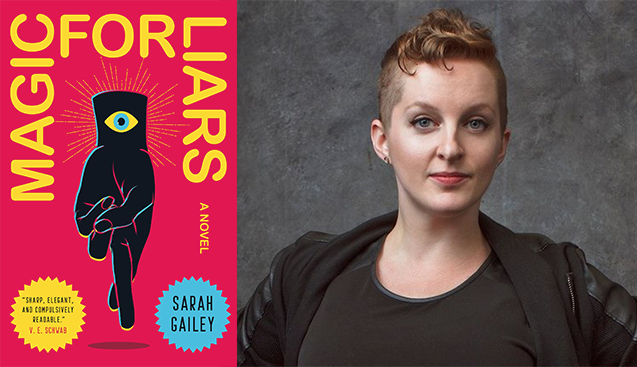 At a recent event for my new book Magic for Liars, someone in the audience asked a question I’ve been wanting to answer since I finished writing it.
“I’m a lesbian, and I’ve read the book. Obviously Magic for Liars is Queer,” she said, with a capital Q in her voice. “Can you talk about how?”

This item is currently out of stock online.
Magic for Liars features queer characters. Some of them are prominent in the narrative and some of them aren’t. It isn’t a story about queer romance or queer sexuality; it simply features those things as part of the world in which the story is set, because that’s the world we live in. In the book, as in reality, there are women who have girlfriends, and men who are bisexual, and teens who are declaring their identities using language that’s unfamiliar to queer adults.
To my mind, those things don’t make the book capital-Q Queer. Casual queer representation is important—and can be deeply refreshing to someone who is accustomed to erasure—but that level of representation should be the standard, not a standout. There’s more to be said than “this man has a boyfriend” or “this character uses they/them pronouns.” There’s more to the queer perspective than labels, romantic and sexual entanglements, or coming-out narratives.
So, here’s the part where I need to make a disclaimer: I can’t speak for everyone.
Nobody can speak for everyone, except to say “everyone is carbon-based,” and there’s probably an expiration date on even that sentiment. There’s more to the queer perspective than I personally can ever understand, because the very nature of the label “queer” is that it encompasses mutually-exclusive life experiences and identities.
That means I can’t speak for all queer people. I can’t speak for all nonbinary bisexuals. I can’t even speak for all the people I’ll be over the course of my life—all the names I’ll wear, all the labels that will suit me.
But I can speak for my book.
The story contained in Magic for Liars is, itself, Queer.
Magic for Liars is a book that is immensely concerned with identity, and whether or not identity is immutable. Ivy Gamble, the protagonist, is born without the magical powers with which her twin sister is gifted. In the world of the book, magic is intrinsic—it can’t be bought or learned, only finessed. Ivy’s life is defined in large part by this difference, this thing she doesn’t share with her sister. She copes for a long time by telling herself that she’s fine without magic, but when the events of the novel give her the opportunity to pass herself off as magical, she can’t resist finding out what it would be like to have a place in the world her sister occupies.

This item is currently out of stock online.
I’ve written elsewhere about self-erasure and the pain of belonging to a community that doesn’t have a place in it for the person I really am. Magic for Liars is a book in conversation with that pain. It’s also about the trying-on of different selves, both in Ivy’s life and in the lives of the characters she meets throughout the story: in this book, everyone is trying to figure out what category they fit into, what story might be theirs, and who they might become. This is especially true of the teenagers, who adopt personas with fluid uncertainty. They’re figuring out who they are by trial and error—a process that is familiar to queer people who, like me, have navigated self-definition via a process of effort and elimination.
It isn’t an accident that these themes live side-by-side with loneliness and alienation. Ivy Gamble and many of her costars struggle with a vague sense of isolation, an ill-defined and constant feeling of otherness. In a world that assumes ordinariness, Ivy is the only person who is aware of the existence of magic; in a world that assumes magical powers, Ivy is the only person who doesn’t understand how magic feels.
When I was a queer person without a community, I often felt like I was the only one who knew what I was going through, how I felt, and what I was struggling with. I felt like my pain was unique. I thought I was alone.
Were I to end Magic for Liars on an optimistic note, I would allow Ivy’s story to continue mirroring mine: Ivy Gamble would find a community of people who were, in fact, just like her. Even if many people in that community were different in a lot of ways—even if they argued all the time, and struggled to define the boundaries of the community—they would still form a family.
Through the love and support of that community, Ivy would come to understand herself. She would develop a sense of security. She would develop a sense of self.
She would develop a sense of pride.
Sarah Gailey is a regular contributor to the B&N Sci-Fi & Fantasy Blog, when they aren’t writing stories at the intersection of queer, magic, and killer hippos. Magic for Liars is available now.