3D Printing: Not So SF-nal Anymore
 A lot of ink, digital and otherwise, is spilled each year as writers—pressured endlessly into coming up with think-pieces—point and laugh at the generations-old predictions science fiction made about the future. Flying cars! We were promised flying cars! Sure, the genre sometimes gets things wrong when it predicts the future, but a surprising number of once science fictional technologies are now a part of our everyday lives. We might not have flying cars, but we are inching toward replicators—even if 3D printing remains in its infancy, we can see Star Trek from where we’re standing. In a few decades, some great SF won’t seem so fictional any more—including these five novels.
Planetfall

Paperback $22.00
Planetfall
By Emma Newman
In Stock Online
Paperback $22.00
Planetfall, by Emma Newman
There is sometimes an assumption in SF that as technology advances and opens new horizons to us, faith and spirituality will wither away. But our actual history hasn’t quite borne that out, and in Planetfall, Newman smartly explores faith alongside technology—and then twists that exploration into an examination of faith in technology. The book is set on an alien world inhabited by a human colony that has fled a troubled Earth in search of “God’s City.” The colonists are entirely reliant on 3D printing for their every need, from repairs, to food, to housing. We may be only a few years away from a 3D printing revolution, adding another intriguing wrinkle to this enveloping mystery novel.
Planetfall, by Emma Newman
There is sometimes an assumption in SF that as technology advances and opens new horizons to us, faith and spirituality will wither away. But our actual history hasn’t quite borne that out, and in Planetfall, Newman smartly explores faith alongside technology—and then twists that exploration into an examination of faith in technology. The book is set on an alien world inhabited by a human colony that has fled a troubled Earth in search of “God’s City.” The colonists are entirely reliant on 3D printing for their every need, from repairs, to food, to housing. We may be only a few years away from a 3D printing revolution, adding another intriguing wrinkle to this enveloping mystery novel.
Forever Peace

Paperback $8.99
Forever Peace
By Joe Haldeman
Paperback $8.99
Forever Peace, by Joe Haldeman
Haldeman’s Nano Assemblers are limited in smart ways: rather than being utopian magic boxes that produce whatever is need when a button is pushed, he imagines they must be large enough to produce the objects being printed, and the resources input must be calculated down to a specific number of atoms. He also makes his Assemblers closed-source, so you can’t just build new ones whenever you like. It’s a small detail, but it makes for one of the most interesting uses of 3D printers in SF. As with other books on this list, reality is catching up—and no doubt the 3D printers of our future will be closed-source as well.
Forever Peace, by Joe Haldeman
Haldeman’s Nano Assemblers are limited in smart ways: rather than being utopian magic boxes that produce whatever is need when a button is pushed, he imagines they must be large enough to produce the objects being printed, and the resources input must be calculated down to a specific number of atoms. He also makes his Assemblers closed-source, so you can’t just build new ones whenever you like. It’s a small detail, but it makes for one of the most interesting uses of 3D printers in SF. As with other books on this list, reality is catching up—and no doubt the 3D printers of our future will be closed-source as well.
All Tomorrow's Parties

Paperback $7.99
All Tomorrow's Parties
Paperback $7.99
All Tomorrow’s Parties, by William Gibson
The Nanofax machine in All Tomorrow’s Parties is pure Gibson: at once a futuristic, sharply creative concept and a well-worn bit of reality; in other words, it’s easy to imagine Gibson (the man who wrote a book about futuristic hacking without owning a computer) as one of the last people in the world using a fax machine in the early 21st century and simply putting a futurespin on it (plus the word nano, guaranteed to transform anything into an SF gadget). But the Nanofax actually exists in a very primitive state these days, and the basic concept of 3D scanning something and transmitting the specs to a 3D printer anywhere in the world is no longer crazy. While it might be decades or longer before the technology is affordable enough to be practical, someday you might be able to scan a birthday gift in your apartment and have it appear halfway across the world.
All Tomorrow’s Parties, by William Gibson
The Nanofax machine in All Tomorrow’s Parties is pure Gibson: at once a futuristic, sharply creative concept and a well-worn bit of reality; in other words, it’s easy to imagine Gibson (the man who wrote a book about futuristic hacking without owning a computer) as one of the last people in the world using a fax machine in the early 21st century and simply putting a futurespin on it (plus the word nano, guaranteed to transform anything into an SF gadget). But the Nanofax actually exists in a very primitive state these days, and the basic concept of 3D scanning something and transmitting the specs to a 3D printer anywhere in the world is no longer crazy. While it might be decades or longer before the technology is affordable enough to be practical, someday you might be able to scan a birthday gift in your apartment and have it appear halfway across the world.
Revelation Space (Revelation Space Series #1)
Paperback $8.99
Revelation Space (Revelation Space Series #1)
Paperback $8.99
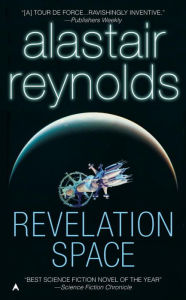
Revelation Space, by Alastair Reynolds
The Manufactories in Reynolds’ Revelation Space series are really just ginormous 3D printers; ranging in size from portable units the size of furniture to huge floating objects in space, they can create just about anything if given enough raw materials and time. When you consider that China now regularly 3D-prints buildings in just hours, it isn’t difficult to imagine the day when Manufactories might be the way just about everything is created, from household objects made in your private garage, to spaceships created in floating complexes out in space—which opens up the dystopian concept of a future where everyone knows how to press a button but are totally reliant on centuries-old designs residing in ancient memory banks (anyone who has ever tried to restore a frazzled hard drive knows what we’re talking about).
Revelation Space, by Alastair Reynolds
The Manufactories in Reynolds’ Revelation Space series are really just ginormous 3D printers; ranging in size from portable units the size of furniture to huge floating objects in space, they can create just about anything if given enough raw materials and time. When you consider that China now regularly 3D-prints buildings in just hours, it isn’t difficult to imagine the day when Manufactories might be the way just about everything is created, from household objects made in your private garage, to spaceships created in floating complexes out in space—which opens up the dystopian concept of a future where everyone knows how to press a button but are totally reliant on centuries-old designs residing in ancient memory banks (anyone who has ever tried to restore a frazzled hard drive knows what we’re talking about).
The Diamond Age: Or, A Young Lady's Illustrated Primer (Hugo Award Winner)
Paperback $20.00
The Diamond Age: Or, A Young Lady's Illustrated Primer (Hugo Award Winner)
In Stock Online
Paperback $20.00
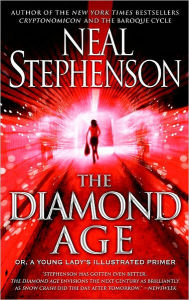
The Diamond Age, by Neal Stephenson
The idea that matter could be broken down into its component molecules =and reconstructed in another form has long lived in SF, and the Matter Compilers in Stephenson’s classic novel The Diamond Age do just that: stuff something into the “deke bin,” and something new comes out the other end. The fact is, nano machines are beginning to be created, so the idea of something being constructed from the molecular level up is no longer insane, just slightly advanced. Or, okay, very advanced, but, slowly but surely, Stephenson’s concept is edging out of SF and into the real world.
The Diamond Age, by Neal Stephenson
The idea that matter could be broken down into its component molecules =and reconstructed in another form has long lived in SF, and the Matter Compilers in Stephenson’s classic novel The Diamond Age do just that: stuff something into the “deke bin,” and something new comes out the other end. The fact is, nano machines are beginning to be created, so the idea of something being constructed from the molecular level up is no longer insane, just slightly advanced. Or, okay, very advanced, but, slowly but surely, Stephenson’s concept is edging out of SF and into the real world.
Aurora
Hardcover $26.00
Aurora
Hardcover $26.00
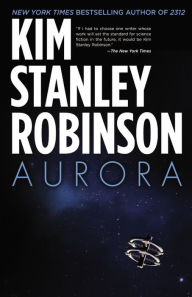
Aurora, by Kim Stanley Robinson
Robinson’s latest opus is engineered to be the final statement on a longstanding SF trope: the generation ship, an impeccably designed craft that will carry multiple generations of humans on a centuries-long voyage across the stars and to distant planets that will become the next cradle of humanity. Of course, keeping a few thousand people alive in the dead vacuum of space for 170 years is going to take some precision planning, and even with varied biomes, a rich array of plant and animal life, and a crew of the world’s brightest, things are going to break, which is where the 3D printers come in. They’re vital tools when it comes to repairing the very structures and systems keeping everyone alive…which is why it’s particularly bad news when one of the printers breaks down. You can print a new printer, sure, but sooner or later, the law of diminishing returns is going to set in. If present day 3D printing fails can teach us anything, it’s that we probably shouldn’t ever be too reliant on technology for survival.
Considering that this means these books are now more realistic than speculative in some ways, we must also logically conclude their authors are wizards. At least we think those are the rules.
Aurora, by Kim Stanley Robinson
Robinson’s latest opus is engineered to be the final statement on a longstanding SF trope: the generation ship, an impeccably designed craft that will carry multiple generations of humans on a centuries-long voyage across the stars and to distant planets that will become the next cradle of humanity. Of course, keeping a few thousand people alive in the dead vacuum of space for 170 years is going to take some precision planning, and even with varied biomes, a rich array of plant and animal life, and a crew of the world’s brightest, things are going to break, which is where the 3D printers come in. They’re vital tools when it comes to repairing the very structures and systems keeping everyone alive…which is why it’s particularly bad news when one of the printers breaks down. You can print a new printer, sure, but sooner or later, the law of diminishing returns is going to set in. If present day 3D printing fails can teach us anything, it’s that we probably shouldn’t ever be too reliant on technology for survival.
Considering that this means these books are now more realistic than speculative in some ways, we must also logically conclude their authors are wizards. At least we think those are the rules.