Throwback Thursday: Another Trip Around Larry Niven’s Ringworld
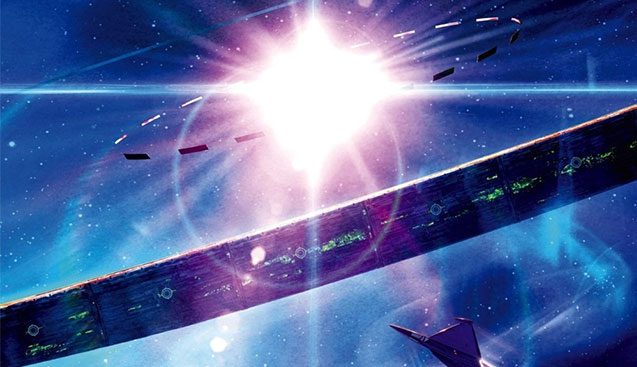 In 2015 the Science Fiction and Fantasy Writers of America made Larry Niven their latest Grand Master, and the impression he’s left on the genre is undeniable. It would be so if the only thing he’d ever written was his best known novel, Ringworld.
Ringworld (Ringworld Series #1) (Hugo Award Winner)
Paperback $10.00
Ringworld (Ringworld Series #1) (Hugo Award Winner)
By Larry Niven
In Stock Online
Paperback $10.00
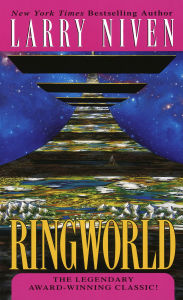
Niven was not the first author to imagine a megastructure in space; that honor probably belongs to Olaf Stapledon in Star Maker. Niven freely admits the influence of physicist and mathematician Freeman Dyson, who first wrote about the theory of totally surrounding a star with a sphere to capture its entire energy output. Niven conceived a less ambitious project—creating a ring around a star to create usable living space. The ring shape offers a number of advantages over a sphere: it can be spun to generate gravity, and if the rim walls are high enough, it can maintain an atmosphere. The ring’s radius is approximately the same as the Earth’s orbit and is almost a million miles wide, giving Ringworld three million times the surface area of Earth.
As the novel begins, alien Pierson’s Puppeteer recruits two humans, Louis Wu and Teela Brown, and Speaker-to-Animals, an alien from the felinoid Kzinti, to join in an expedition to the Ringworld. They crash-land there after their ship is damaged by the meteor defense system and discover the huge megastructure, located 200 light years from Earth, is populated by hominid races related to the genetic lineage of Earth. They have little time to investigate this mystery, however, since their primary focus becomes finding a way to get off Ringworld. They manage to escape—at least, those of them who choose to leave.
Niven was not the first author to imagine a megastructure in space; that honor probably belongs to Olaf Stapledon in Star Maker. Niven freely admits the influence of physicist and mathematician Freeman Dyson, who first wrote about the theory of totally surrounding a star with a sphere to capture its entire energy output. Niven conceived a less ambitious project—creating a ring around a star to create usable living space. The ring shape offers a number of advantages over a sphere: it can be spun to generate gravity, and if the rim walls are high enough, it can maintain an atmosphere. The ring’s radius is approximately the same as the Earth’s orbit and is almost a million miles wide, giving Ringworld three million times the surface area of Earth.
As the novel begins, alien Pierson’s Puppeteer recruits two humans, Louis Wu and Teela Brown, and Speaker-to-Animals, an alien from the felinoid Kzinti, to join in an expedition to the Ringworld. They crash-land there after their ship is damaged by the meteor defense system and discover the huge megastructure, located 200 light years from Earth, is populated by hominid races related to the genetic lineage of Earth. They have little time to investigate this mystery, however, since their primary focus becomes finding a way to get off Ringworld. They manage to escape—at least, those of them who choose to leave.
The Ringworld Engineers (Ringworld Series #2)
Paperback $7.99
The Ringworld Engineers (Ringworld Series #2)
By Larry Niven
In Stock Online
Paperback $7.99
In the introduction to sequel The Ringworld Engineers, Niven claims that he never intended to write more in the series, but many readers pointed out problems with the engineering of the Ringworld, including the MIT students who famously chanted “The Ringworld is unstable” at the 1971 World Science Fiction Convention (where Ringworld was awarded the Hugo). It was a challenge a hard SF writer like Niven found difficult to pass up. It probably didn’t hurt that in the years before Niven actually wrote the sequel, fans had already developed solutions to the book’s, er, structural problems. One idea was to stabilize it with ram jets powered by solar wind, and indeed, a major plot point of the sequel are the sacrifices necessary to shore up the Ringworld.
The sequel also provided an opportunity to explain how our hominid relations wound up on Ringworld, and to reveal the identity of the fabled “engineers” who built it. Careful readers of another book in Niven’s Known Space series, Protector, could probably have answered those riddles pretty easily—the book posits that the hominid line is not native to Earth, but originated on a planet much closer to the galactic core. That planet’s inhabitants, known as the Pak, have three life stages: child, breeder, and protector. The first two are analogous to a child and adult Homo habilis. But when a breeder reaches the age of 40 or so, he or she develops an overwhelming desire to eat the “tree of life” root. That root, or more precisely a virus growing in the root, then converts a breeder into a protector.
In the introduction to sequel The Ringworld Engineers, Niven claims that he never intended to write more in the series, but many readers pointed out problems with the engineering of the Ringworld, including the MIT students who famously chanted “The Ringworld is unstable” at the 1971 World Science Fiction Convention (where Ringworld was awarded the Hugo). It was a challenge a hard SF writer like Niven found difficult to pass up. It probably didn’t hurt that in the years before Niven actually wrote the sequel, fans had already developed solutions to the book’s, er, structural problems. One idea was to stabilize it with ram jets powered by solar wind, and indeed, a major plot point of the sequel are the sacrifices necessary to shore up the Ringworld.
The sequel also provided an opportunity to explain how our hominid relations wound up on Ringworld, and to reveal the identity of the fabled “engineers” who built it. Careful readers of another book in Niven’s Known Space series, Protector, could probably have answered those riddles pretty easily—the book posits that the hominid line is not native to Earth, but originated on a planet much closer to the galactic core. That planet’s inhabitants, known as the Pak, have three life stages: child, breeder, and protector. The first two are analogous to a child and adult Homo habilis. But when a breeder reaches the age of 40 or so, he or she develops an overwhelming desire to eat the “tree of life” root. That root, or more precisely a virus growing in the root, then converts a breeder into a protector.
The Ringworld Throne (Ringworld Series #3)
Paperback $8.99
The Ringworld Throne (Ringworld Series #3)
By Larry Niven
In Stock Online
Paperback $8.99
The Pak Protector is Baby Boomer’s dream. Thinning hair, thick wrinkly skin, and arthritis are not signs of impending decrepitude. Instead, they are the beginning of a transformation into a superhero. Under the influence of the tree of life virus, the hair completely falls off as the cranium expands to give the protector superior intelligence. Skin becomes wrinkled and tough enough to turn a knife, and swollen joints provide more leverage for increased speed and strength. Protectors are fighting machines whose sole purpose is to safeguard their descendants.
Women get short shrift in the first Ringworld novel. Teela Brown, the main female character, is little more than a good luck charm—literally, since the Puppeteers started breeding humans for luck. In The Ringworld Engineers she (or Niven, depending on your point of view) receives a measure of redemption when she becomes a key player in saving the structure. Male characters still predominate in The Throne of Ringworld, but there are more major female characters than in the earlier on.
The Pak Protector is Baby Boomer’s dream. Thinning hair, thick wrinkly skin, and arthritis are not signs of impending decrepitude. Instead, they are the beginning of a transformation into a superhero. Under the influence of the tree of life virus, the hair completely falls off as the cranium expands to give the protector superior intelligence. Skin becomes wrinkled and tough enough to turn a knife, and swollen joints provide more leverage for increased speed and strength. Protectors are fighting machines whose sole purpose is to safeguard their descendants.
Women get short shrift in the first Ringworld novel. Teela Brown, the main female character, is little more than a good luck charm—literally, since the Puppeteers started breeding humans for luck. In The Ringworld Engineers she (or Niven, depending on your point of view) receives a measure of redemption when she becomes a key player in saving the structure. Male characters still predominate in The Throne of Ringworld, but there are more major female characters than in the earlier on.
Ringworld: The Graphic Novel, Part One

Paperback $19.99
Ringworld: The Graphic Novel, Part One
By
Larry Niven
Adapted by
Robert Mandell
Illustrator
Sean Lam
In Stock Online
Paperback $19.99
After the third Ringworld book was published in 1996, the Internet took off, and the Ringworld discussions with it. In his introduction to the fourth installment, Ringworld’s Children, Niven states that the web discussions about the series gave him all the material that he needed to write the book. (It must be nice having your fans do so much of the heavy lifting.) The plot centers on saving Ringworld from the human and Kzinti space fleets surrounding it. Protectors from a number of races, including one of the original builders, work, sometimes together and sometimes at odds, to find a solution the threat.
The first Ringworld lived for years in fandom and on the internet, then disappeared into hyperspace for parts unknown at the end of Ringworld’s Children. Louis Wu, who escaped from Ringworld at the end of the first book, only to return and be stranded on Ringworld in the second, was a major character throughout all four books. He got off before it dropped into hyperdrive, and appeared in Fate of World: Return from Ringworld. For that reason, some consider that book part of the series. But to paraphrase that Duke Ellington classic, it don’t mean a thing, if it ain’t got that ring. If you ask me, there are just four Ringworld books (not including the graphic novel adaptation), and together they form an interesting piece of science fiction history.
After the third Ringworld book was published in 1996, the Internet took off, and the Ringworld discussions with it. In his introduction to the fourth installment, Ringworld’s Children, Niven states that the web discussions about the series gave him all the material that he needed to write the book. (It must be nice having your fans do so much of the heavy lifting.) The plot centers on saving Ringworld from the human and Kzinti space fleets surrounding it. Protectors from a number of races, including one of the original builders, work, sometimes together and sometimes at odds, to find a solution the threat.
The first Ringworld lived for years in fandom and on the internet, then disappeared into hyperspace for parts unknown at the end of Ringworld’s Children. Louis Wu, who escaped from Ringworld at the end of the first book, only to return and be stranded on Ringworld in the second, was a major character throughout all four books. He got off before it dropped into hyperdrive, and appeared in Fate of World: Return from Ringworld. For that reason, some consider that book part of the series. But to paraphrase that Duke Ellington classic, it don’t mean a thing, if it ain’t got that ring. If you ask me, there are just four Ringworld books (not including the graphic novel adaptation), and together they form an interesting piece of science fiction history.