


 Order History
 Premium Membership & Rewards
 Help Center / FAQ


Valley of the Dolls: 50th Anniversary Edition

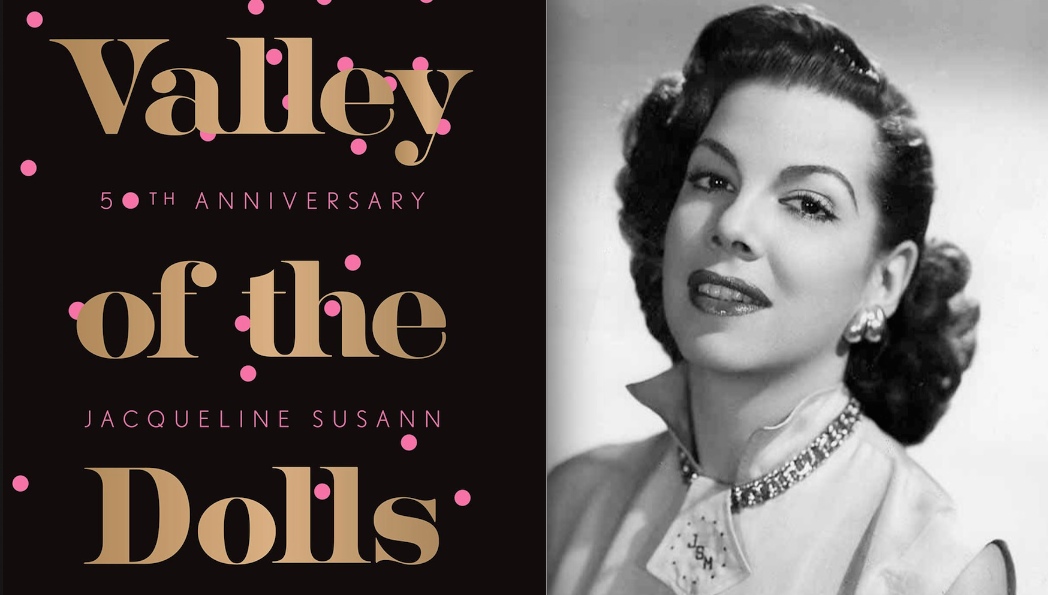
With its new black cover and red edging, it looks like the Bible. Fitting, because like the Gideons’ favored volume, Valley of the Dolls has spent a lot of time stashed in nightstand drawers. Not the nightstands of hotels, where the temporary guests have no reason to hide their vices, but the nightstands of suburban homes and small city apartments inhabited by the readers, especially housewives and what used to be called career girls, who bought 31 million copies of the Bantam mass market paperback and, maybe, were a little ashamed to read it in the open. Those were the nightstands from which kids, who knew something racy was being kept from them, filched the book and read it on the sly.
Fifty years after it was released, Jacqueline Susann’s story of three young women trying to make it in the showbiz worlds of New York and Hollywood still ain’t the Bible, but it’s acquired at least a glimmer of respectability. That started in 1997 when Grove Press reissued the novel in a fabulous pink paperback edition with a die-cut cover from under which peeked the stars of the 1967 film version. This was a meaningful collision. Grove, the house that, under Barney Rosset, had spent the ’60s as haven to the avant-garde and the prosecuted, the American publisher of Burroughs, Miller, Genet, de Sade, and so many others, was now the publisher of the book that had epitomized the mainstream the authors on Grove’s list had scorned. Of the pieces that noted the ’97 return of Susann’s novel, none was smarter or more impassioned than Mim Udovitch’s in the Village Voice Literary Supplement. Udovitch, who understood the novel as a prefeminist touchstone, was out to stake a claim for all those women who had been mesmerized by the book, who felt Susann was speaking rough truths about their lives and had been looked down on by the literary establishment for wallowing in trash. In the literary season in which Udovitch was writing, the book that was supposed to define women’s empowerment was Katharine Graham’s memoir Personal History. In it the Washington Post publisher wrote, among other things, about how she struggled to take over the paper after the previous publisher, her husband, Philip, committed suicide. Udovitch wasn’t having it. I’m sick, she announced, of being asked to marvel at the courage of Katharine Graham for taking over a paper she already owned.
It was a great rude remark, and it suggested how the division that existed over Valley of the Dolls, the adulation of a wide readership, and the scorn of cultural gatekeepers had always in part been a class division. That division was never clearer than in the review by the hapless Gloria Steinem, who wrote about Valley of the Dolls for the New York Herald Tribune Book Week. In 1987 Steinem told Susann’s biographer Barbara Seaman that she had said “Valley of the Dolls is for the reader who has put away comic books but isn’t yet ready for the editorials in the Daily News.” The class snobbishness of Steinem’s remark encapsulates the suspicion with which the literary establishment has always reacted to any book the popular audience responds to. That isn’t to say that a book is good because it’s popular. But if a book resonates with the reading public to the tune of 31 million paperback copies, any after-the-fact analysis needs to dig a little deeper than merely putting the response down to the bad taste of the masses.

Ships in 1-2 days.
There’s no denying Susann was a formally crude writer, working in a genre that was often cruder. Her novels didn’t offer the noble suffering endured by the heroines of Fannie Hurst and Olive Higgins Prouty. Susann’s beat was showbiz at its most ruthless and fame at its gaudiest. As an unsuccessful actress, sometime TV game show panelist, wife to the producer Irving Mansfield, mistress to stars both male and female, and, after she achieved fame, tireless self-promoter, Susann well knew the territory she was working. Trading in her own experience, as well as gossip about Judy Garland and Ethel Merman and Marilyn Monroe, Susann was employing the same formula Harold Robbins had worked to great success in his 1961 smash The Carpetbaggers (crass and vulgar to its soul, it is nonetheless a protean read), which had played off the stories of Howard Hughes, Jean Harlow, and others. One of the reasons authors no longer write trashy romans à clef about the rich and famous, the genre epitomized by Susann and Robbins and later Sidney Sheldon, is that the public no longer needs novelists to deliver disguised gossip when they can get it with the identities right out in the open. Websites and shows like TMZ provide much nastier gossip than any of the guess-who stories Susann and Robbins traded in. And when it’s the celebs themselves providing the gossip via reality TV shows, you know that Susann died before she got a chance to see her great subject, the self-cannibalizing potential of fame, taken to its most hideous extremes.
But vulgarity needn’t preclude sincerity or honesty. Nothing in Valley of the Dolls feels cynically calculated. What gives it its conviction — and what may have turned off the critics who can’t get past the surface absurdities of melodrama — is that as you read it you feel that Susann believes every word. In its way, this is an absolutely uncompromised novel. Susann drew in readers by putting them in the sensible shoes of her heroine (and stand-in), Anne Welles, who comes to postwar New York from a soul-stifling New Hampshire town (perhaps a nod to Grace Metalious’s Peyton Place?) and is swept up by the glamour of it all. Then, with heedless deliberation, Susann smashed those fantasies. Valley of the Dolls is a tour of hell in which every success or accomplishment is a herald to some new dissatisfaction, some new heartbreak. Neely O’Hara, the novel’s version of Judy Garland and its one true monster, goes from young singing sensation to wildly revered diva. No defeat is bad enough to preclude a comeback for Neely, and no success is so fulfilling that it will keep her from fucking up again.
Neely is the novel’s horror show in full, foul-mouthed flower. What makes her train wreck of a life unique is that Susann — for every character, not just Neely — removed the cliché that had provided the escape route in every lonely-at-the-top saga: the possibility of redemption. Nobody gets past their weakness here, not even the levelheaded Anne, whose grim future is laid out in the book’s final pages. As for the romantic notion of escape, Susann treats that for the lie it is when Lyon Burke tries to persuade Anne to return to the New Hampshire house she’s inherited from her mother and live with him while he finishes his novel. Lyon is everything Anne wants in a man, and even that won’t persuade her to give up New York for the picturesque little New England cow town she escaped. New York begins to look frayed and familiar to Anne as the novel goes on, but it beats the hell out of New Hampshire, and Anne is savvy enough to recognize the return to the simple life as the crock it is. Susann once said that the book gave readers living ordinary lives the kick of feeling they had found something better than the hell of showbiz success. But she was underselling herself, because the dissatisfaction she was writing about was the same for her readers — whether they were suffering it on Park Avenue or on Main Street.
Oddly, there’s no cruelty in Susann’s dashing every hope for happiness that she holds out. Rather, she’s keeping faith with an audience who, whether they had articulated it or not, had begun to resent being placated by soap operas and romance novels. Unlike the good cry they offered, the refuge of uplift to be found in the saga of some self-sacrificing heroine, Susann told her female readers that life was just as unfair and hypocritical and unfulfilling as they suspected it to be, and you can’t help but think part of the mammoth response to the book was gratitude to its author for not bullshitting them.
In 2000 the great feminist critic Ellen Willis wrote, “For its coiners, the idea [behind the phrase “the personal is political”] was that the social rules governing sex, marriage, and motherhood were part of a system that enforced women’s subordination, so that much of what appeared to individual women to be their own private unhappiness was widely shared and reflected their social inequality.”
Valley of the Dolls wasn’t the first novel to suggest that private unhappiness was systemic rather than personal. One of Susann’s models, the 1958 The Best of Everything, by Rona Jaffe, remains a remarkable work about the confining expectations placed on women. Like Valley, it follows a group of young women determined to make it in New York (this time in the publishing world). Far less profane and blunt than Susann’s writing would be, the novel still manages to be startlingly frank. When the smart-girl heroine, Caroline, finally goes to bed with the man she’s in love with, the sex is so unsuccessful that afterward she’s not sure whether or not she’s still a virgin. There are excruciating blind date scenes written from Caroline’s point of view in which her merciless eye for mediocrity is brought to bear on the well-meaning dullards who’ve been funneled her way by friends. What remains startling is that this smart young woman, who has no interest in fulfilling the expectations that have ben set for her, remains boxed in by the sexual double standard of the era, essentially unable to divorce any hope for love and a satisfying sex life from marriage.
And that’s the failure of imagination that hovers over Valley of the Dolls. The women here aren’t powerless, but their brains and success are not enough to keep them from buying into the internalized notions of what, for a woman, was meant to constitute happiness. None of them are so enamored of their careers that they wouldn’t chuck it for the right man. (Susann doesn’t delve nearly as deeply into the men, but she gets at how sex roles crippled them, too, nowhere more so than in the places where the nice, mild guys who’ve been content with a goodnight kiss suddenly explode in tirades of sexual jealousy when it becomes apparent to them they don’t have what it takes to excite the women they love.) And so the dolls, Susann’s own slang for the pills that deliver the release of sleep that each of the women in her novel seeks, are a logical step. This is a world in which Sleeping Beauty doesn’t want to be awakened but wants to keep on sleeping. You read Valley of the Dolls and you know why feminism had to come.
It seems incredible that we still have to insist that a novel can be entertaining, moving, enveloping, even important — and Valley of the Dolls is an important novel — without being literary. Susann defined a widespread dissatisfaction and despair shared by many women before there was a movement dedicated to naming and ameliorating that despair. And there’s no reason to think Valley of the Dolls would have been a better novel had the modern feminist movement, which burgeoned a few years later with the 1969 Women’s Strike for Equality, been there to support her. In fact it probably wouldn’t have. Writing out of her own experience and her insatiable need for fame, Susann didn’t worry about whether she was striking the right ideological note, whether she would be judged on the perceived right side of issues. She simply told the truth. And I’m not going to end with a line like “In the process, she also wrote a wildly entertaining novel.” That was no “also” for Jackie Susann. It was everything.